


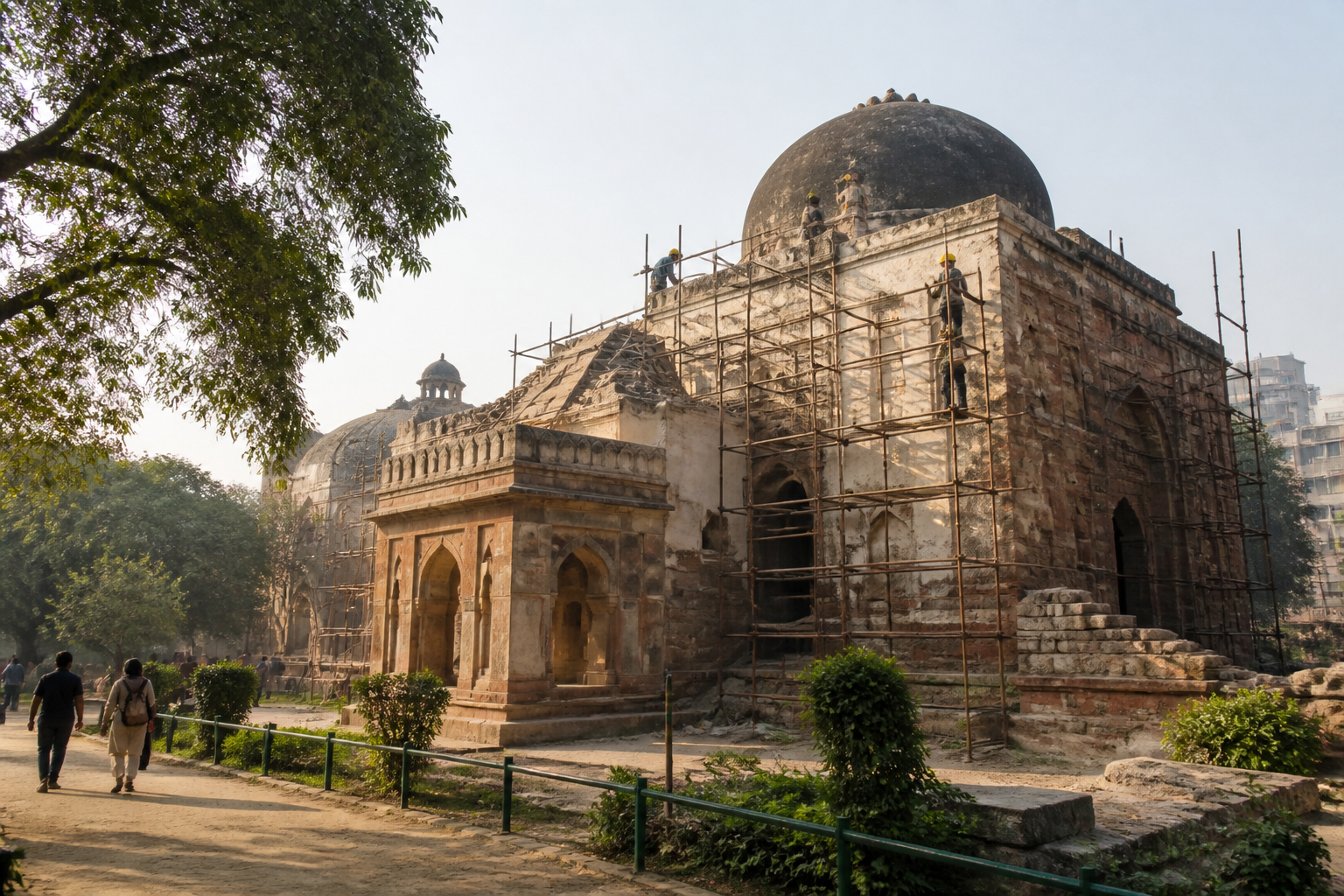
Restrictions at Hauz Khas Fort, Jantar Mantar, Agrasen ki Baoli and several other Delhi monuments are not isolated closures. They are evidence of an ongoing conservation system in which the Archaeological Survey of India must protect fragile structures, repair ageing buildings and upgrade visitor facilities while keeping some of the capital’s most important public heritage sites accessible.
An RTI response cited in the report shows that the ASI’s Delhi Circle has restricted access to parts of 10 monuments as conservation, structural repair and visitor-facility works continue. The sites include historic complexes from different periods of Delhi’s urban development: Sultanate-era structures at Hauz Khas and Tughlaqabad, the eighteenth-century astronomical instruments at Jantar Mantar, Mughal buildings inside the Red Fort, and colonial-era or later facilities associated with other protected monuments.
The restrictions reveal how heritage management operates beyond the familiar image of monument cleaning or façade restoration. At several sites, the work concerns the structural safety of buildings, delicate historic materials, internal spaces, visitor circulation and basic amenities. These interventions may be less visible than a restored façade, but they determine whether a monument can remain open without exposing its fabric to avoidable damage.
At Hauz Khas, emergency structural repairs are underway at the group of monuments. The complex developed around a large medieval reservoir built during the reign of Alauddin Khalji and later acquired a madrasa, a tomb and other structures associated with Sultan Firoz Shah Tughlaq. The RTI response indicates that a portion of the group of buildings at Hauz Khas I has been restricted to visitors, although it does not specify when the restrictions began.
This is significant because Hauz Khas is not a single-purpose heritage site. It combines a historic water landscape, religious and educational structures, tomb architecture and an intensely used contemporary urban neighbourhood. The conservation challenge is therefore not limited to protecting isolated monuments. It involves managing movement through a complex that remains embedded in a living part of Delhi, where heritage, public access and surrounding urban activity meet.
A similar question appears at Jantar Mantar, where visitor movement has been restricted around some structures. Built in 1724 by Maharaja Sawai Jai Singh II of Jaipur, the site contains massive masonry instruments created for astronomical observation. Their scale and material construction make the complex distinctive, but the same physical character also means that public circulation has to be managed around historic structures that cannot be treated like ordinary open space.
At Agrasen ki Baoli, another centrally located monument, access has also been restricted in parts of the structure. The report does not provide the precise repair scope for the site. That absence is itself relevant to public understanding: visitors may experience a closure or a restricted route without being given a clear public timeline or detailed explanation of the work underway.
The Red Fort provides the clearest example of the long-term balance between preservation and access. The ASI’s Delhi Circle has restricted access to six structures inside the complex: the Hammam, Moti Masjid, Diwan-i-Khas, Khas Mahal, Rang Mahal and Sheesh Mahal. These buildings represent different parts of Mughal court and palace life. The Diwan-i-Khas was the Hall of Private Audience under Shah Jahan, the Khas Mahal formed part of the emperor’s private residential quarters, and the Rang Mahal was associated with the imperial household.
Some restrictions at the Red Fort have been in place for years. The Hammam and Moti Masjid have remained closed to visitors because their delicate marble and inlay work are vulnerable to damage from heavy footfall. This establishes an important distinction between a temporary repair closure and a long-standing access decision based on the limits of a monument’s physical capacity. In such cases, opening every space to visitors is not automatically compatible with public access in the larger sense of preserving the site for the future.
The Qutub Minar complex illustrates another form of restricted access. The first floor of the Hindu Remains Corridor, the Jamali Kamali Tomb and the internal structure of the Qutub Minar have been kept out of bounds, according to the RTI response. Access to the interior of the Qutub Minar was closed following a stampede in 1981 and has remained restricted. The complex therefore connects conservation concerns with visitor safety and the management of movement through a high-footfall heritage destination.
At other monuments, the work is focused on improving the conditions in which visitors experience protected buildings. Visitor facilities are being refurbished at Tughlaqabad Fort and the tomb of Ghiyasuddin Tughlaq. Public amenities are being upgraded at Humayun’s Tomb, while accessibility improvements are underway at the Qutub Minar complex. These works broaden the meaning of conservation. A monument’s public value depends not only on the survival of historic fabric but also on whether visitors can approach, understand and use the site safely and equitably.
The RTI response also records work at less prominent components of larger complexes. Structural repairs and renovation are underway at the signal regiment building and toilet block at Salimgarh Fort. At the Red Fort, conservation work is taking place around the well area, including the parapet at the Lahore Gate. Repair work is also underway at the mosque and adjoining cells at Safdarjung Tomb.
These details show that heritage spending is distributed across a network of buildings and facilities rather than concentrated only on the most recognisable monument in a complex. A toilet block, parapet, mosque, adjoining cell or visitor route may not define a site’s public image, but its condition affects safety, access and the functioning of the monument as a public place.
The financial figures in the RTI response provide a measure of the scale of this work. The Delhi Circle was allocated Rs 19.10 crore in 2021-22, of which nearly the entire amount was spent. The allocation rose to Rs 30.50 crore in 2022-23, with expenditure also reported at about Rs 30.50 crore. In 2023-24, Rs 36.61 crore was allocated and around Rs 36.57 crore was spent. The allocation then fell to Rs 17.85 crore in 2024-25, with about Rs 17.85 crore spent. For 2025-26, the allocation was Rs 28.70 crore and around Rs 28.67 crore had been spent, according to the response.
Across these five financial years, the figures indicate that the Delhi Circle received allocations ranging from Rs 17.85 crore to Rs 36.61 crore. Reported expenditure remained close to the allocated amounts in each year. The figures do not, by themselves, establish whether the funding was sufficient for the full conservation needs of the sites, nor do they provide a project-by-project breakdown. They do, however, show that the restrictions are occurring within a continuing public expenditure programme rather than a single repair campaign.
The pattern also underlines the administrative difficulty of maintaining a large and varied heritage portfolio. The ASI must address emergency structural repairs at one site, protect delicate interiors at another, improve accessibility at a third and upgrade basic facilities elsewhere. These tasks require different technical approaches and cannot be measured only by the visible completion of a restoration project.
The public consequence is a more complicated visitor experience. A person visiting the Red Fort, Qutub Minar, Hauz Khas or another protected site may find that the monument is open but specific rooms, structures or internal areas are not. The RTI response does not specify when all the reported restrictions began or provide completion dates for the works. Without that information, visitors may find it difficult to distinguish between permanent safety decisions, temporary construction closures and access limits linked to fragile materials.
That distinction matters for a city whose historic sites function as cultural destinations, educational spaces and public landmarks. Restrictions can protect buildings from further damage, but unclear communication can also reduce public understanding of why access has changed. The supplied RTI response establishes the locations and categories of work, but not a common timeline or public disclosure format for each project.
The broader urban question is how Delhi preserves heritage while managing the pressures created by popularity, weathering, age and everyday use. The sites named in the response are not part of one architectural period or one neighbourhood. They represent the Sultanate, Mughal, eighteenth-century and later histories of the city. Their conservation therefore forms part of the maintenance of Delhi’s physical memory across a dispersed urban landscape.
The evidence confirms that access restrictions are being used alongside structural repairs, conservation, accessibility improvements and facility upgrades. It also shows that several restrictions are long-standing, particularly where heavy footfall threatens fragile material or where earlier safety concerns remain relevant. What remains unclear from the RTI-based information is the expected completion date for the ongoing works, the project-wise cost allocation and the process through which visitor access will be reviewed.
For now, the next measurable developments are the progress of repairs at the listed monuments, the continuation of facility and accessibility upgrades, and any public clarification from the ASI on timelines and access conditions. Those details will determine whether the current restrictions remain temporary measures, become permanent protections for vulnerable spaces, or lead to a more managed form of public access across Delhi’s historic sites.
