


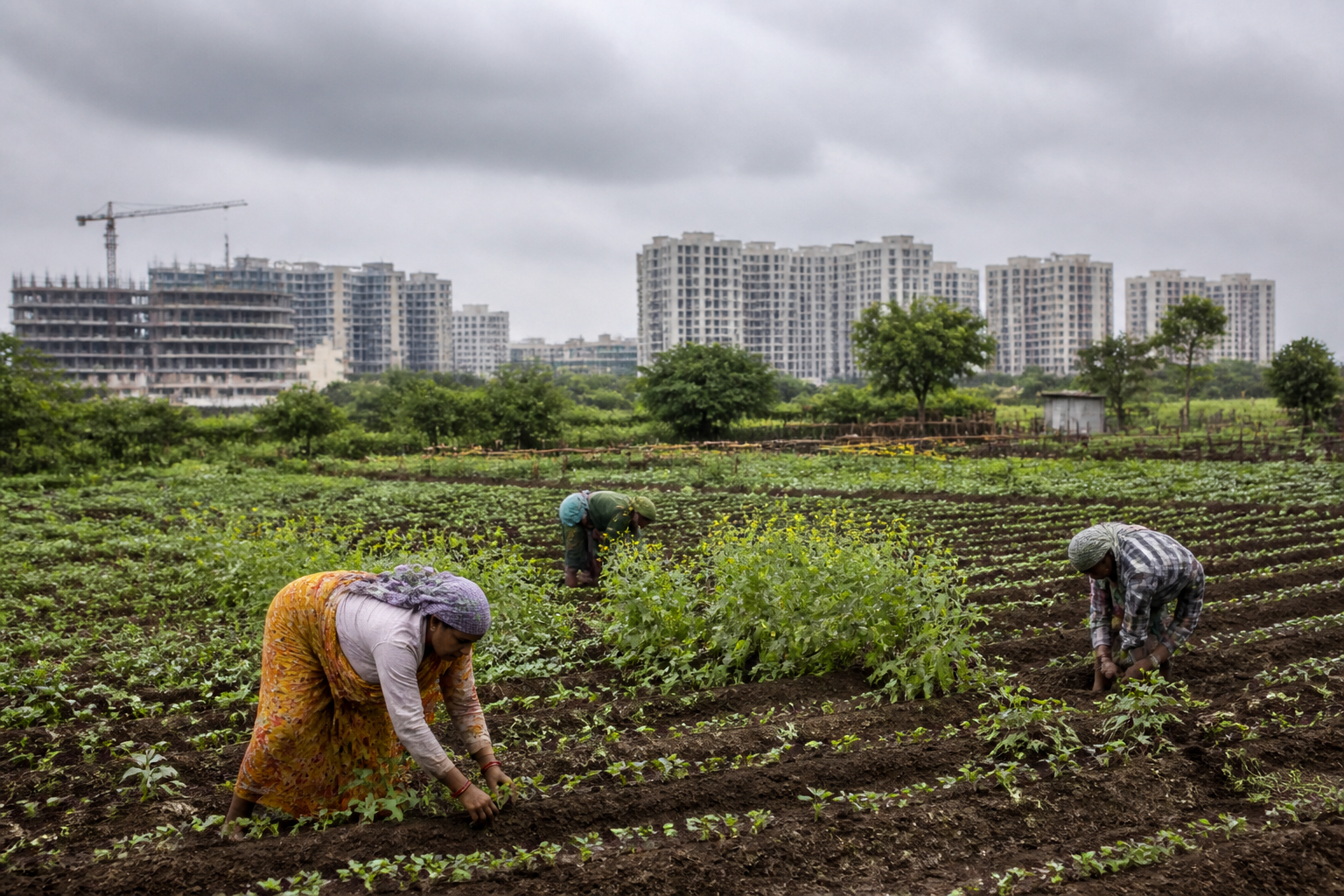
Telangana’s vegetable cultivation area has fallen from about 5.45 lakh acres in 2013-14 to 1.13 lakh acres in 2024-25, a decline of nearly 80 per cent that is increasing the State’s dependence on supplies from elsewhere. The figures, highlighted by public policy expert Dr Narasimha Reddy Donthi in a representation to Chief Minister A Revanth Reddy, point to a food-supply problem that is particularly significant for Hyderabad and the State’s growing urban and peri-urban settlements.
The immediate concern is not only the amount of land under cultivation. It is the weakening of the local system that connects fertile land, farmers, wholesale markets, transport, storage and consumers. According to the report, the State’s own Assembly reply records that about 6 lakh metric tonnes of vegetables were imported from other states in 2025-26, against an estimated Telangana requirement of around 40 lakh metric tonnes. The figures indicate a substantial gap between local production and consumption, although the source does not provide a year-by-year series showing how that gap has changed.
Telangana now ranks 15th among Indian states in area under vegetable cultivation and 14th in production, according to the material cited in the report. Those rankings place the State’s position within a wider national context, but they do not by themselves explain the decline. The more important question is what has happened to the conditions that make vegetable cultivation viable close to the State’s largest urban markets.
Dr Reddy’s representation identifies several pressures operating at the same time. Around Hyderabad, and increasingly across Telangana, common and fertile agricultural land is being diverted to real estate and industrial use. Such conversion changes the relationship between the city and its surrounding food-producing areas. Land that once supported short-cycle crops can become unavailable for cultivation, while farmers who remain in agriculture face production risks without a dependable mechanism to recover costs.
The representation also points to soil erosion, nutrient depletion and chemical contamination associated with unregulated fertiliser and pesticide use. These concerns matter because vegetable cultivation depends on repeated cropping and reliable soil productivity. The source does not quantify the extent of soil damage or establish how much of the acreage decline can be attributed to these factors. It does, however, present them as part of a combination of pressures that has made cultivation more difficult.
Price volatility is another central issue. Vegetable farmers can be penalised both when harvests are small and when production is high. A poor harvest can reduce income, while a large harvest without adequate procurement or storage can push prices down at the farm gate. The absence of a State Minimum Support Price for vegetables and the lack of a dedicated procurement mechanism leave farmers exposed to this instability, according to the representation.
This is where the urban food system becomes an administrative issue rather than only an agricultural one. Consumers in Hyderabad may encounter price changes in markets, but the causes can lie far beyond the retail outlet: the availability of land near the city, the cost of cultivation, the timing of harvests, the capacity of markets to absorb produce and the ability to move vegetables quickly. The source links the decline in local cultivation to growing dependence on other states, but it does not provide a breakdown of imported quantities by commodity, source state or season.
The reported dependence also raises questions about resilience. When a larger share of vegetables is brought in from outside Telangana, the food supply chain becomes more dependent on transport and external production conditions. The source does not claim that a specific disruption has occurred, nor does it quantify the effect of transport delays on prices. It does, however, identify transport and cold-chain infrastructure as areas requiring government attention. Dr Reddy has called for stronger facilities, basic vegetable processing and price-regulation mechanisms.
Cold-chain capacity is particularly relevant to a perishable commodity. Without adequate storage and timely movement, vegetables have to be sold quickly, increasing the pressure on farmers during periods of high supply. The source does not state the existing cold-storage capacity or the volume of produce lost after harvest, so the scale of that problem cannot be established from the available evidence. The policy demand is nevertheless clear: production support alone is insufficient if farmers do not have dependable routes to markets.
The representation also highlights the mismatch between the financial needs of vegetable farmers and existing institutional credit arrangements. Vegetable crops often operate on short production and cash-flow cycles, while farmers may not have access to a simplified loan window designed around those schedules. The source does not provide figures on outstanding farm credit, rejection rates or the number of vegetable growers without institutional loans. It does identify the lack of suitable credit as one of the factors discouraging or weakening cultivation.
Seeds form another part of the proposed response. Telangana, according to the representation, lacks state-supported vegetable seed production and a quality certification system that farmers can trust. Dr Reddy has sought a dedicated State vegetable seed production and certification programme, as well as the development of climate-resilient varieties and farmer advisories to address rising temperatures and rainfall variability. The source does not specify which varieties are affected or provide data on yield changes linked to climate conditions, so those impacts remain insufficiently quantified.
The institutional gap is visible in the range of responsibilities involved. Cultivation, seed supply, land-use protection, credit, procurement, market infrastructure, transport and cold-chain systems may involve different departments and levels of government. Dr Reddy has therefore called for a dedicated vegetables division or directorate with clear nodal responsibility. The proposal is intended to bring the different parts of the supply chain under a more defined administrative framework, rather than treating vegetables as a narrow crop-specific concern.
Land-use policy is especially important around Hyderabad, where urban expansion has placed pressure on agricultural and common land. The representation seeks legal protection for fertile agricultural land near urban areas and a sustainable policy to limit diversion to non-agricultural use. The source does not identify particular parcels, projects or notifications connected to the reported decline. It also does not establish whether land conversion is the single largest cause. The evidence supports a structural concern about competing land uses, not a claim that every converted parcel would otherwise have remained in vegetable cultivation.
The proposed policy response extends beyond production. Dr Reddy has urged the government to establish measurable targets for reversing the decline in the CURE plan and the Telangana Rising 2047 framework. He has also called for an actual procurement mechanism linked to any vegetable Minimum Support Price, market reforms, and a substantial increase in physical and weekly markets. These proposals address different stages of the chain: land and cultivation at the beginning, markets and procurement after harvest, and access for consumers at the end.
Urban and peri-urban agriculture is included in the representation alongside crop rotation and non-chemical or low-input cultivation. The suggestion recognises that food production near cities is shaped by both land availability and farming practices. However, the supplied material does not define the proposed scale, land tenure arrangements or institutional model for such agriculture. Those details would be necessary before assessing how much of the supply gap it could address.
The most immediate social concern identified in the report is unequal exposure to food-price volatility. Dr Reddy wrote that vegetables are a primary and affordable source of protein, fibre and micronutrients for many Telangana households. He specifically identified women and children in low-income urban and peri-urban households as facing the sharpest impact because of existing vulnerability to anaemia and undernutrition. The source does not provide household survey data or a measured link between the cultivation decline and nutritional outcomes. The concern is presented as a policy argument about affordability and access.
What the available evidence establishes is a sharp contraction in the area under vegetable cultivation, a reported dependence on supplies from other states, and a set of linked weaknesses in land policy, farm economics, seed systems, markets and logistics. What remains unclear is how much each factor has contributed, how the decline is distributed across districts and crops, and whether the government has accepted the figures or adopted any of the proposed measures.
Those unanswered questions will determine whether the issue becomes a measurable food-system reform agenda or remains a representation awaiting action. The next developments to monitor are the State government’s response, any official verification of the cultivation and import figures, the treatment of vegetables in the CURE and Telangana Rising 2047 frameworks, and whether a dedicated institutional and procurement mechanism is created. For Hyderabad, the underlying issue is direct: the city’s food security is increasingly connected to decisions about land, markets and infrastructure beyond its municipal boundary.
