


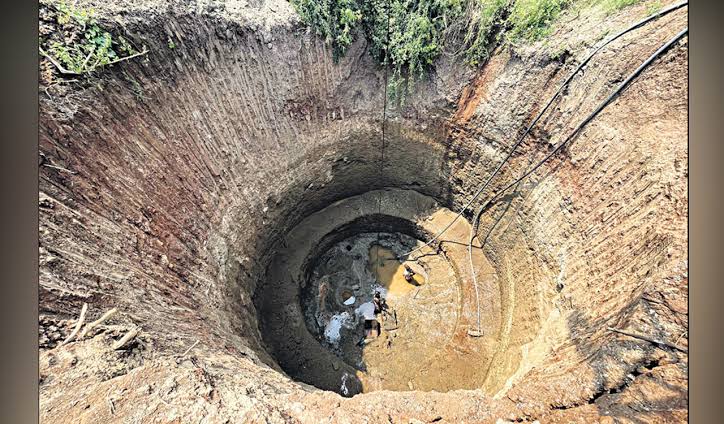
HYDERABAD: Telangana has recorded a notable improvement in groundwater levels during August, despite a sharp rainfall deficit during the month. The average groundwater depth across the state improved from 9.48 metres below ground level at the end of July to 7.87 metres by the end of August.
The data was collected by the State Groundwater Department through 1,771 monitoring stations covering all mandals across Telangana’s 33 districts. The improvement offers some relief for agriculture and rural communities that depend on groundwater for irrigation. Groundwater levels varied considerably across the state. Adilabad recorded the shallowest average level at 3.48 metres below ground level, while Medchal-Malkajgiri recorded the deepest at 12.12 metres. Overall, 23 districts reported groundwater depths between five and 10 metres, while 10 districts remained in the 10–15 metre range. Hyderabad also recorded a substantial rise in groundwater availability during August. The average level improved from 12.25 metres below ground level at the end of July to 10.12 metres by the end of August.
The increase was not uniform across Telangana. Compared with the second half of July, groundwater levels rose by an average of 1.61 metres during the second half of August. Improvements were recorded in 27 districts. Kamareddy registered the largest increase at 4.65 metres, while Jogulamba Gadwal recorded the smallest improvement at 0.34 metres. This regional variation highlights the importance of local rainfall, soil conditions, water use and recharge patterns. A rise in the state average does not necessarily mean that every area has adequate groundwater reserves. The improvement in Telangana groundwater levels has provided an important buffer for farmers during a difficult monsoon season. Agriculture officials indicate that farmers using groundwater for irrigation have largely been able to maintain their crops despite Telangana recording a 38 per cent rainfall deficit during August.
However, the current situation remains dependent on how September develops. If rainfall remains limited, groundwater-dependent farming areas could begin facing irrigation pressure. The increase in Telangana groundwater levels therefore provides short-term support rather than a permanent solution. Continued extraction without sufficient recharge could gradually reduce this buffer. The figures also underline the importance of protecting recharge zones, maintaining lakes and tanks, and improving rainwater harvesting in both urban and rural areas. Hyderabad, in particular, needs sustained attention to groundwater recharge as construction and rising water demand place pressure on underground reserves. With the monsoon entering its later stages, September rainfall will be closely watched. Adequate showers could strengthen groundwater reserves further, while another dry spell may quickly increase pressure on irrigation and drinking-water sources.
Read more: Hyderabad Monsoon Rains Likely To Ease From September 4
Hyderabad Groundwater Levels Rise Despite Monsoon Deficit

