


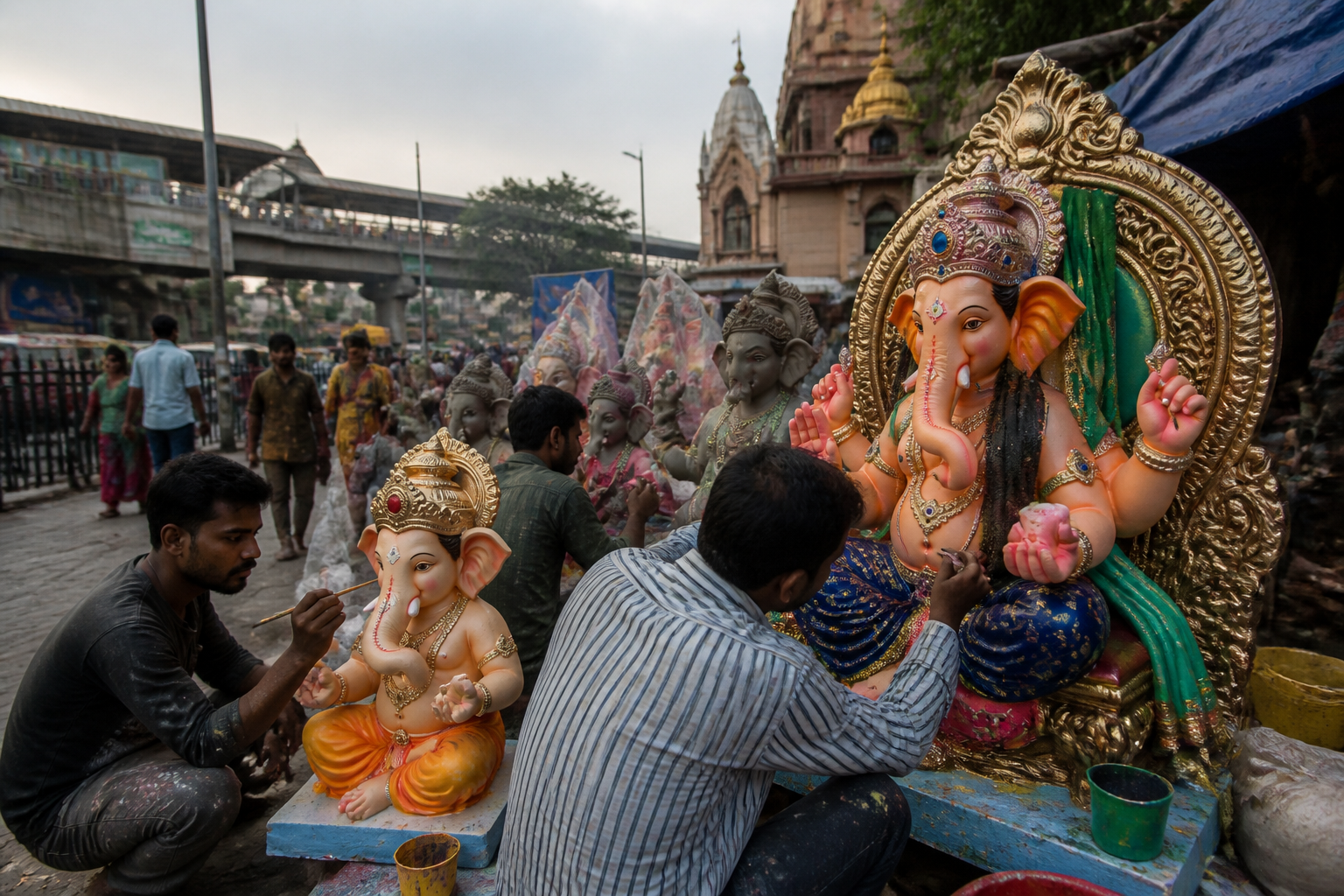
Delhi’s Ganpati idol market near Jhandewalan shows how a seasonal religious economy depends on informal public space—and how quickly that livelihood can become insecure when temporary stalls face removal. The market, located near Jhandewalan Metro station between Karol Bagh and Rajendra Nagar, is serving a changing customer demand for traditional and contemporary idols ahead of Ganesh festival celebrations. At the same time, artisans working on the pavement say they have been asked by the police to remove their temporary shops and sales areas.
The report by Jagran – New Delhi places two different urban realities side by side. One is a visible, time-bound market that brings together artisans, buyers and festival demand. The other is the uncertain status of the land on which that market operates. The artisans have spent around 15 days preparing idols, while some have travelled from Rajasthan, Mumbai and Maharashtra, and Kolkata. If the stalls are removed, their immediate concern is not only where to sell the completed idols but also where to store them safely.
This tension is common to many seasonal urban markets: the activity is temporary, but the infrastructure and administrative arrangements required to support it are not. Artisans need space to work, access for customers, protection for fragile stock and enough time to recover production costs. Municipal and police authorities, meanwhile, have to manage pedestrian movement, road and footpath access, public safety and competing claims over public land. The report does not establish the precise reason for the removal instruction, whether an alternative site was offered or which agency controls the location. Those unanswered questions are central to understanding the dispute.
At Jhandewalan, the market is not simply a retail counter appearing before a festival. The artisans prepare the idols on site, shaping, painting and decorating them over a period ranging from about 15 days to one month. The work includes constructing the form, refining facial expressions, shaping the eyes and limbs, and adding colours and ornaments. The production process therefore requires more space and time than a conventional temporary sales stall.
The artisans’ accounts also point to a mobile production network. Workers from several parts of India travel to Delhi to meet demand during the festival season. One artisan from Rajasthan, identified in the report as Shravan Kumar, has been making Ganpati idols for 25 years and learnt the craft from his father. The report says the family’s third generation is now continuing the tradition. That detail matters because the market is not only a short-term retail arrangement; it is also a point in a wider chain of inherited skills, seasonal migration and urban consumption.
The market is adapting to consumer preferences. Alongside traditional idols, artisans are producing Bal Ganesh figures, idols seated on thrones, figures shown in different poses and designs featuring Ganpati on a car. The report says buyers are increasingly looking beyond size to facial expression, design and distinctiveness. Idol-making is therefore responding to the same personalisation trend visible in many urban consumer markets: standard forms remain available, but buyers also seek products that appear distinctive and suited to their own celebration.
The available price and size information illustrates the scale of the production. Idols measuring between six and eight feet are being sold for approximately Rs 25,000 to Rs 30,000. The report does not provide the number of artisans, total inventory, daily sales, input costs or the proportion of unsold stock. It also does not state how much of the sale price reaches the artisans after the cost of clay, colours, transport, rent or labour. Without those figures, the overall economic value of the market cannot be calculated. The available evidence does, however, show that the financial exposure of each artisan can be significant when large and fragile idols are produced over several weeks.
That exposure is intensified by the seasonal nature of the work. The artisans have a narrow period in which to complete production and sell their stock. A delay or forced relocation during that period can affect both sales and storage. Unlike a permanent shop, a temporary market may not have a formal back-up facility, customer signage or an established alternative location. The report records the artisans’ concern but does not confirm whether the authorities have specified a deadline for removal or whether any relocation plan exists.
This is where the story becomes an urban governance question rather than only a festival feature. Public-space management often treats temporary commerce as an obstruction to be cleared or as an activity to be tolerated for a limited period. Both approaches can leave the people involved without predictable rules. Artisans may invest in production before knowing whether they will be allowed to occupy a site through the selling period. Authorities may act only when congestion or complaints become visible. The result is an unstable arrangement in which both sides face uncertainty.
The Jhandewalan location adds another layer. The market is near a metro station and a major temple, placing it in a high-footfall area with established movement of commuters, worshippers, shoppers and residents. Such locations can help artisans reach customers, but they also carry competing demands for pedestrian circulation and access. A pavement that functions as a workplace and marketplace for artisans may simultaneously be treated by authorities as a movement corridor. The source does not provide pedestrian-flow data, traffic observations or details of any obstruction, so it is not possible to determine from the report whether the stalls created a verified safety problem.
The institutional picture is similarly incomplete. The police are reported to have instructed the artisans to remove the shops, but the report does not identify a municipal order, a vending certificate, a designated vending zone or a written notice. It also does not record a response from the police, the municipal authority, the metro agency or the temple administration. These distinctions matter because enforcement, street vending regulation, traffic management and public-space maintenance may involve different agencies. Without knowing which agency authorised the temporary market or ordered its removal, responsibility remains unclear.
The report’s evidence does not support a conclusion that the artisans are operating legally or illegally. It establishes only that temporary stalls have been created on the pavement and that the artisans say they have been told to leave. It also does not establish whether the market was planned, informally accepted or established without permission. Those facts would require documentary verification, including any permit, notice, vending-zone designation or correspondence between the artisans and the authorities.
What is clear is the mismatch between the timing of urban administration and the timing of seasonal livelihoods. The artisans begin work well before the festival because the idols require sustained manual labour. Administrative decisions made close to the festival can therefore affect inventory that has already been produced. The longer the production cycle and the larger the idol, the more difficult it is to shift operations at short notice. The source’s reference to 15 days to one month of preparation provides a concrete measure of that vulnerability.
The story also highlights how cultural production remains embedded in the physical city. The idols are not made in an isolated industrial unit described in the report. They are being shaped and decorated in a publicly visible setting, close to transit and a religious landmark. This makes the work accessible to customers and gives the market visibility, but it also exposes artisans to enforcement, weather and the limits of pavement space. The report mentions that workers continue despite weather conditions, but it does not provide details about shelter, drainage, electricity or waste arrangements.
For Delhi, the immediate issue is whether the artisans will be able to complete sales from the location or will have to move. The larger issue is whether seasonal markets can be accommodated through predictable, coordinated arrangements rather than improvised occupation followed by sudden clearance. The supplied report does not indicate any policy framework or formal process for this particular market, and it does not say whether an alternative site has been identified.
The evidence therefore confirms three things: demand for Ganpati idols is producing a seasonal market near Jhandewalan; artisans from Delhi and other states are investing significant time in manual production; and the market’s temporary stalls face removal instructions that could affect their ability to sell. It does not yet confirm the legal status of the stalls, the reason for the police action, the availability of relocation space or the authorities’ next steps. Those are the facts that would determine whether this is a short-term site-management issue or a broader failure to plan for seasonal urban livelihoods.

