


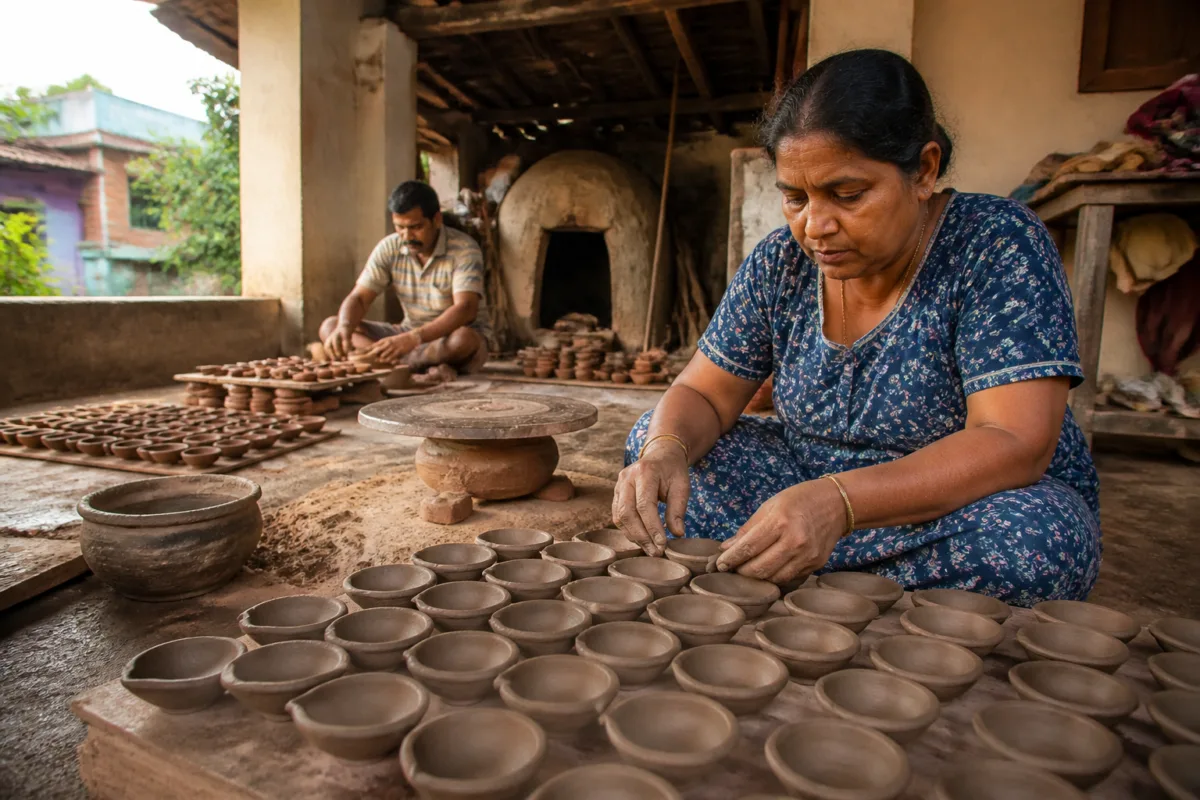
Improved sales of Bicholim earthen lamps have brought temporary relief to pottery-making families in Kumbharwada, Bordem, but the better season has also exposed how vulnerable the traditional craft remains. For a community of around 25 potter households, dry weather has reduced production losses, while rising costs, shrinking local markets and competition from outside Goa continue to threaten the survival of the industry.
The improvement is linked to an unusual reversal in the relationship between weather and livelihoods. Farmers have faced concern because of dry conditions and deficit rainfall, but the same weather has helped Kumbharwada’s artisans. Earthen lamps need to be shaped, dried and fired before they can be sold. Untimely rain can interrupt that process, damage products and leave makers with losses at the point when seasonal demand is most important.
Artisans told the Times of India that favourable weather allowed them to avoid some of those losses this year. The development, however, should not be read as a recovery of the pottery industry. It is better understood as a short-term easing of one operational risk in a craft economy that has been declining over several years.
That distinction matters because the central problem in Kumbharwada is not simply whether artisans can produce enough lamps for one season. It is whether the local system that once supported pottery-making still exists. The source report describes a sharp contraction in the number of active kilns, with only one or two remaining operational compared with the larger number of workshops that existed earlier. A reduction in kilns means fewer production units, lower collective capacity and a smaller base from which skills can be passed to the next generation.
Ramakant Shetkar, a senior traditional clay artist from Kumbharwada, said the business had been severely affected by increasing production costs and inadequate support for artisans. He also said there was still hope of preserving the craft if younger people took an active interest and accepted responsibility for carrying forward the family occupation.
His comments point to two linked problems. The first is the economics of production: artisans must absorb higher input costs while competing in a market where consumers can buy similar products from elsewhere. The second is the continuity of labour and knowledge. When the activity becomes less viable, younger members of artisan families have fewer reasons to remain in it, and the skills associated with preparing clay, shaping lamps, managing kilns and selling the finished products become harder to sustain.
Kumbharwada’s decline also reflects a shift in how local craft reaches the market. The area was once known for a flourishing earthen lamp-making industry and its pottery products had a wider market. Artisans now largely depend on sales from their homes. That change reduces their reach beyond the immediate neighbourhood and leaves individual households responsible for finding customers, displaying products and absorbing unsold stock.
The market pressure is intensified by products manufactured in Rajasthan, Khanapur in Karnataka and Dodamarg in Maharashtra. These lamps have established a strong presence in Goan markets and pose stiff competition to local makers. The competition is not only between individual products; it is between different production systems. Kumbharwada’s remaining artisans are working through a shrinking network of local kilns and household-based sales, while products arriving from outside the state have already secured access to the same consumer market.
The available account does not establish whether the outside products are cheaper, produced at a larger scale or distributed through stronger retail networks. It does show, however, that local artisans have lost the wider market they once enjoyed. That loss is important because traditional production cannot remain viable on cultural value alone if the makers lack reliable access to buyers.
The story also demonstrates how climate variability affects small urban and peri-urban enterprises differently. Rain is not merely a seasonal inconvenience for pottery makers. It can alter the timing of production, interfere with drying and increase the risk of damaged goods. A dry spell can therefore improve the immediate production cycle, even while creating problems elsewhere in the local economy. For artisans, the weather advantage is real but temporary because it does not resolve costs, market access or the decline in workshop capacity.
This creates a structural vulnerability. When production depends on a limited number of kilns and household-level sales, even a modest disruption can have an outsized effect on livelihoods. The source report does not provide figures for annual output, prices, household income or the scale of this year’s sales increase. It is therefore not possible to measure the financial improvement or determine whether it has restored profitability. What is clear is that artisans themselves view the better sales as relief rather than a solution to the industry’s longer decline.
The institutional gap is equally significant. Artisans have cited inadequate support, but the supplied report does not identify a specific government programme, funding allocation, market intervention or local administrative mechanism currently assisting Kumbharwada. That absence leaves an important part of the story unresolved: whether existing support systems are reaching the community, whether the artisans are eligible for them and what form of assistance would address the problems they have described.
The issue should not be reduced to the preservation of an old occupation for its own sake. Kumbharwada’s pottery tradition is also a local production system rooted in place. It connects households, workshops, craft knowledge, seasonal demand and the physical infrastructure of kilns. When only one or two kilns remain, the decline affects more than the number of lamps available for sale. It weakens the local ecosystem through which the craft is taught, produced and marketed.
At the same time, the source material does not establish that the craft is already extinct or that its decline is irreversible. The remaining families continue to produce lamps, and the improvement in sales has provided some encouragement. Shetkar’s call for greater involvement by younger people indicates that knowledge and family connections remain present. The question is whether those assets can be matched by conditions that make continued participation economically possible.
The evidence from Bicholim therefore reveals a familiar urban economy problem: local producers are expected to compete in an open market without necessarily having comparable production capacity, distribution access or institutional support. Weather can determine whether goods survive the production process, but it cannot create customers, reduce costs or replace missing kilns. A favourable season may protect artisans from one form of loss while leaving the underlying market structure unchanged.
For Kumbharwada, the next stage will be defined by whether the current improvement extends beyond seasonal demand. The facts currently available confirm better sales, fewer weather-related production losses and continuing pressure from rising costs, outside competition and generational disengagement. They do not establish a long-term recovery. The survival of Bicholim’s earthen lamp tradition will depend on whether the remaining pottery families can secure stronger market support and whether younger members of the community choose to continue the work that its last operational kilns still sustain.

