


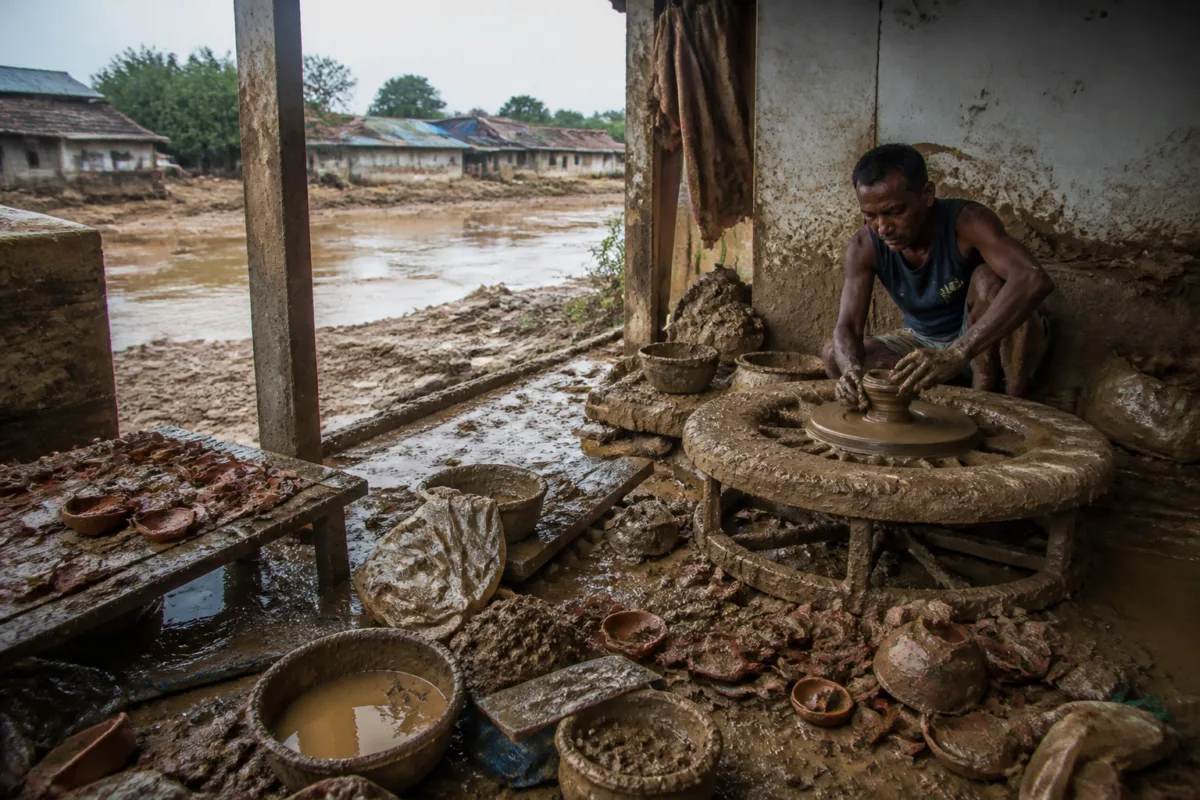
The flooding of Biripur village in Odisha’s Ganjam district has destroyed thousands of earthen lamps and damaged potters’ workshops just days before Diwali, leaving around 100 families without the seasonal income on which they depend. The loss is not only a festival story: it shows how a sudden river surge can erase months of household production when livelihoods, homes and workspaces occupy the same vulnerable setting.
According to a report by the Times of India, Biripur’s potter families had prepared stocks of diyas to meet the Diwali market when the Rushikulya River overflowed. Floodwaters entered homes and workshops on the night of October 28, reportedly reaching three to four feet in some places. The water destroyed finished lamps, damaged pottery equipment and halted production after the flood receded.
The village’s economic cycle is closely tied to the festival calendar. Residents told the newspaper that preparations usually begin about a month before Diwali. Families procure specific black soil and firewood, shape the lamps, fire them and then sell them during the short period when demand is highest. The report says potters produce between 2,000 and 10,000 diyas ahead of the festival, depending on the household.
That compressed production cycle leaves little room for recovery. A flood arriving after the lamps have been made can destroy finished inventory, while damage to a potter’s wheel or workshop prevents the family from replacing it. The timing also matters: the closer the disaster occurs to Diwali, the less opportunity artisans have to restart production, source raw materials and reach buyers.
The accounts from Biripur indicate that both the productive asset base and the household stock were exposed to the same flood. Budhia Muduli, a 59-year-old resident quoted by the newspaper, said the village had made several diyas to meet festive demand, but the flood destroyed the stock and damaged workshops. Manoj Muduli, 25, said residents had no time to shift the lamps and other earthen items when the water surged into the village.
Rajendra Muduli’s pottery wheel was also reportedly damaged, bringing his work to a halt. This detail is important because a wheel is not merely a household object; it is a core production asset. When such equipment is damaged, the effect extends beyond the immediate value of the device. The family loses the ability to produce, while the repair or replacement cost arrives at the same time as the loss of saleable goods.
The report also identifies a second constraint: the affected families have been unable to resume production because their workshops are damaged and they lack suitable black soil. This means that the return of floodwaters to normal levels does not automatically restore livelihoods. Recovery depends on access to a functioning workspace, tools, raw materials, fuel and enough time before the market opportunity closes.
Biripur’s experience illustrates a recurring weakness in the way small urban and rural economies are often understood. Livelihoods are frequently counted through the final product sold in a market, while the physical systems that support production remain largely invisible. In this case, the diya is the visible commodity. Behind it are soil procurement, firewood, workshop space, pottery wheels, storage and household labour. Damage to any one of these links can interrupt the entire chain.
The village’s vulnerability is also shaped by the location of work. For the families described in the report, homes and workshops appear to function as closely connected spaces. That arrangement may be practical for household-based craft production, but it creates concentrated risk during flooding. The same water entering a home can destroy living space, raw materials, finished products and equipment at once.
The flood also exposes the financial risk of seasonal dependence. The families rely heavily on Diwali sales and earn a significant share of their annual income from the festival market, according to the report. A failed season therefore affects more than one week of sales. It can reduce the money available for household expenses and for the next production cycle, although the report does not quantify the losses or detail what assistance the families may receive.
This distinction matters for recovery policy. Replacing damaged goods alone would not necessarily restore the village’s earning capacity. The reported losses include finished diyas, workshops, pottery wheels and access to raw material. A response that addresses only one category could leave families unable to restart. At the same time, the available report does not establish whether any government assessment, compensation process or relief intervention has begun.
The account raises questions about how flood preparedness reaches small producer communities. Residents said the surge caught them off guard and that they did not have time to move their stocks. The report does not provide details on warnings, evacuation arrangements, local drainage, embankments, river monitoring or the responsibilities of the panchayat and district administration. Those gaps prevent a conclusion about what failed institutionally, but they identify the information that would be needed to understand the event fully.
Preparedness for a settlement such as Biripur cannot be limited to moving people to safety. For households whose income depends on stored goods and basic equipment, warning time also determines whether assets can be raised, moved or protected. Even a short window may be valuable if families have designated storage areas, raised platforms or a coordinated plan for shifting fragile inventory. The supplied report does not say whether such arrangements exist.
The story also complicates the idea that traditional livelihoods are insulated from modern climate and infrastructure pressures. Pottery is an established craft, but its production is tied to environmental resources and exposed physical spaces. Access to suitable black soil and firewood is already part of the preparation process. When flooding damages the workshop and interrupts access to those inputs, the craft’s survival depends on systems beyond the artisan’s control.
There is a governance dimension to this vulnerability. Biripur’s affected families belong to the Kumbhara community in Karapada panchayat, placing the immediate response within a local administrative structure while the flood involves a river system and district-level disaster management. The report names the panchayat but does not describe the coordination between local representatives, revenue officials, disaster authorities or livelihood departments. That institutional chain will determine whether the loss is treated as household damage, artisan livelihood loss or a wider community recovery requirement.
The limited numbers available still show the scale of exposure. Around 100 families make earthen lamps in the village. Individual households produce between 2,000 and 10,000 diyas before the festival. Even without a reported monetary valuation, these figures indicate that the destruction affected a substantial volume of seasonal inventory. They also show why a single flood event can have a community-wide effect when many households depend on the same market and face the same hazard.
What remains unclear is as important as what is known. The report establishes that floodwater entered the village, stocks and workshops were damaged, and production could not resume immediately. It does not establish the total financial loss, the number of damaged homes, whether any families were displaced, the status of relief applications, or whether alternative markets remain available after Diwali. It also does not provide independent hydrological or administrative records about the Rushikulya River’s rise.
The central urban and settlement question is therefore not simply how many diyas were washed away. It is whether local economies built around household production have any protected space, advance warning and institutional support when a flood strikes at the most commercially important moment of the year. Biripur’s experience shows the consequences when a livelihood system has little separation between home, workshop, storage and market inventory.
For now, the evidence confirms a severe festival-season disruption for Ganjam’s potter families. The next developments to monitor are any official damage assessment, relief or compensation measures, restoration of workshops and access to raw materials, and whether the affected households can resume production after the immediate Diwali market has passed.

