


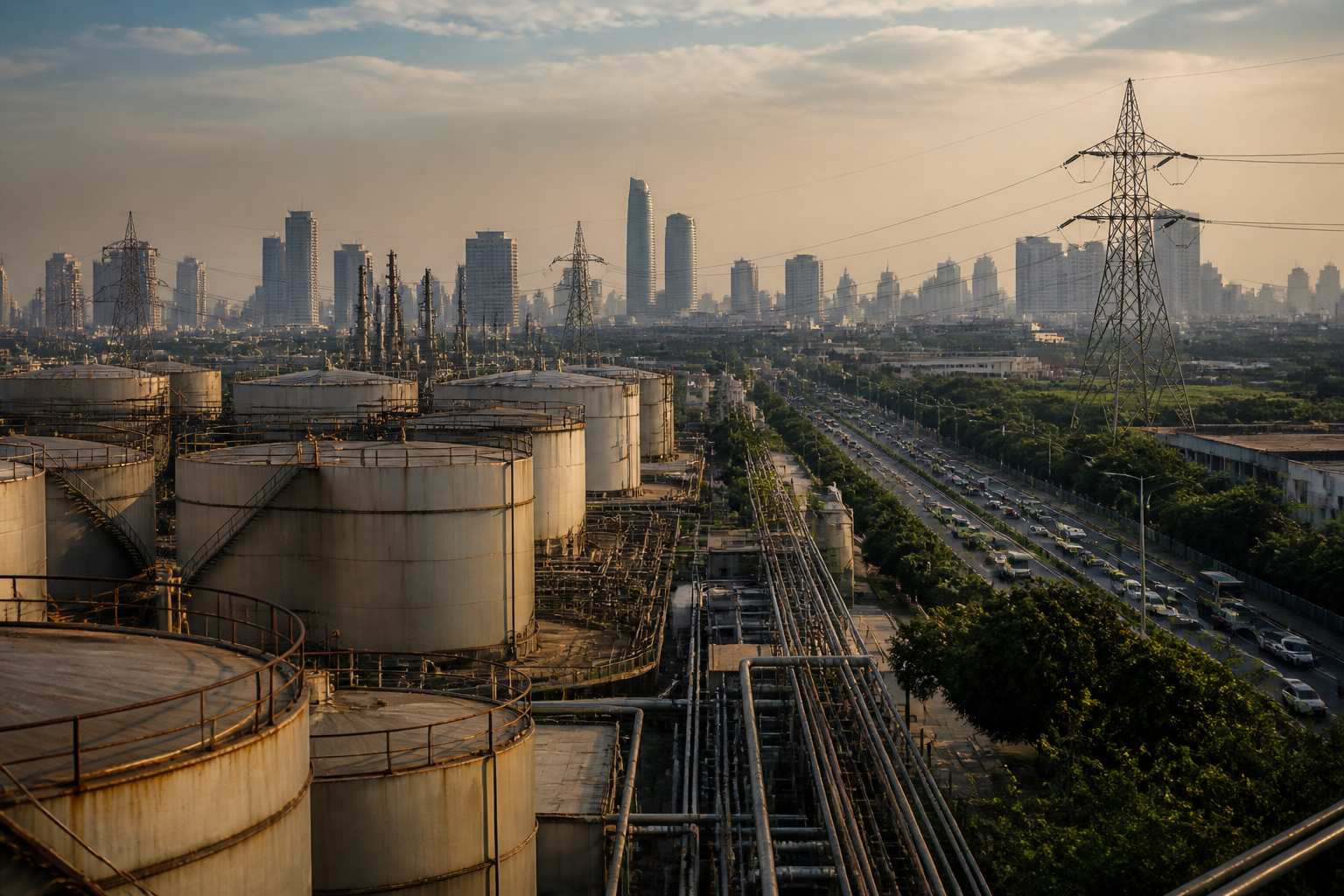
BRICS is gaining weight in global energy markets, but its growing share of oil production does not translate into a common energy policy. The grouping brings together major producers including Russia, Saudi Arabia, Iran and the United Arab Emirates with major consumers such as India and China, creating significant collective influence while exposing sharply different national interests.
That tension will be central as BRICS leaders gather in New Delhi on September 12 and 13. Energy security, the West Asia conflict and trade are expected to feature prominently in discussions. For India, the issue extends beyond diplomacy: energy supply, price stability and access to fuel are closely connected to the functioning of cities, transport systems, industries and household economies.
The central fact is the scale of the grouping’s energy presence. The 11-member BRICS grouping accounts for roughly 41% to 47% of global crude oil production, according to the figures cited by Economic Times. A broader BRICS+ calculation referenced in the report puts the share above 42% of global crude production and estimates that the coalition holds roughly half of the world’s proven natural gas reserves.
Those numbers give BRICS substantial weight in global energy markets. They also make the grouping appear, at first glance, capable of acting as a collective energy force. Yet production share is not the same as coordinated control. Oil-producing members may seek to protect export revenues and manage their own market positions, while importing countries such as India and China are primarily concerned with reliable supplies and affordable prices.
This producer-consumer divide is the first institutional barrier to a common energy policy. Members do not enter the grouping with identical exposure to energy markets. Some depend heavily on oil and gas exports, while others require large and continuing imports to meet domestic demand. Their priorities during a supply disruption, price spike or geopolitical crisis can therefore diverge even when they sit within the same diplomatic forum.
The grouping’s energy diversity extends beyond hydrocarbons. The source report notes that some members are seeking to expand renewable-energy manufacturing capacity. That adds another layer to the policy challenge. BRICS is not only a collection of oil producers and consumers; it also includes countries with different positions on energy transition, manufacturing and future supply chains. A single energy agenda would have to accommodate these competing economic structures.
The result is a difference between aggregate power and operational capacity. BRICS may represent a large share of global production, but that does not establish a system for responding to real-time disruptions. Burzine Waghmar of the SOAS South Asia Institute at the University of London said in an email response cited by Economic Times that BRICS cannot, and will struggle to, serve as a safety net during energy crises or global resource crunches.
Waghmar attributed that limitation to the absence of an institutional framework, unified political will and physical infrastructure required to manage real-time supply or price disruptions. This assessment is important because it shifts attention from the size of the resource base to the machinery needed to deploy it. Energy security is not created merely by bringing producers and consumers into the same organisation.
A crisis-response mechanism would require members to agree on what constitutes an emergency, how supplies would be redirected, which institutions would coordinate action and how the costs would be shared. The supplied material does not establish that BRICS has such an arrangement. Instead, it points to the lack of the institutional and physical conditions needed for a common response.
That distinction matters for cities because urban economies are highly exposed to energy interruptions even when the disruption occurs far from them. Fuel availability influences road transport, freight movement, construction activity and the cost of delivering goods. Electricity and gas systems support housing, commercial buildings, public services and industrial operations. When energy prices rise or supplies become uncertain, the effects can move through municipal services and household budgets.
India and China occupy a particularly significant position within this structure because they are identified in the source as major energy consumers, while Russia, Saudi Arabia, Iran and the UAE are identified as major oil producers. The relationship is therefore not simply between like-minded political partners. It is also a negotiation between countries that may want to sell energy, countries that need to buy it, and countries pursuing different combinations of fossil-fuel and renewable-energy capacity.
For India, the consumer side of this equation is especially relevant. The report also refers to a $226 billion hole in India’s BRICS trade, although the supplied material does not provide the details behind that figure. It does, however, show why energy cooperation cannot be assessed only through the headline production share. A grouping may be powerful in aggregate while individual members continue to face imbalances in trade, supply dependence and access to infrastructure.
BRICS’s broader scale adds political significance to the energy discussion. The grouping now has 11 members, compared with its original formation around Brazil, Russia, India and China and the later addition of South Africa. The source says the members together account for around a quarter of global nominal GDP and nearly half of the world’s population. These figures indicate a broad economic and demographic base, but they do not remove the policy differences within it.
The same breadth that gives BRICS visibility can make collective decision-making more difficult. A larger group brings more markets, resources and national priorities into the room. It can also make consensus harder when members are affected differently by sanctions, conflicts, commodity prices, trade routes and energy transitions. The source specifically identifies differences over energy security and geopolitics as a major challenge.
The upcoming New Delhi meeting therefore has two distinct dimensions. One is diplomatic: energy security, the West Asia conflict and trade are expected to be discussed by leaders. The other is institutional: whether the grouping can move from broad declarations of importance towards mechanisms that address concrete energy vulnerabilities. The supplied material does not report a new common energy framework or an agreed crisis-response system.
That absence is the key evidence-led conclusion. BRICS has scale, resource concentration and a mixture of major producers and consumers. It does not follow that it can operate as an oil cartel or an energy safety net. The report explicitly says the grouping is far from being an oil cartel, while the expert assessment identifies missing institutions, political alignment and physical infrastructure as constraints.
The larger urban question is how energy-rich coalitions can convert market weight into dependable public outcomes. Production figures may signal influence, but residents and businesses experience energy security through prices, continuity of supply and the reliability of the systems that depend on fuel and power. Those outcomes require coordination mechanisms, not only a large share of global resources.
For now, the evidence supports a cautious reading of BRICS’s energy role. Its members collectively command a significant portion of global crude production and a large share of the world’s population and economic output. But their differing positions as exporters, importers and renewable-energy manufacturers limit the prospects for a unified policy. The next development to monitor is whether the New Delhi discussions produce a concrete institutional response or remain focused on the grouping’s aggregate geopolitical weight.
