


Delhi Lieutenant Governor Taranjit Singh Sandhu has approved a health scheme providing cashless medical care to registered construction workers and eligible dependent family members, extending coverage for hospitalisation, diagnostics, medicines and specialised treatment through empanelled hospitals.
The Delhi Building Workers Health Scheme was approved earlier by Chief Minister Rekha Gupta and the Delhi Cabinet, according to a statement issued on Saturday. The scheme will cover more than 2.7 lakh building and construction workers who are currently registered as live members with the Delhi Building and Other Construction Workers Welfare (DBOCWW) Board.
Under the scheme, every registered construction worker and their eligible spouse will receive one annual health check-up. Beneficiaries will also be entitled to cashless outpatient consultations, diagnostic services, medicines and inpatient treatment through a network of empanelled hospitals operating at Central Government Health Scheme rates, the statement said.
The coverage includes emergency treatment, occupational diseases, chronic illnesses, specialised care, maternal healthcare and rehabilitation. Treatment will be available up to Rs 2 lakh per beneficiary each year, subject to an overall family limit of Rs 10 lakh annually.
The scheme also provides for emergency access outside the empanelled hospital network. In the event of a worksite accident or medical emergency, a beneficiary can receive treatment at the nearest non-empanelled hospital. Such a hospital will be treated as provisionally empanelled for the limited duration of the emergency treatment, according to the statement.
The Delhi Building and Other Construction Workers Welfare Board, an autonomous statutory body established in 2002, registers construction workers and administers welfare schemes using the cess collected from construction employers. The health scheme will therefore be delivered through the existing welfare-board framework, with a separate implementation arrangement for its technical and medical administration.
Officials said a Project Implementing Agency would be engaged initially for three years. The contract may be extended by another year following a performance review. The agency will be responsible for implementing the scheme across the beneficiary network and supporting the systems required for healthcare delivery and claims management.
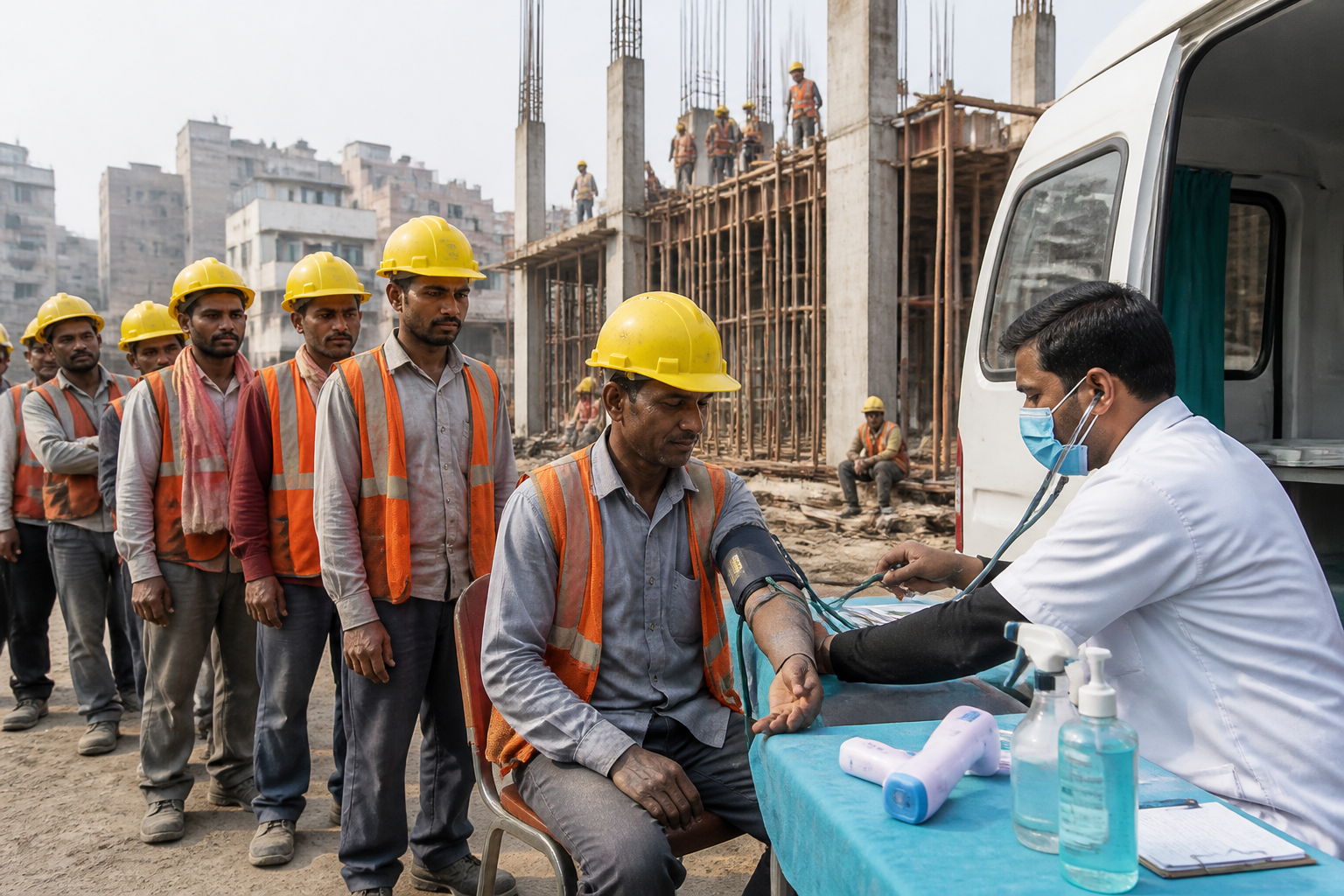
Mobile Medical Units will be provided to transport workers from worksites to empanelled hospitals, coordinate health screenings and create awareness about the scheme. This provision is intended to connect workers at construction sites with the newly approved healthcare network, although the statement did not specify the number of mobile units or their operating locations.
A dedicated software system will digitally manage beneficiary records, treatment history and claims processing. The system is also expected to provide the administrative infrastructure for tracking the use of the health benefits and processing claims across participating hospitals.
The approval places healthcare support for construction workers within the welfare responsibilities funded through the construction cess. The next implementation steps will involve appointing the Project Implementing Agency, establishing the hospital network and operationalising the mobile medical units and digital claims system.
