


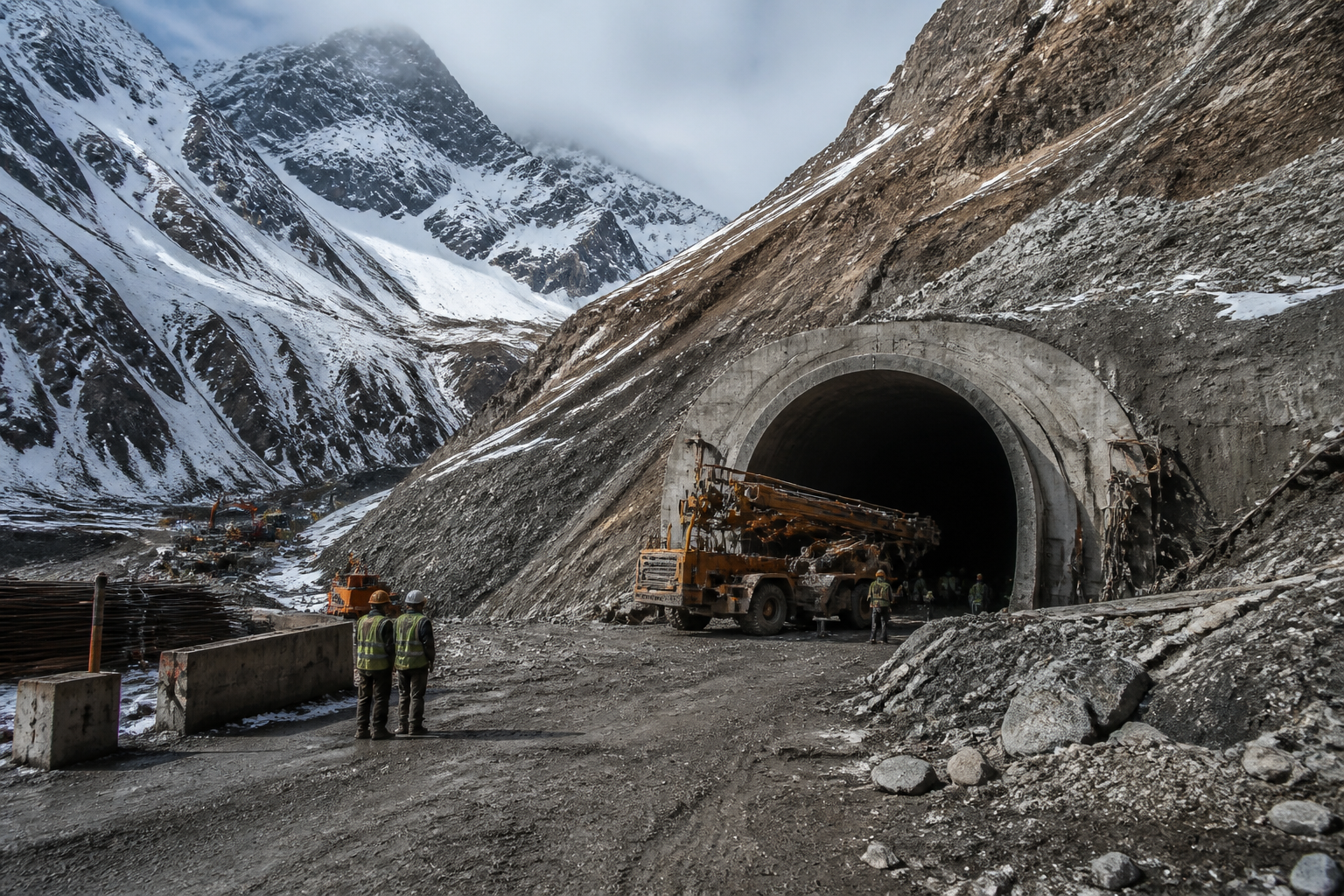
The Zojila Tunnel is being built as more than a 13-kilometre passage through the Himalayas. According to Harpal Singh, project head and general manager at Megha Engineering and Infrastructures Ltd (MEIL), the project is a test of how India builds critical infrastructure where geology, weather, safety and human endurance collide. Its larger promise is to reduce the winter isolation of Ladakh and improve access between Kashmir and the region, but the account of its construction shows why all-weather connectivity in the Himalayas is difficult to deliver.
Singh, who has worked on the project through some of its most challenging phases, describes Zojila as a “geological laboratory”. The phrase captures the central engineering problem: the ground cannot be treated as uniform. In one stretch, workers may encounter hard rock; a short distance away, the tunnel may pass through squeezing or crumbling ground, water-bearing strata and changing stresses. Singh says conditions can change every 10 metres. The tunnel is also being constructed in a seismic zone, adding another layer of uncertainty to excavation and support work.
The project’s importance comes from the role played by the Zojila Pass in regional connectivity. Singh says the pass historically remained closed for three to five months during winter, while the closure period has now reduced to two to three months. For communities dependent on the route, the difference between seasonal access and dependable year-round connectivity is not simply a matter of travel time. It affects the movement of medicines, food and fuel, access to healthcare and education, and the ability of residents to remain connected to services outside the region.
Singh points to the consequences of isolation through everyday examples. A patient from Dras may need to be airlifted to Srinagar, while a child from Kargil may have to travel to appear for an examination. In this context, the tunnel is being presented as an alternative to relying on weather-sensitive surface movement or emergency air transport. Singh expects improved connectivity to create opportunities for tourism and employment in areas including Sonamarg, Dras and Kargil, although the interview does not establish the scale or timing of those economic effects.
That distinction matters. A tunnel can remove a physical bottleneck, but the benefits of connectivity depend on the wider system around it. Roads approaching the tunnel must remain usable, transport services must operate reliably, and communities must be able to access the economic and public services that improved mobility makes possible. The interview provides a clear account of the connectivity problem and the intended public benefits, but it does not provide a detailed implementation plan for these supporting systems.
The construction conditions explain why the project cannot be understood merely through its length. Temperatures at the site can fall to minus 30 degrees Celsius. Pipelines can freeze, heavy snowfall can block access roads and moving workers between camps and the tunnel becomes difficult. At an altitude Singh places at around 11,000 feet, the work environment affects not only excavation but also the basic logistics of keeping people, machinery and supplies operational.
Excavation is also the most exposed phase of tunnel construction. Permanent lining is installed only after initial support has stabilised the tunnel, leaving workers operating in a period when the surrounding rock and water conditions remain active risks. Singh describes the excavation stage as particularly unsafe and recalls the death of a worker after a section of the tunnel collapsed and trapped the machine he was operating. His account underlines that construction risk is not an abstract technical variable. It is experienced directly by workers operating below unstable roofs, amid seepage and changing ground conditions.
The geography of the Zojila Pass has shaped the construction method as much as the geology has. Singh says the tunnel could not be approached through multiple access points because of the terrain. Work therefore progressed from two fronts, one from the Kashmir side and the other from Ladakh. This arrangement reflects the practical limits imposed by the mountain environment: additional access points may accelerate excavation in theory, but they also require suitable terrain, roads, logistics and safe working areas.
The project’s human organisation is another part of its infrastructure story. Engineers, technicians and workers have come from different parts of India, while their families remain elsewhere. Singh says the remote location offers limited access to schools, colleges and the everyday support systems that families rely on. The result is a form of labour separation in which the project’s workforce bears the immediate hardship of the site, while families absorb the longer-term social cost of prolonged absence.
Singh argues that compensation alone cannot sustain motivation in such conditions. His view is that workers at high altitude need a sense of purpose, along with visible participation from senior managers. He says he stays with the team and eats in the same mess, and that leaders must be present at the site when conditions become difficult. During harsh winters, this can include reaching the site early and helping clear roads alongside workers.
This account points to an institutional feature often missing from infrastructure announcements: delivery depends not only on design and equipment but also on the management of people under extreme conditions. A project can have a defined alignment and construction technology, yet still be constrained by access roads, freezing temperatures, worker welfare and the ability of teams to operate safely through repeated disruptions. The interview does not provide detailed data on staffing, accident rates, construction productivity or cost, but it makes clear that these operational issues are central to the project’s progress.
The Zojila Tunnel also illustrates the changing scope of Indian tunnelling. Singh recalls that when he graduated from Thapar Engineering College in 1984, tunnelling in India was more commonly associated with hydropower, irrigation and some urban sewerage projects. Highway and railway tunnels were not projects that young engineers routinely expected to work on. His career reflects a broader shift in the role of tunnels within infrastructure planning, from specialised structures serving individual water or energy projects to strategic links intended to maintain mobility across difficult terrain.
That shift raises the standard by which such projects should be assessed. The tunnel’s value cannot be measured only by the number of kilometres excavated. It must also be considered in relation to the seasonal closure of the pass, the continuity of essential supplies, access to healthcare and education, the safety of workers, and the reliability of the roads and systems connected to either end. The supplied interview establishes these as the principal issues, but does not include official figures on project cost, construction progress, opening date, traffic capacity or the expected reduction in travel time.
The institutional responsibility is similarly distributed. MEIL is executing the project, while the tunnel’s wider public purpose concerns connectivity between Kashmir and Ladakh and the functioning of places such as Sonamarg, Dras and Kargil. Delivery therefore involves more than the contractor’s excavation work. Access roads, winter maintenance, emergency response and the operation of the connected transport network will determine how consistently the tunnel serves residents and travellers once it becomes operational. The interview focuses on construction experience rather than setting out the full administrative or funding structure, so those details remain outside the evidence available here.
The project’s significance ultimately lies in the gap between physical connection and lived accessibility. For a resident who needs medical treatment, a student travelling for an examination or a community waiting for fuel and food supplies, the value of an all-weather route is measured through reliability. For workers, the same infrastructure is being created in an environment where every excavation cycle involves uncertain ground, freezing temperatures and difficult access. These are two sides of the same urban and regional infrastructure question: whether a national link can remain dependable in the places where building and maintaining it are most difficult.
The evidence from Singh’s account confirms that the Zojila Tunnel is a high-risk, high-altitude infrastructure project with potential consequences for regional connectivity and winter isolation. It also shows that the project’s success will depend on factors beyond the tunnel structure itself, including safe excavation, worker welfare, access logistics and the performance of connected roads and services. The next developments to monitor are the project’s construction milestones, its confirmed operational timeline, and the official plans for managing connectivity and public access once the tunnel is ready.
