


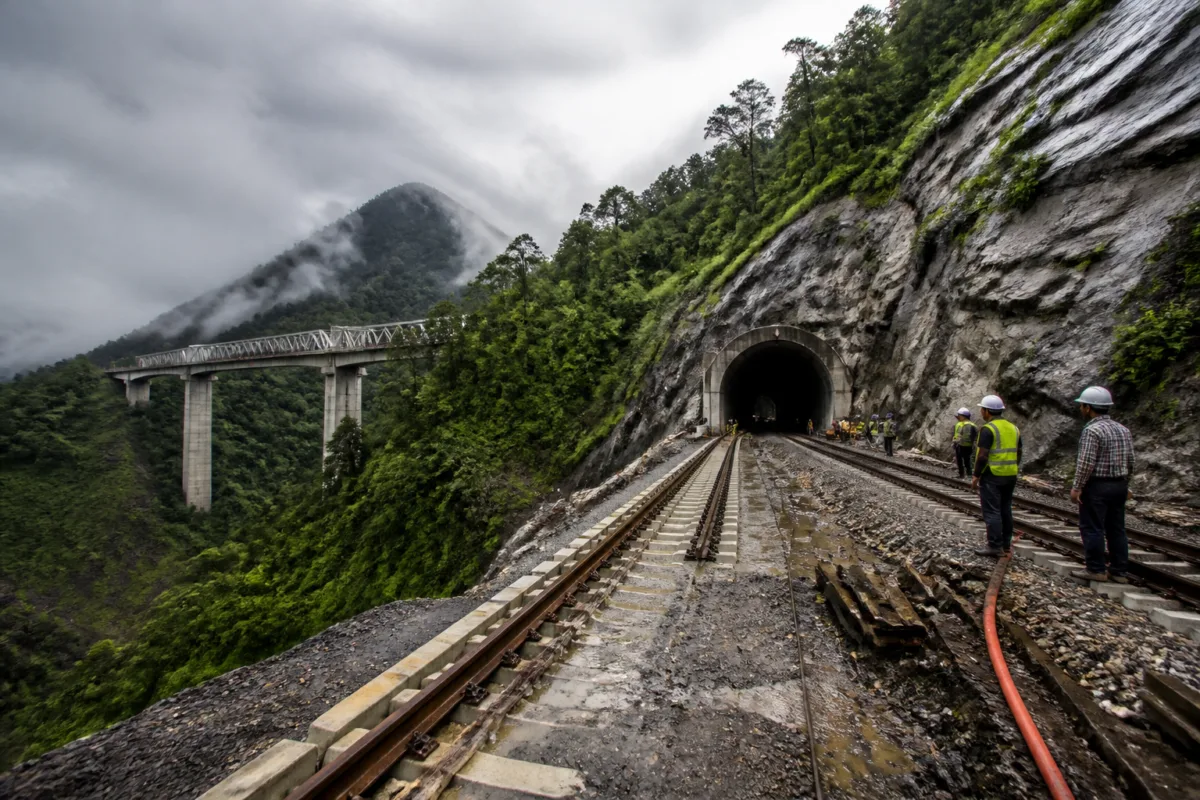
Sikkim is moving closer to its first railway connection, but the Sevoke–Rangpo line shows why transport infrastructure in the Himalayas cannot be judged by distance alone. The 44.96-km railway project, targeted for completion by December 2027, is approximately 80% complete as of September 2026. Yet nearly 86% of its alignment is underground, and the route still has to negotiate fragile slopes, difficult geology, heavy rainfall, environmental constraints and a history of delayed clearances and land acquisition.
The line will connect Sevoke in West Bengal with Rangpo in Sikkim. It is designed to bring the state onto India’s railway network for the first time through five planned stations: Sevoke, Riyang, Teesta Bazar, Melli and Rangpo. Teesta Bazar is planned as an underground station. Of the total alignment, about 41.55 km lies in West Bengal and 3.41 km in Sikkim.
That geography explains why the project is more complicated than its length suggests. Sikkim sits in the young Himalayas, where steep slopes, deep valleys, seismic conditions, heavy monsoon rainfall and variable rock formations make conventional surface railway construction difficult. The route requires 14 tunnels, major and minor bridges and extensive slope protection. The longest tunnel is around 5.3 km.
The railway is therefore being built as a largely underground system through terrain where every excavation can become a site-specific engineering problem. The project uses the New Austrian Tunnelling Method, which allows support measures to be adapted to the ground conditions encountered during excavation. That flexibility is important in a landscape where the stability and composition of the rock can change along the route.
The underground design also reflects an effort to limit surface disturbance across a mountainous and environmentally sensitive landscape. But placing most of the line below ground does not remove the risks. Tunnelling requires continuous attention to ground behaviour, excavation safety and structural stability, while bridge construction must deal with valleys, uneven terrain and difficult access.
The route’s environmental setting has affected the project from the beginning. The alignment passes through or near ecologically sensitive areas, including the Mahananda Wildlife Sanctuary region, and required environmental and forest clearances. The project was sanctioned in 2008-09, but substantial construction did not begin for several years. Land acquisition and clearances were among the issues that delayed progress, with construction gathering pace in 2018.
This gap between sanction and construction is a familiar institutional challenge in large infrastructure projects. Administrative approval establishes a project in principle, but physical delivery depends on land availability, statutory permissions, contractor mobilisation, access to work sites and the ability to manage local environmental conditions. In the Sevoke–Rangpo case, the engineering challenge became significant only after those preparatory questions had also been addressed.
The pandemic added another interruption. Work was affected between 2020 and 2022, according to the supplied report, while earlier completion deadlines were revised as the project encountered construction and implementation difficulties. The current target is December 2027, and the project is now reported to be nearing completion at Teesta Bazar, the planned underground station.
The risks have remained visible during construction. In August 2025, heavy rainfall triggered a landslide near Tunnel No. 7 at Rabijhora. Northeast Frontier Railway said the slope failure occurred about 30 metres from the tunnel and that the tunnel itself was not in danger. No casualties or injuries were reported, and officials said railway machinery and assets were not lost. Workers and equipment had been moved away as a precaution, while debris removal and protective work began after the incident.
The incident does not establish that railway construction caused the landslide. It does, however, illustrate the operating environment in which the project is being built. The same combination of steep slopes, rainfall and unstable ground can affect both construction sites and the transport corridors the railway is intended to complement.
Sikkim currently depends heavily on road and air links. Travellers arriving by train generally use New Jalpaiguri in West Bengal and continue by taxi, shared vehicle or bus towards Gangtok and other destinations. The road journey from the Siliguri area commonly takes around four to five hours, depending on traffic and conditions. Pakyong Airport provides another option when flights are operating, although weather and flight availability can affect its usefulness.
The most important road connection is NH-10, which links the Siliguri area with Sikkim. The route is vulnerable to landslides, congestion and closures, particularly during the monsoon. When it is disrupted, the consequences extend beyond tourist travel. Residents, businesses and essential supplies also depend on the corridor, leaving the state reliant on a limited number of links that can be affected by the same weather conditions.
The Sevoke–Rangpo line is intended to provide an additional route for passengers and freight. Its significance is therefore not simply that Sikkim will gain a railway station. It will add another transport mode to a state whose current access system is concentrated around roads and intermittent air services. The railway could make journeys easier to plan and support the movement of supplies, but its practical value will depend on the services eventually operated and how effectively it connects with road transport within Sikkim.
The project also has a strategic dimension. Sikkim shares a border with China, and improved transport access to the state has implications for the movement of goods and supplies. However, the precise operational or defence benefits cannot be established from the supplied material before the line becomes functional. The immediate and verifiable outcome is narrower: the project will create a railway connection to Rangpo, while the wider network implications remain dependent on future stages.
Those future stages are important because Rangpo is not the same as railway access to Gangtok. A proposed line between Rangpo and Gangtok, approximately 34 km long, is being assessed under the multimodal planning process associated with the PM Gati Shakti National Master Plan. That assessment is not an approval for construction. Similarly, a final location survey has been approved for a proposed route connecting Melli to Dentam through Jorethang and Legship. The proposed route is around 75 km long, but a survey approval should not be treated as a completed or operational railway project.
This distinction separates the immediate project from the longer-term vision. The Sevoke–Rangpo line is under construction and has a stated completion target. The proposed extensions are at different stages of evaluation or survey. Their eventual progress would involve the same questions that have shaped the first line: geological feasibility, environmental permissions, land requirements, funding, construction access and the safety of operating through a difficult mountain system.
The project cost has been reported at Rs 17,124 crore for the approximately 44.5-km Sivok–Rangpo railway line. The variation between the reported 44.5-km and 44.96-km figures reflects the way project descriptions may be rounded, but the larger point is clear: the line is expensive because it is tunnel- and bridge-intensive rather than because it covers a long distance across open land.
That is the central infrastructure lesson from Sikkim’s first railway. Length alone is a poor measure of difficulty. A short Himalayan alignment can require more complex design, more approvals and more safety work than a much longer railway across relatively level terrain. It can also be more exposed to weather-related interruptions during construction and operation.
For Sikkim, the December 2027 target is therefore both a delivery milestone and a test of whether a transport link can be built in a landscape where environmental protection, engineering safety and connectivity demand must be managed together. The evidence currently confirms substantial progress, but not an operational railway. The immediate developments to monitor are the completion of the remaining works, the opening of the planned stations and the official decisions governing any extension beyond Rangpo.

