


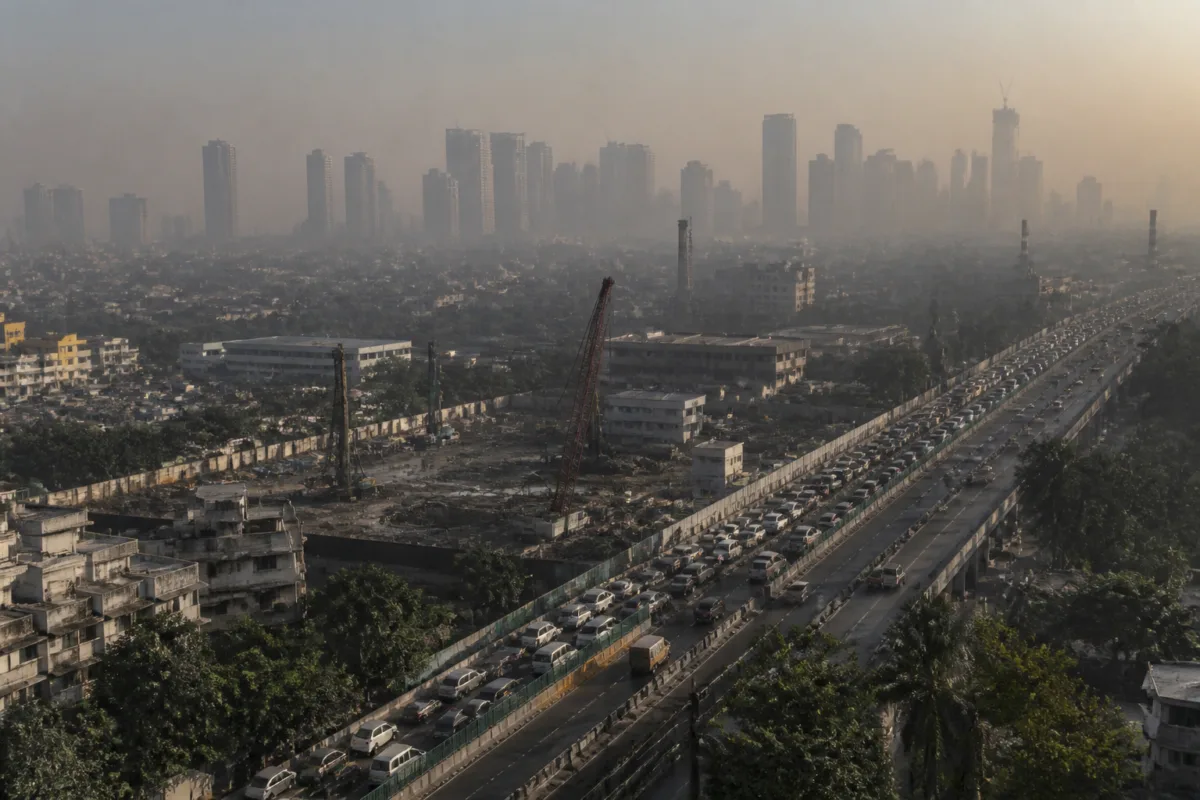
Mumbai’s air pollution problem is no longer confined to the municipal boundary. The evidence presented in a recent analysis by Chandra Bhushan, CEO of environmental research body iFOREST, points to an airshed extending across the Mumbai Metropolitan Region (MMR), where urban expansion, vehicle growth, industry and construction are increasingly concentrated outside the Brihanmumbai Municipal Corporation (BMC) area.
That distinction matters because Mumbai’s annual PM10 concentration, although lower than its 2018 peak, remains above India’s national standard. The report says the city recorded an annual PM10 level of 88 micrograms per cubic metre in 2025, around 1.5 times the national standard. Seasonal averages are more severe: between October and March, PM10 levels can reach three to four times the national standard, while winter concentrations can be 10 to 15 times the World Health Organization’s recommended safe level.
The central argument is not that Mumbai lacks pollution-control measures. It is that the administrative geography responsible for implementing them does not match the geography through which pollution moves. The BMC governs only about 6% of the roughly 7,000-square-kilometre airshed identified in the analysis. Pollution generated elsewhere in the region can therefore undermine action taken within the city.
This is a familiar institutional problem in urban India: the boundary of the agency responsible for a problem is often narrower than the system creating it. Air moves across municipal borders, but enforcement, planning approvals, road construction, industrial regulation and waste management remain divided between multiple authorities.
The scale of regional change explains why a city-only strategy is increasingly inadequate. Since 2011, the MMR has added at least 3.9 million people, with 3.2 million settling outside BMC limits, according to the report. In 2011, more people lived within Mumbai than outside it; by 2025, that relationship had reversed.
The physical expansion of the region has also been uneven. Since 2017, BMC is reported to have added approximately 10.5 square kilometres of new roads, bridges, buildings and other built-up areas. The rest of the MMR added about 270 square kilometres during the same period—an area comparable to the size of Nashik Municipality. The geography of construction and land conversion has therefore shifted decisively beyond the municipal corporation’s direct control.
Vehicle ownership has followed the same pattern. Registered vehicles across MMR rose from 4.36 million in 2011 to 12.31 million in 2025, nearly tripling over the period. Six in ten of those vehicles are now registered outside BMC limits. The report also states that the Maharashtra Pollution Control Board monitors about 33,700 industrial units in the region, of which only 25% are located in Mumbai and 75% are outside it.
These figures do not establish that every increase in pollution came from outside Mumbai. They do, however, show why focusing public attention and enforcement mainly on BMC roads and construction sites risks missing the region’s largest growth zones. Urbanisation, motorisation and industrialisation have expanded faster in the wider metropolitan region than within the core city.
The available emissions evidence also has limitations. MMR does not have a pollution inventory covering the entire region, according to the analysis. Instead, the latest BMC inventory is used as a broad indicator. It attributes approximately 26% of the PM10 load to road and construction dust, 23% to industry, 20% to transport, 14% to waste burning and 14% to cooking fuels used in homes and eateries. Together, these sources account for about 96% of the PM10 load in that inventory.
Because the inventory is not specific to the full MMR, it should not be treated as a definitive regional source apportionment. Its value is diagnostic: it identifies several sectors that require coordinated action and shows why a single intervention—such as road sweeping or temporary construction restrictions—cannot resolve the problem.
The region’s physical setting compounds the governance challenge. The airshed is bounded by the Arabian Sea to the west and the Western Ghats to the east. During winter, the report says, the Western Ghats can partly restrict the movement of air, allowing pollution to remain trapped in the basin. The monsoon provides a seasonal contrast, with rainfall helping to clear the air between June and September. The result is a pollution pattern that is both regional and strongly seasonal.
The proposed institutional response is a regional clean-air plan supported by an air-quality authority for MMR. Such an arrangement would need to coordinate municipalities, the MPCB and other agencies across the metropolitan region. The report notes that, unlike Delhi’s airshed, where regional action involves multiple states, Mumbai’s wider pollution geography lies within Maharashtra. That could make coordination administratively simpler, although the supplied material does not establish that a new authority has been approved or created.
Existing clean-air plans for Mumbai, Navi Mumbai, Thane, Vasai-Virar, Ulhasnagar and Badlapur are described in the analysis as having vague actions and responsibilities, limited targets and unrealistic timelines. The proposed regional model would instead assign responsibilities, budgets, deadlines and measurable targets. The significance of that shift is administrative: a plan becomes enforceable only when an agency is identifiable, funding is available and performance can be measured.
The report also cautions against treating Delhi’s most visible pollution responses as ready-made solutions for Mumbai. Measures such as odd-even traffic restrictions, cloud seeding and emergency restrictions under the Graded Response Action Plan are presented as reactive interventions that may impose costs without addressing the region’s structural sources. The analysis instead identifies industrial fuel switching, stronger emissions monitoring, construction dust controls, public transport expansion, vehicle electrification, waste-burning enforcement and fire management as connected parts of a regional strategy.
Industry is one of the areas where the scale of the problem is particularly evident. The report estimates that MMR has around 19,000 polluting industries and says industrial activity accounts for roughly one-third of regional pollution. It identifies hundreds of small industrial boilers that burn about two million tonnes of coal annually. The proposed response includes shifting industrial energy use towards gas or electricity, developing shared boiler facilities and improving the operation and verification of continuous emissions monitoring systems.
Construction presents a parallel challenge. With more than 10,000 construction sites across MMR, inspection-based enforcement alone may not be sufficient. The report proposes requiring formal dust-management plans at the design stage, followed by online monitoring and independent third-party audits. This would move dust control from a periodic compliance exercise into the project-planning process, although the supplied material does not provide evidence that such a system is currently mandated across the region.
Transport policy illustrates the contradiction between existing mobility patterns and rising emissions. Nearly 65% of trips in MMR are reportedly already made by public transport, described in the analysis as the highest share in India. Yet vehicle numbers have almost tripled since 2011. This suggests that a high public-transport share does not automatically prevent motorisation when the metropolitan region continues to expand, travel distances increase and private vehicles grow rapidly in peripheral areas.
The report proposes increasing public transport use and electrifying remaining vehicles, including a possible ban on new petrol and diesel vehicle registrations from 2031. That is a policy proposal, not an announced government decision, and its implementation status is not established in the supplied material.
Other sources are less visible but locally important. Waste burning is reported around Deonar, Dharavi and other wards with large informal settlements, while solid fuels continue to be used alongside LPG in some slum and rural settlements. Bakeries and eateries also burn wood and coal. Satellite fire detections across MMR rose from 5,716 in 2022 to 7,810 in 2025, according to the analysis. These figures indicate a need for better control of waste, forest and agricultural fires, but they do not by themselves identify the precise contribution of each fire category to PM10 levels.
Monitoring is another structural weakness. About 70% of continuous monitoring stations are located in Mumbai and Navi Mumbai, leaving large parts of MMR with limited coverage. A regional network combining evenly distributed continuous monitors, low-cost sensors and satellite observations could help identify hotspots and connect pollution levels to specific sources. The purpose would not simply be to produce more readings, but to link data to enforcement and intervention.
The evidence therefore supports a clear conclusion: Mumbai’s air-quality problem is regional in origin, seasonal in intensity and fragmented in administration. The annual decline from the 2018 PM10 peak is important, but the 2025 level and winter concentration pattern show that improvement has not yet brought the city within national or international health benchmarks cited in the report.
What remains unresolved is whether Maharashtra’s municipalities and regulatory agencies can operate through a common regional framework, with shared targets and reliable data. The next meaningful test will be whether pollution-control plans move beyond city-specific announcements and establish responsibility across the full MMR airshed.

