


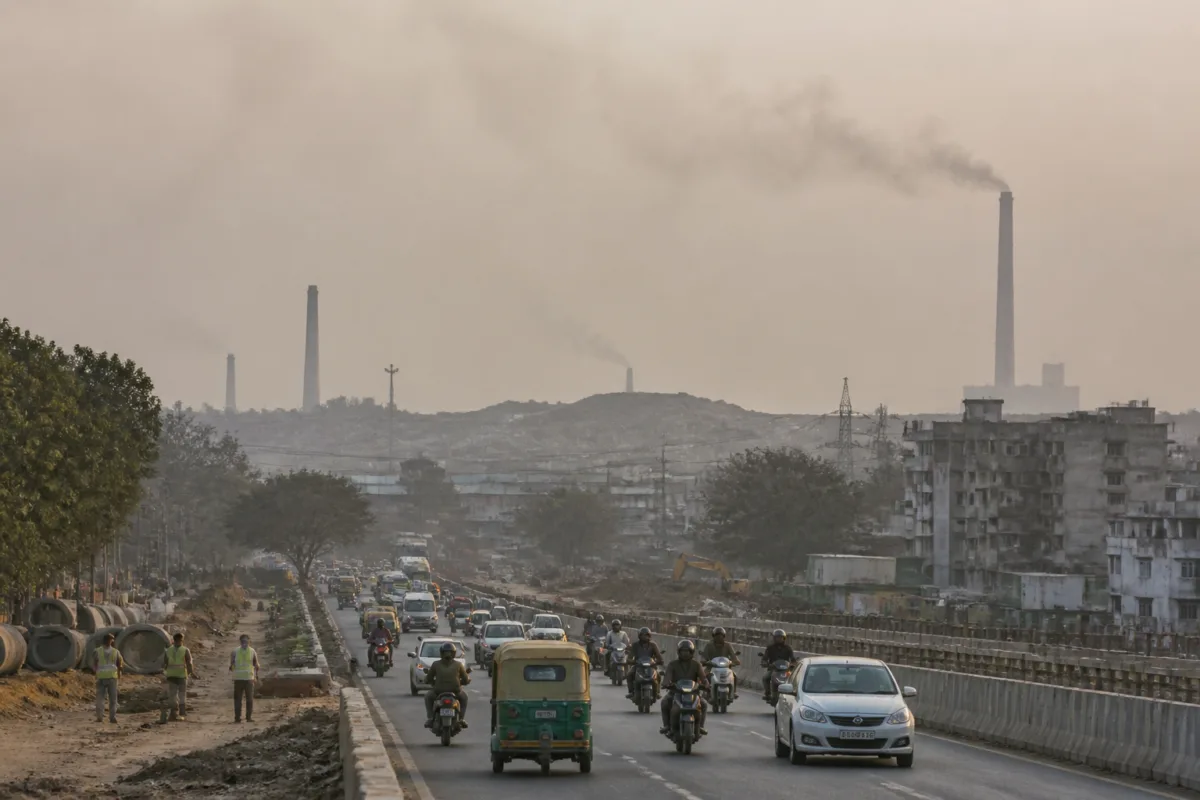
Ahmedabad’s air pollution problem is becoming harder to reconcile with claims that the city is being made pollution-free. A report published by Gujarat Samachar says the city recorded no day of fully clean air up to October 2026, with air quality classified as ‘moderate’ on 179 of 303 days and ‘extremely harmful to health’ on 70 days. However, the supplied report does not identify the source of these figures or the monitoring methodology, leaving the central data in need of verification.
The report places Ahmedabad’s air-quality deterioration within a familiar urban pattern: industrial emissions, dust from damaged and repaired roads, construction activity and waste-related pollution. These sources are different in origin and are usually managed by different institutions, but their combined effect is experienced by residents as one problem — polluted air in neighbourhoods, along traffic corridors and near industrial or waste-processing areas.
That distinction matters because urban air pollution cannot be addressed through a single intervention. Industrial smoke requires emissions monitoring and enforcement. Road dust requires effective construction management, street cleaning and timely maintenance. Construction sites require dust-control measures. Waste sites require containment, processing and safeguards against fires or windblown material. If these sources are treated separately without a coordinated city-level strategy, spending on one programme may not translate into a measurable improvement in the air residents breathe.
Gujarat Samachar reports that smoke from industrial chimneys is being released at night in parts of Ahmedabad. The report does not name the industrial units, identify their locations or provide inspection records, emissions measurements or enforcement orders. Those details are essential for determining whether the reported problem involves illegal emissions, inadequate pollution-control equipment, failures in monitoring or gaps in regulatory action.
The night-time reference also raises an institutional question. If emissions are more difficult to observe outside regular working hours, effective regulation would require monitoring systems capable of recording pollution continuously rather than relying only on occasional inspections. The supplied material does not establish whether such continuous monitoring is in place, how violations are detected or what penalties have been imposed. These are unresolved questions rather than established failures.
Road dust is identified in the report as another important contributor. It links dust pollution to roads damaged during the monsoon and to what it describes as a slow municipal response to repairs. Dust from unpaved shoulders, broken surfaces, construction debris and traffic can become a recurring source of particulate pollution, especially when road works remain incomplete. Yet the report provides no road-wise maintenance data, dust measurements or details of municipal contracts, making it impossible to determine the relative contribution of road dust to the city’s overall air-quality readings.
Construction is a similar case. Ahmedabad’s expanding built environment generates excavation, demolition, transport and material-handling activity. Each stage can release dust if sites do not use barriers, covered trucks, wheel washing, water sprinkling or other controls. The report names construction as a pollution source but does not provide the number of sites inspected, the number found violating norms, or the action taken against them. Without those records, the scale of the construction-related contribution remains unestablished.
The report also points to the Pirana dumping site and its large waste mounds as a source of toxic particles. Pirana has long been associated with Ahmedabad’s waste-management challenge, but the supplied article does not provide current information on the quantity of legacy waste, remediation status, fires, methane management, leachate control or the movement of waste to alternative facilities. It therefore establishes the site as a reported concern, not the precise share of the city’s pollution attributable to it.
The figures cited for 2026 are presented as evidence of a deteriorating trend. According to the report, the air-quality index was around 72 to 75 during May and June but crossed 150 by October. On commonly used AQI scales, those numbers represent a substantial change in conditions, but the interpretation depends on the pollutant measured, the monitoring station, the averaging period and the scale applied. The supplied material does not identify any of these variables. It also uses the description ‘extremely harmful to health’ without explaining the classification system behind it.
That missing information is particularly important because city-wide air quality is not a single physical condition. Readings can vary sharply between industrial areas, high-traffic roads, construction zones, residential neighbourhoods and relatively open areas. A city average can conceal localised exposure, while a single station cannot represent the experience of all residents. To assess the reported claim that Ahmedabad had no clean-air day, readers would need the station locations, daily readings, pollutant categories, data completeness and the definition of a clean-air day.
The count of 303 days also requires clarification. The article says the figures cover the period up to October 2026, but it does not specify the exact end date or explain whether all calendar days were included. It reports 179 moderate days and 70 extremely harmful days, without accounting for the remaining days or describing their categories. This does not invalidate the concern, but it means the figures cannot yet be independently assessed from the supplied material.
The spending question is equally central to the story. Gujarat Samachar describes crores of rupees being spent in the name of pollution control and environmental improvement, while air quality remains poor. However, the report does not name the schemes, departments, budgets, contractors or time periods involved. It also does not distinguish between money allocated, money spent and money that produced measurable pollution-control outcomes. That distinction is fundamental to evaluating public expenditure.
Ahmedabad’s air-quality governance is spread across several layers. Municipal authorities influence road maintenance, construction permissions, waste handling and local services. Pollution-control regulators oversee industrial emissions and environmental compliance. State agencies may be involved in enforcement, monitoring and broader environmental programmes. The report does not record responses from these institutions, nor does it identify a single authority responsible for the city-wide outcome. This fragmentation can make it difficult for residents to know who is accountable when pollution sources overlap.
The policy challenge is therefore not simply to announce cleaner-air programmes. It is to connect monitoring, enforcement, municipal operations and public disclosure. A credible assessment would need to show where pollution is being measured, which sources are contributing, what interventions are funded, how compliance is checked and whether air-quality readings improve after action is taken. None of those links is documented in the supplied report.
The timing of the report is significant because it places the deterioration in October, as winter begins and Diwali approaches. Seasonal changes can affect air movement and pollutant concentration, while festival-related emissions and increased dust can add pressure to already poor conditions. The supplied material says pollution may become more severe, but that is presented as an expectation rather than an established outcome. No forecast, monitoring data or official warning is included.
For residents, the immediate issue is exposure. Poor air quality affects people differently depending on age, health, occupation and the amount of time spent outdoors. Commuters, roadside workers, construction workers and residents living near industrial or waste sites may face different exposure patterns from people in other parts of the city. The report raises this public-health concern but does not provide hospital data, respiratory illness figures or evidence linking particular health outcomes to the reported readings.
What the available evidence confirms is narrower but still important: a Gujarat Samachar report has raised serious questions about Ahmedabad’s air-quality performance and about the relationship between public spending and measurable environmental outcomes. What it does not yet establish is the exact accuracy of the 179-day and 70-day counts, the source-level contribution of industries, roads, construction and Pirana, or the effectiveness of specific government programmes.
Those questions should be resolved through the underlying monitoring records, official AQI data, pollution-control inspection reports, municipal road and construction-enforcement records, and expenditure documents. Until those materials are identified and reviewed, the reported figures should be treated as claims requiring verification rather than as a complete account of Ahmedabad’s air-quality conditions.

