


The reported return of a Merchant Discount Rate (MDR) on parts of the Unified Payments Interface from 15 October 2026 appears designed to solve a structural problem in India’s digital payments system without directly charging everyday users. Under the framework described by Aaj Tak Business, consumers will continue to make person-to-person transfers and ordinary merchant payments without a platform fee, while the cost of processing larger transactions will be shifted into a tiered system paid mainly by eligible merchants and payment businesses.
That distinction matters because UPI is no longer a niche payment product. It is embedded in routine urban transactions, from buying vegetables and paying for public transport-related services to settling bills, shopping online and transferring money to family members. Any change in the economics of the system therefore affects more than banks and fintech companies. It also touches the viability of QR-based commerce, the operating costs of small businesses and the ability of digital payment infrastructure to expand beyond India’s largest cities.
According to the report, the Department of Financial Services and the National Payments Corporation of India have issued a new MDR framework that will take effect on 15 October. MDR is the commission associated with accepting a digital payment. It is generally distributed across the merchant’s bank, the payment service provider and the payment network. Since January 2020, UPI MDR has been kept at zero as part of the policy effort to accelerate digital payments.
The proposed framework changes that model selectively rather than imposing a universal charge. Person-to-person transfers are described as remaining free, regardless of whether the amount transferred is ₹100 or ₹1 lakh. For person-to-merchant payments, customers are also not expected to pay an additional fee when they scan a QR code or use a UPI identity to complete a purchase. The report says consumer-facing applications such as Google Pay, PhonePe, Paytm and BHIM will not be permitted to impose a platform fee or hidden charge on users.
The principal threshold is ₹2,000. Merchant transactions up to that amount will carry zero MDR, meaning that neither the customer nor the merchant is expected to pay a transaction charge under the reported framework. For eligible larger merchants, payments above ₹2,000 will attract an MDR of 0.4 per cent. A ₹3,000 payment would therefore create a reported merchant-side charge of about ₹12, while a ₹5,000 payment would create a charge of about ₹20.
A cap is proposed for very high-value transactions. For payments of ₹75,000 or more, the maximum MDR is reported to be ₹300. This means a ₹1 lakh or ₹5 lakh payment would not attract a charge above that ceiling. The design separates routine, low-value digital commerce from larger transactions, where the payment cost is considered more capable of being absorbed by the merchant or institution accepting the money.
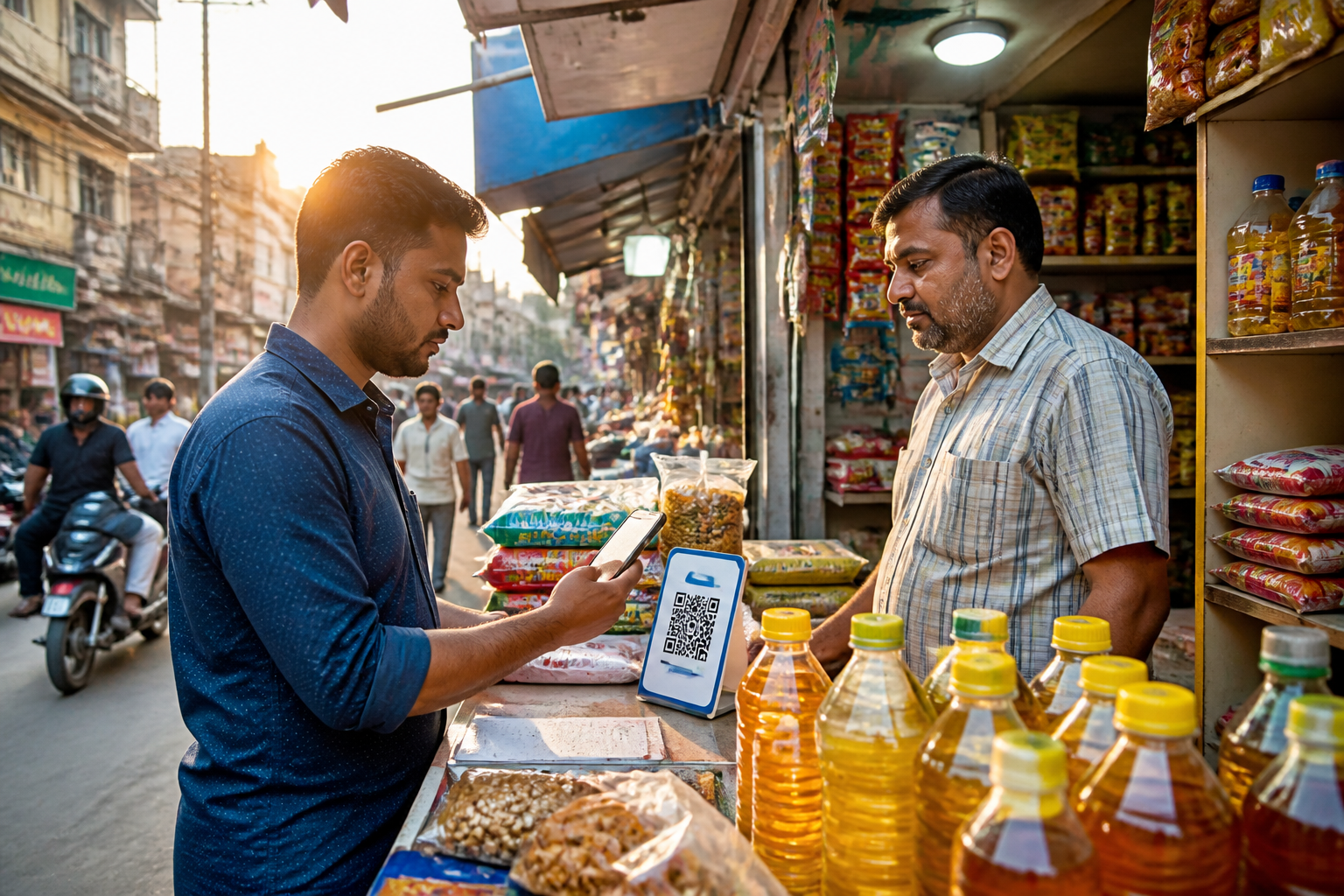
The strongest protection in the framework is aimed at small merchants and informal urban commerce. Vegetable sellers, tea stalls, neighbourhood grocers, street vendors and auto drivers increasingly rely on QR codes because they reduce the need for cash handling and allow customers to pay from bank accounts. The report says merchants with total monthly UPI QR receipts of up to ₹1 lakh will be placed in a P2PM category and will continue to pay zero MDR on all transactions, including those above ₹2,000.
This provision is significant because the economics of UPI are not uniform across the city. A large retail chain, an online platform and a street-side vendor may all display a QR code, but they do not have the same margins, transaction volumes or ability to negotiate payment costs. Applying a flat charge across them could make digital acceptance less attractive for the smallest businesses. The reported P2PM exemption recognises that the public value of UPI is partly measured by its reach into low-value, fragmented commerce.
The report cites figures suggesting that more than 96 per cent of UPI merchant transactions are for ₹2,000 or less, and that more than 95 per cent of small and medium merchants will remain outside the MDR burden. These numbers, if reflected in the framework, indicate that the policy is intended to raise revenue from a relatively narrow segment of higher-value merchant payments while protecting the bulk of everyday QR transactions.
Essential services receive a separate treatment. Railway tickets, fuel payments, insurance and telecom transactions above ₹2,000 are reported to carry a flat MDR of ₹5 rather than a percentage-based charge. On a ₹2,500 fuel payment or a ₹50,000 insurance premium, the merchant would pay the same reported ₹5 fee. A flat charge makes the cost predictable and prevents the payment fee from rising in direct proportion to the value of a necessary service.
The policy argument behind the change is the cost of maintaining a payment network that operates continuously. The report refers to server capacity, cybersecurity and fraud prevention as recurring expenses for banks and fintech companies. The zero-MDR model helped build adoption, but it also left payment providers dependent on other revenue sources or public support while transaction volumes expanded.
The reported framework would direct 5 per cent of the total MDR collected into a development fund for strengthening digital payment infrastructure in smaller cities and rural areas. That proposed allocation links the pricing change to a broader infrastructure question: whether India can maintain reliable, secure and widely accessible digital payments as usage grows outside major urban centres. The available material does not establish the fund’s administrative structure, disbursement process or monitoring mechanism, which will be important to understanding how the money is used.
The revenue estimates illustrate the scale of the industry’s expectations. Jefferies and Bernstein are cited as estimating that MDR on large merchant payments could create annual new revenue of between ₹5,000 crore and ₹22,000 crore for the payments industry. The report also says MDR would attract 18 per cent GST. On a hypothetical annual MDR pool of ₹10,000 crore, that would imply ₹1,800 crore in GST revenue, before any corporate income tax effects.
The report says the government would not receive the MDR directly. Instead, the revenue would be distributed within the digital payments ecosystem, including banks, payment applications and NPCI, with the government benefiting through taxation. It also links the new framework to the subsidy used to support UPI infrastructure, estimated in the report at ₹1,500 crore to ₹2,000 crore annually. Whether the new arrangement reduces that budgetary requirement will depend on the final rules, collection levels and the continuing cost of maintaining the network.
The most important operational safeguard is the prohibition on passing MDR directly to customers. Under the reported rules, a shopkeeper cannot add a separate amount to the bill on the grounds that the customer is paying by UPI. If a merchant demands an additional 0.4 per cent or another surcharge, the customer can complain to the bank or the relevant authority. The effectiveness of this protection will depend on whether consumers know where to report violations and whether payment companies and regulators respond consistently.
The framework therefore attempts to preserve UPI’s public-facing promise while creating a revenue mechanism behind it. Its success will not be measured only by whether customers continue to see a zero-fee payment screen. It will also depend on whether small merchants remain willing to accept digital payments, whether larger businesses absorb the cost without imposing informal surcharges, and whether the proposed development funding improves network capacity in underserved areas.
The supplied report establishes the broad structure and the stated rationale but does not provide the full text of the DFS-NPCI framework, implementation guidelines or complaint-handling procedures. Those documents will determine how merchant categories are identified, how monthly thresholds are calculated and how enforcement will work. The next significant milestone is the reported implementation date of 15 October 2026, when the division between free everyday UPI use and chargeable higher-value merchant payments is expected to take effect.
