


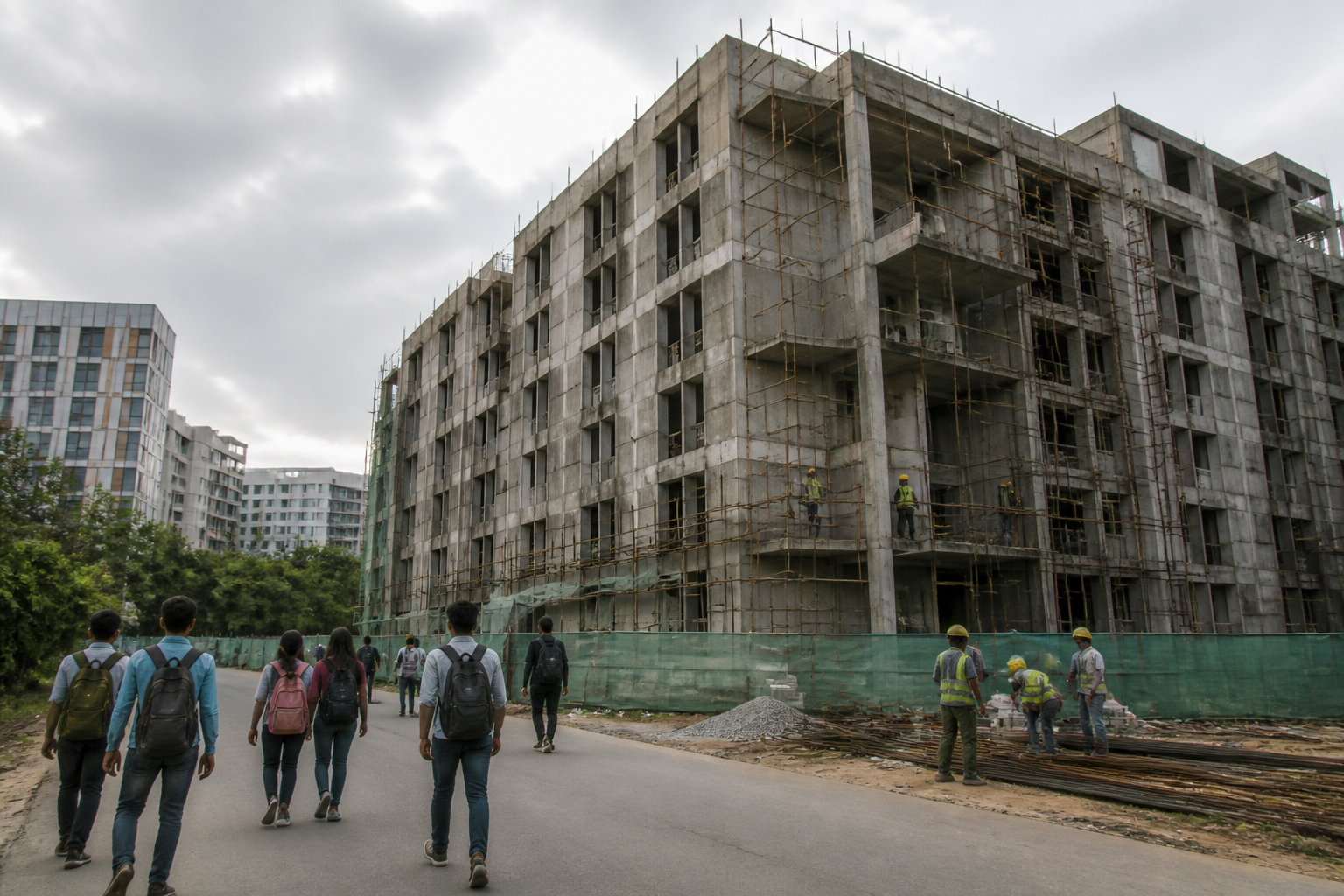
Delhi’s plan to build hostels for 10,000 students is a significant response to a housing problem that has been visible for years but became impossible to ignore after the Satya Niketan building collapse. The initiative promises safe and affordable accommodation, but its real test will be whether it can move students away from an informal paying guest market that has expanded faster than the city’s institutional housing capacity.
Chief minister Rekha Gupta announced the hostel plan after a five-storey building being used as a paying guest facility in Satya Niketan, near Delhi University’s South Campus, collapsed on September 6. Seven people were killed, including five Delhi University students. The incident brought renewed attention to the shortage of safe accommodation for students who come to Delhi from other parts of the country.
Gupta said the proposed hostels would accommodate girls and boys from any university. The chief minister described the objective as providing students with a safe and supportive place to stay while they pursue their education. The government has said the programme can be expanded as demand grows, suggesting that the initial 10,000 places are intended as a starting point rather than a complete response to the shortage.
The announcement is important because student housing is not only an education-sector issue. It is also a question of urban land, building regulation, transport access, public safety and institutional responsibility. When universities admit students without providing enough accommodation, the unmet demand moves into the private rental and PG market. That market then becomes the practical housing system for students, even when many properties operate in densely populated areas and may not meet building or safety norms.
Delhi University illustrates the scale of the mismatch. The university has around 2.5 lakh regular students, many of them from outside the city, but its existing hostel capacity is reported at only 7,210 places. The university has planned to increase capacity to 12,754 seats. Even after that expansion, the number of institutional beds would remain far below the likely requirement created by the university’s student population and its role as a national education destination.
This gap helps explain why students are pushed towards paying guest accommodation at high rents. The available source describes many such buildings as unsafe and uncomfortable, with some constructed in densely populated areas in violation of building norms. The problem is therefore not simply that Delhi has too few hostels. It is that the city’s student accommodation system has allowed private supply to fill a public and institutional gap without a sufficiently visible framework for safety, pricing and accountability.
The government’s proposed response combines new construction with regulation. Hostels are already under construction or have been proposed at several institutions, including Ambedkar University, Dhirpur, GB Pant Engineering College and Polytechnic, Indira Gandhi Hospital and Medical College, and Delhi Sports University. Departments including health, higher education, and women and child development are involved in developing the facilities through the public-private partnership model.
The use of PPP construction indicates that the government is attempting to expand accommodation through more than direct departmental building. That approach may allow different institutions and departments to participate in delivery, but it also makes the allocation of responsibility important. The available announcement does not specify the total project cost, the number of sites, the construction schedule, the terms of private participation or the criteria by which students will receive accommodation. Those details will determine whether the proposal becomes a functioning housing programme or remains a capacity announcement.
The government also plans to survey colleges that have sufficient land for hostel construction. This is a crucial administrative step because the availability of land is likely to shape where new accommodation can be built. Student hostels need to be located close enough to educational institutions or reliable public transport to remain useful. A hostel that is affordable but poorly connected could shift the burden from rent to commuting time and cost. The supplied announcement, however, does not yet establish the locations, connectivity arrangements or selection process for the proposed 10,000 places.
The stated design of the hostels addresses several weaknesses associated with informal accommodation. An official said the facilities would include Wi-Fi, round-the-clock electricity and water supply, study rooms, libraries and hygienic messes. Security would include continuous CCTV surveillance and biometric entry systems. The official also said fire-safety measures and regular structural audits would receive the highest priority.
These features show that the proposal is being framed as more than a bed-creation exercise. For students, the quality of accommodation affects the daily conditions under which education takes place. Reliable electricity and water, study space, food and security are part of the housing service. The emphasis on structural audits and fire safety also reflects the specific public concern created by the Satya Niketan collapse.
However, safety cannot be secured only through features listed in a project plan. It depends on continuing inspections, clear responsibility for maintenance, transparent compliance records and enforcement when buildings fail to meet standards. The announcement refers to regular structural audits, but it does not state how frequently they will occur, who will conduct them, whether reports will be public or what penalties will apply when deficiencies are found. These implementation details will be central to the credibility of the programme.
The proposed hostels also sit alongside a separate regulatory response to Delhi’s PG market. Soon after the Satya Niketan incident, a high-level meeting chaired by lieutenant governor TS Sandhu and attended by the chief minister examined the issue. Education minister Ashish Sood later told a student delegation that the government would introduce comprehensive legislation and regulations for paying guest accommodation within two months.
An 18-member high-level committee is drafting the policy. Its proposed elements include mandatory licences for PGs, zone-wise rent bands, structural and fire-safety audits, and a central portal listing rents, amenities and compliance details. Together, these measures would attempt to make a largely fragmented accommodation market more legible to students, parents and regulators.
The proposed portal could address one of the information problems in the current system. Students searching for accommodation often need to judge safety, facilities and rent through fragmented listings or informal networks. A central record of licensed properties, amenities and compliance information could make it easier to distinguish regulated accommodation from buildings operating outside the formal system. But the source does not yet confirm whether the portal has been approved, how properties would be verified or which agency would maintain it.
Zone-wise rent bands would also represent a significant intervention in the student housing market. The available report does not provide the proposed rent levels or explain how they would be calculated. It is therefore not possible to assess whether the measure would make accommodation affordable, how it would interact with market rents or whether it would apply uniformly across different neighbourhoods. The policy’s effect will depend on these details and on enforcement against unlicensed or non-compliant operators.
The institutional capacity figures make clear why regulation alone is unlikely to solve the problem. Even if every PG is brought under a safety framework, students would still depend heavily on private accommodation if universities do not expand their own housing stock. Conversely, new hostels without rules for existing PGs would leave a large part of the student population exposed to the same accommodation market that has come under scrutiny after the collapse.
Delhi’s response is therefore developing on two connected tracks: build more institutional hostels and regulate the private PGs that currently absorb excess demand. The first addresses supply. The second addresses the conditions under which students live while that supply remains inadequate. Neither track can fully substitute for the other.
The government’s own description of Delhi as an education hub adds another layer to the issue. A city that attracts students from across the country requires accommodation systems that match the scale of its educational institutions. Admissions, campus expansion and student migration create urban demand beyond the classroom. That demand includes rooms, food, water, electricity, security and transport. If these services are not planned alongside education capacity, students are left to negotiate the city through an informal housing system.
The Satya Niketan collapse has made the consequences of that mismatch visible. The deaths of seven people, including five Delhi University students, transformed a routine question of hostel availability into a question of urban safety and administrative accountability. The proposed programme acknowledges that students need housing designed around their specific circumstances rather than accommodation adapted from whatever private building stock is available.
What remains uncertain is the delivery framework. The government has announced a target of 10,000 hostel places and identified institutions where construction is under way or proposed. It has also outlined facilities, safety systems and a regulatory policy under preparation. The next evidence will come from the site survey, project timelines, PPP terms, licensing rules, audit procedures and the actual number of beds delivered.
For now, the announcement confirms the scale of Delhi’s institutional housing deficit but does not yet close it. The city’s student accommodation policy will be judged not only by how many hostels are announced, but by whether students can access them affordably and whether every available accommodation option meets enforceable safety standards.
