


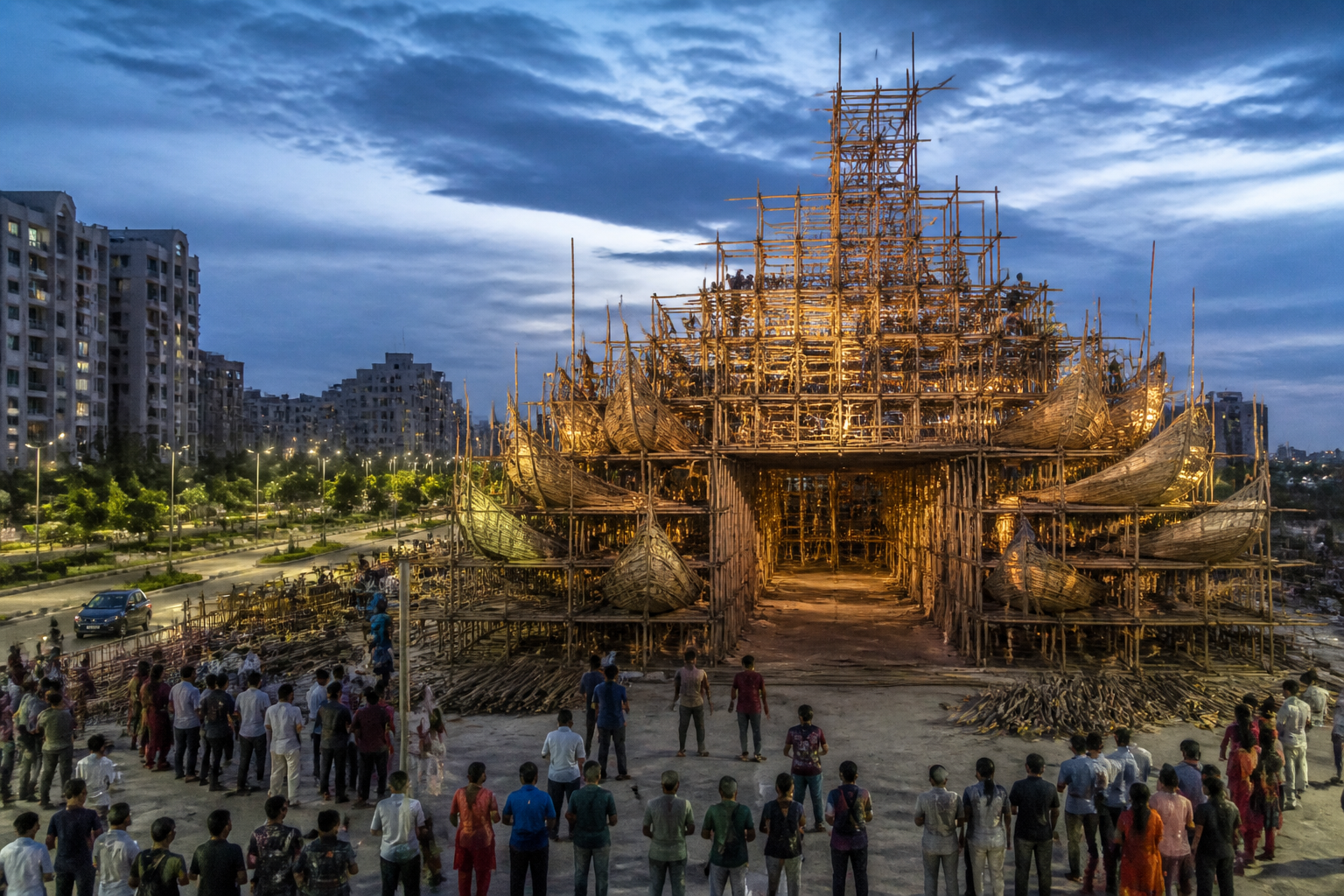
New Town’s Durga Puja landscape is becoming a visible contest over more than themes, crowds and spectacle. Three prominent puja committees are bringing senior political, administrative and public figures into their organisational structures this year, turning a festival in a planned township into a window on how influence, civic permissions and cultural identity intersect in urban space.
The three pujas are different in institutional character. New Town Sarbojanin, held at City Square near Central Mall, was earlier associated with the wife of Debashis Sen, a former chief of the West Bengal Housing Infrastructure Development Corporation, or HIDCO. This year, control has shifted to Rinku Majumdar, the wife of state minister Dilip Ghosh, who is also serving as the puja’s chief adviser. The committee’s president, Lakshmikanta Kar, reportedly approached Ghosh several times before securing his consent to be associated with the event.
The change is significant because New Town is not an old neighbourhood with a single inherited civic or cultural centre. It is a planned extension where residential blocks, institutional land and designated public spaces coexist. A puja held beyond the boundaries of one block therefore depends on an organisational structure capable of negotiating access to common spaces and permissions from the development authority. The report says the committee faced difficulty obtaining HIDCO’s permission to use the ground, and that Majumdar secured the approval.
That detail places the festival within the everyday machinery of urban governance. A public ground is not simply an empty site waiting for a temporary event. Its use involves an authority, a permission process and an institutional decision about how a shared space will be occupied. In New Town, where large-scale development has created a new urban population without the long social history of older Kolkata neighbourhoods, such events can become important markers of collective identity. They can also reveal who has the access and influence to organise them.
The second event, New Town Sanatani Durga Puja, is being held at the New Town Mela Prangan, around 1.25 kilometres from City Square. The puja was inaugurated by Suvendu Adhikari in 2022 and was held again the following year, but it did not take place for the next two years. Its principal organiser, Barun Biswas, told Anandabazar that the administration had opposed the event and that the committee could not hold the puja in 2024 despite a court ruling because of alleged administrative non-cooperation. He said the committee did not approach the court in 2025.
Those claims are presented by the organiser and are not independently established in the supplied report. They nevertheless point to a central question about public festivals in planned urban areas: whether access to public land is governed consistently by transparent rules or is shaped by institutional relationships and the political status of organisers. The report does not provide the relevant court order, the administrative correspondence or HIDCO’s response. What it does show is that permission and administrative cooperation have become part of the story of this puja, rather than a routine background process.
The Sanatani puja has also assembled a high-profile leadership structure. Subrata Gupta, described in the report as the chief adviser to the chief minister, is its public face. Swami Pradiptananda, also known as Kartik Maharaj, is the principal patron, while actor George Baker is the president. Baker was a BJP candidate from Howrah in the 2014 Lok Sabha election and was later a nominated member of Parliament under the Anglo-Indian quota, according to the report.
The third event is the DB Block puja, which is older than the other two. Its principal organiser for several years has been Anupam Ghosh, a member of the BJP’s state committee who has recently been appointed convener of the party’s media cell. He is the president, while his wife, Pramita Saha Ghosh, is joint secretary. This year, Ashok Lahiri, described in the report as the vice-chairman of NITI Aayog and a former BJP legislator from Balurghat, has become the chief adviser. Lahiri lives in the DE Block, which does not have its own puja, and many residents of that block participate in the DB Block event.
The DB Block puja illustrates another feature of New Town’s urban culture: block-level events can serve populations that do not necessarily have a puja within their own immediate residential cluster. Organisers say residents participate spontaneously, while the inclusion of a senior public figure has increased the event’s prominence. This creates a layered geography of participation. The puja is formally located in one block, but its social reach extends to neighbouring residents who lack a comparable event nearby.
The organisers reject the suggestion that the three committees are competing politically. Biswas said the Sanatani puja had selected its office-bearers because of their local standing, cultural associations and commitment to tradition. Ghosh similarly said the DB Block puja was a people-led block event rather than a contest with other committees. Yet the language of distinction remains visible. Ghosh claimed that the character of Bengali Durga Puja in New Town could be found at his event and questioned whether the same could be found at the other prominent pujas.
This is where the festival becomes an urban story rather than merely a cultural calendar item. Kolkata’s major pujas have long carried associations with political leaders and local power networks. The Anandabazar report describes an earlier pattern in which Trinamool Congress leaders were linked with well-known pujas across the city, accompanied by allegations that police and the administration were used to influence crowd flows. The report does not establish those allegations, but it places New Town’s current contest within a wider political history of public festivals.
What appears new in New Town is the concentration of BJP-associated figures across three significant events. The report describes the three pujas as being under BJP influence and says all have selected themes connected with Sanatan tradition. The distinction between them is expressed through the scale of the associated personalities, the location of the events and the visual language of the pandals.
New Town Sarbojanin is using a lotus theme. Rows of boats have appeared in front of the bamboo structure at City Square, and Majumdar said the boats would become lotus petals, while declining to disclose further details. The Sanatani puja plans to connect Sanatan tradition with modern science, presenting a narrative that runs from Aryabhata, Kanada and Sushruta to the modern era and includes the origin of the universe. The DB Block puja has selected the Mahakumbh as its theme, using installations, light and sound to depict the gathering at Prayagraj and the story of the Samudra Manthan.
These themes show how temporary architecture is being used to project institutional identity. A pandal is not only a structure for a religious ritual. It is also a public-facing installation that communicates who the organisers are, what cultural history they claim and which audience they want to attract. In a newly developed township, where neighbourhood identity is still being formed, such installations can help create a sense of place. They can also turn public grounds into stages for competing narratives of tradition and legitimacy.
The administrative dimension remains less clear. The supplied report identifies HIDCO’s role in granting permission for the City Square ground and describes a dispute over administrative cooperation at the Mela Prangan, but it does not set out a common policy for allocating public land to puja committees. It also does not establish whether the three committees were assessed under identical conditions, whether fees or safety requirements differed, or how crowd management and post-event restoration would be handled.
Those unanswered questions matter because the political profile of an organising committee should not, in principle, determine how a public space is accessed. The available evidence does not prove that it did. It does, however, show that political association, administrative access and public cultural programming are closely connected in the way these events are being presented. The visibility of senior figures has become part of the pujas’ public identity, alongside their themes and locations.
New Town’s Durga Puja story therefore reflects a broader challenge for planned urban settlements. They need shared civic institutions, but those institutions do not emerge automatically from roads, towers and designated plots. Public festivals often fill that gap by creating recurring spaces for social participation. At the same time, their organisation can reproduce the influence networks that shape access to other urban resources.
The evidence confirms a shift in the public profile of three New Town pujas and documents the central role of political and administrative figures in their structures. It does not establish whether one committee will attract more visitors, whether permissions were granted unfairly or whether any authority intervened improperly. Those questions would require the relevant approvals, court documents, official responses and crowd or participation data. For now, the clearest signal is that New Town’s festival geography is being built through a combination of block-level participation, public-space permissions and increasingly prominent political sponsorship.
