


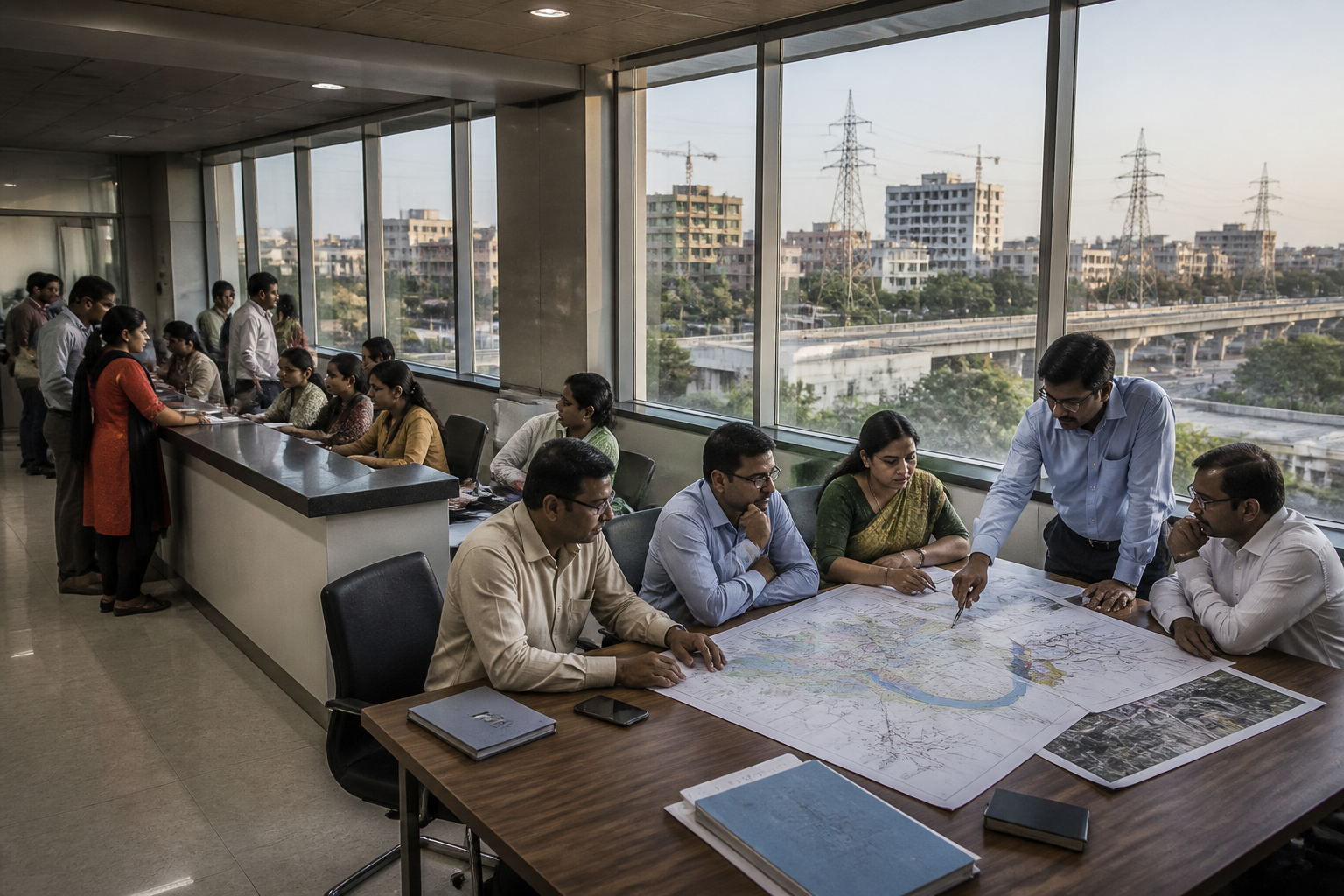
Gujarat’s development strategy did not begin with investment announcements alone. The account of 2003 shows a state attempting to build the administrative machinery needed to convert investment proposals, citizen demands, electricity reforms, education campaigns and disaster recovery into measurable government action. That distinction remains central to understanding how infrastructure and economic development actually move from policy documents to the ground.
The year came after the 2001 earthquake and the political and administrative challenges associated with 2002. According to the account published by Jagran, Gujarat was seeking a more durable development direction by placing investment, administrative responsiveness and direct engagement with industry and citizens at the centre of its approach. The significance of this period lies less in any single announcement than in the way several initiatives were brought together as parts of a governance strategy.
The first Vibrant Gujarat Global Investors Summit was held in Ahmedabad on 28 September 2003. Compared with the much larger investment platform it later became, the first summit was a relatively small event. Its importance, however, was that Gujarat presented itself clearly to investors as an investment destination and created a forum for direct interaction between government and industry.
An investment summit can produce proposals and announcements, but those announcements do not by themselves create factories, ports or jobs. Projects require land, electricity, water, roads, environmental clearances and coordination between multiple departments. For an investor, the practical test of government is therefore not only what is said at a summit, but what happens after the event: how quickly decisions are taken, how clearly procedures are communicated and whether different departments can work together.
This is where the 2003 account connects investment promotion with administrative reform. Investment facilitation began to be treated not merely as an industrial policy issue, but as a responsibility shared across the administration. The emphasis was on coordination, faster decision-making and clearer processes. A delay in one department could affect the progress of an entire project, with consequences for investment and employment. The emerging model therefore treated administrative capacity as part of the state’s economic proposition.
That approach carries an important lesson for the built environment. Large projects are rarely held back by one factor alone. Land, utilities, access roads, approvals and institutional coordination are interdependent. A government may announce a project or attract an investor, but implementation depends on whether these systems can work together. The 2003 experience described by Jagran suggests that Gujarat was beginning to recognise this connection explicitly.
At the same time, the state experimented with a different form of administrative access for citizens. The Swagatam system was introduced in April 2003 to allow grievances that had not been resolved at lower levels to reach the chief minister’s office. Senior officials participated through video conferencing, and complaints were reviewed regularly. By December 2003, 469 complaints had reached the chief minister’s level, of which 443 had been resolved, according to the report.
The figures provide a limited but useful view of the system’s early operation. Swagatam was not presented simply as a digital record-keeping exercise. Technology was used to reduce the distance between citizens and the administration, while officials were expected to respond to unresolved complaints in a more visible and structured setting. The underlying administrative change was the creation of an escalation route: when a local mechanism failed, a citizen had a defined way to seek review at a higher level.
This matters because urban and regional development is experienced through routine administrative decisions. A delayed connection, unresolved land issue, incomplete public work or failure to deliver a service can become a major barrier for households and businesses. Grievance systems do not replace functioning local institutions, but they can reveal where those institutions are failing. The evidence supplied in the report does not establish how Swagatam performed over the long term, but its early design indicates an attempt to make accountability more direct.
Electricity reform formed another part of the same direction. Work began on separating power supply for agricultural and non-agricultural uses, an approach that later took the form of the Jyotigram scheme. The stated objective was not limited to improving electricity supply. Regular power for rural households, irrigation, small businesses, education and village-level economic activity was treated as part of a broader development system.
The separation of agricultural and non-agricultural supply also reflected the difficulty of managing competing demands through a single distribution arrangement. Rural electricity affects more than farm production. It shapes household services, school functioning, small commercial activity and the viability of local settlements. The material supplied does not provide detailed performance data for the later scheme, so its eventual results cannot be assessed here. What it does show is that electricity was being linked to social and economic infrastructure rather than treated as an isolated utility issue.
Education campaigns such as Shala Praveshotsav and Kanya Kelavani extended this administrative approach into villages and schools. The government and senior officials began travelling to rural areas, with school enrolment, particularly for girls, being treated as a wider administrative responsibility rather than only an education department concern. Officials’ presence in villages and schools was intended to test delivery on the ground instead of relying only on records and departmental figures.
This field-facing approach is significant because state capacity is not measured only by the number of schemes announced. It is also reflected in whether officials can identify gaps between formal targets and actual conditions. The report presents these campaigns as an effort to make implementation more visible to senior administration. It does not provide enrolment data or independent evaluation, so the scale of their impact cannot be established from the supplied material alone. Their institutional significance, however, lies in the attempt to connect policy monitoring with direct observation.
Disaster management provided another important link between past crisis and future administrative capacity. Gujarat’s experience of the earthquake was used to support the creation of the Gujarat State Disaster Management Act in 2003 and the Gujarat State Disaster Management Authority on 1 September that year. The framework was described as extending beyond post-disaster relief to include preparedness, risk reduction, rehabilitation and reconstruction.
That shift is especially relevant to cities and infrastructure because disasters expose the weakness of systems that appear functional during ordinary times. Recovery depends on building standards, institutional coordination, public communication, land decisions, utilities and the ability to restore essential services. A disaster management authority can create an institutional framework for these tasks, but the supplied account does not provide enough evidence to measure its effectiveness or compare its performance with other states.
Taken together, the initiatives described for 2003-04 point to a development strategy built around several connected administrative functions. Investment promotion sought to improve the state’s relationship with industry. Swagatam attempted to create a higher-level grievance channel for citizens. Electricity reform linked utility supply with rural economic activity. Education campaigns brought senior administration into direct contact with villages and schools. Disaster management sought to convert crisis experience into permanent institutional capacity.
The common thread was not a single scheme or technology. It was the attempt to make the administration more responsive to different forms of demand: investor demand for predictable approvals, citizen demand for grievance resolution, rural demand for reliable electricity and social demand for better access to education. In each case, implementation depended on coordination across departments and on the ability to monitor outcomes beyond formal announcements.
This also explains why the history of the Vibrant Gujarat summit cannot be separated from the wider governance story. An investment platform attracts attention, but the administrative system determines whether proposals can proceed. A project requires decisions about land, water, power, roads and clearances, often involving different agencies. The report’s central argument is that Gujarat began treating this institutional capacity as part of its development model in 2003.
The later debate over Gujarat’s development model has included different assessments of its economic achievements and social outcomes. The supplied material does not provide evidence to settle those wider debates. It does, however, identify a formative period in which investment and administrative reform were placed together. That relationship is important because capital inflows alone do not guarantee balanced or durable development.
For cities and regions, the larger question is whether governments can turn political and economic priorities into reliable systems of delivery. Roads, industrial facilities, utilities, schools and disaster-resilient settlements all depend on institutions that can coordinate, respond and learn. The 2003 initiatives described by Jagran show an early effort to build those links in Gujarat, while the available evidence leaves the longer-term results to be assessed through additional data and independent evaluations.

