


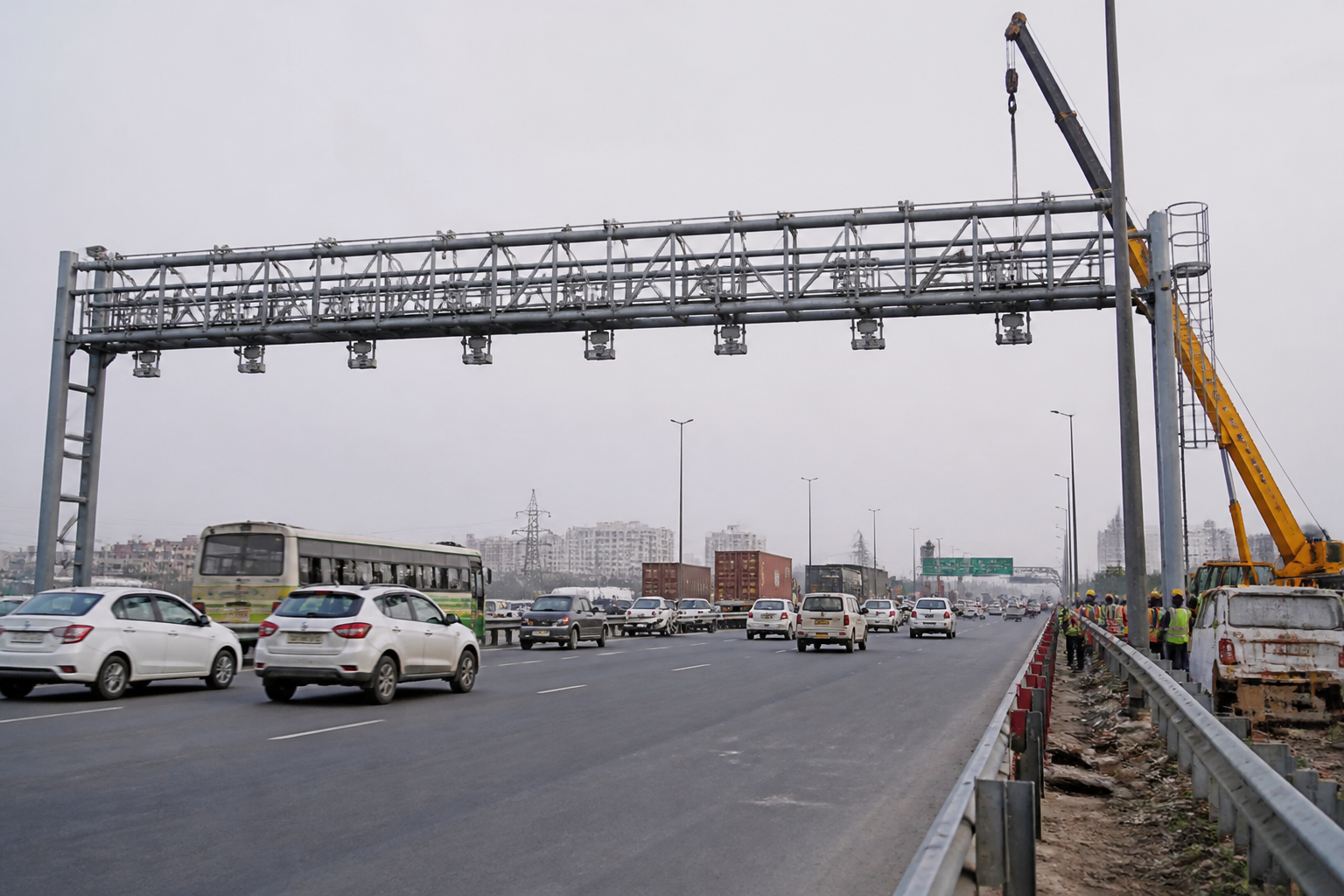
Delhi’s barrier-free tolling project has moved forward after the National Highways Authority of India gave the Municipal Corporation of Delhi a no-objection certificate for installing multi-lane free flow gantries at two border locations. The system is intended to collect entry fees and environmental compensation charges without forcing vehicles to stop at toll points.
The approvals cover proposed gantries at Jhinjholi Border on the Urban Extension Road-II and Harewali, and at Kundli Border on the Kundli-Ghaziabad-Palwal Expressway Main on National Highway 44. NHAI officials said the no-objection certificates for 10 other locations on national highways would be issued soon.
The proposed multi-lane free flow system will use radio-frequency identification and automatic number plate recognition to identify vehicles as they pass through entry points. The objective is to reduce stopping, manual intervention and congestion at Delhi’s border crossings while allowing the municipal corporation to collect the applicable charges.
Officials said joint site verification and technical feasibility assessments were being carried out by NHAI in coordination with the MCD. After the site inspections are completed and feasibility reports are received, the remaining locations will be processed for approval.
The approvals follow a meeting held by NHAI on August 19 after the MCD wrote to the highways authority on August 7 seeking permission for the gantries. NHAI officials were reportedly surprised by the timing of the request because the Supreme Court had directed the MCD in January to implement a barrier-free multi-lane free flow system across all 126 toll collection points in Delhi by October 2026.
NHAI agreed to issue the approvals on the condition that the system must operate completely without barriers on stretches under its jurisdiction. The authority also said that manual toll collection or any other intervention must not adversely affect the smooth movement of traffic.
The project is also linked to a continuing disagreement over vehicle identification technology. The Centre has been encouraging the MCD to adopt FASTag-based tolling, which would allow vehicles to use a single tag instead of multiple systems. The MCD, however, has not yet adopted FASTag and continues to operate a separate RFID tag system.
The remaining approvals, technical feasibility assessments and integration of the identification and enforcement systems will determine whether the MCD can meet the Supreme Court’s October 2026 deadline. NHAI and MCD officials are expected to continue joint site verification and process the pending locations after the feasibility reports are completed.
