


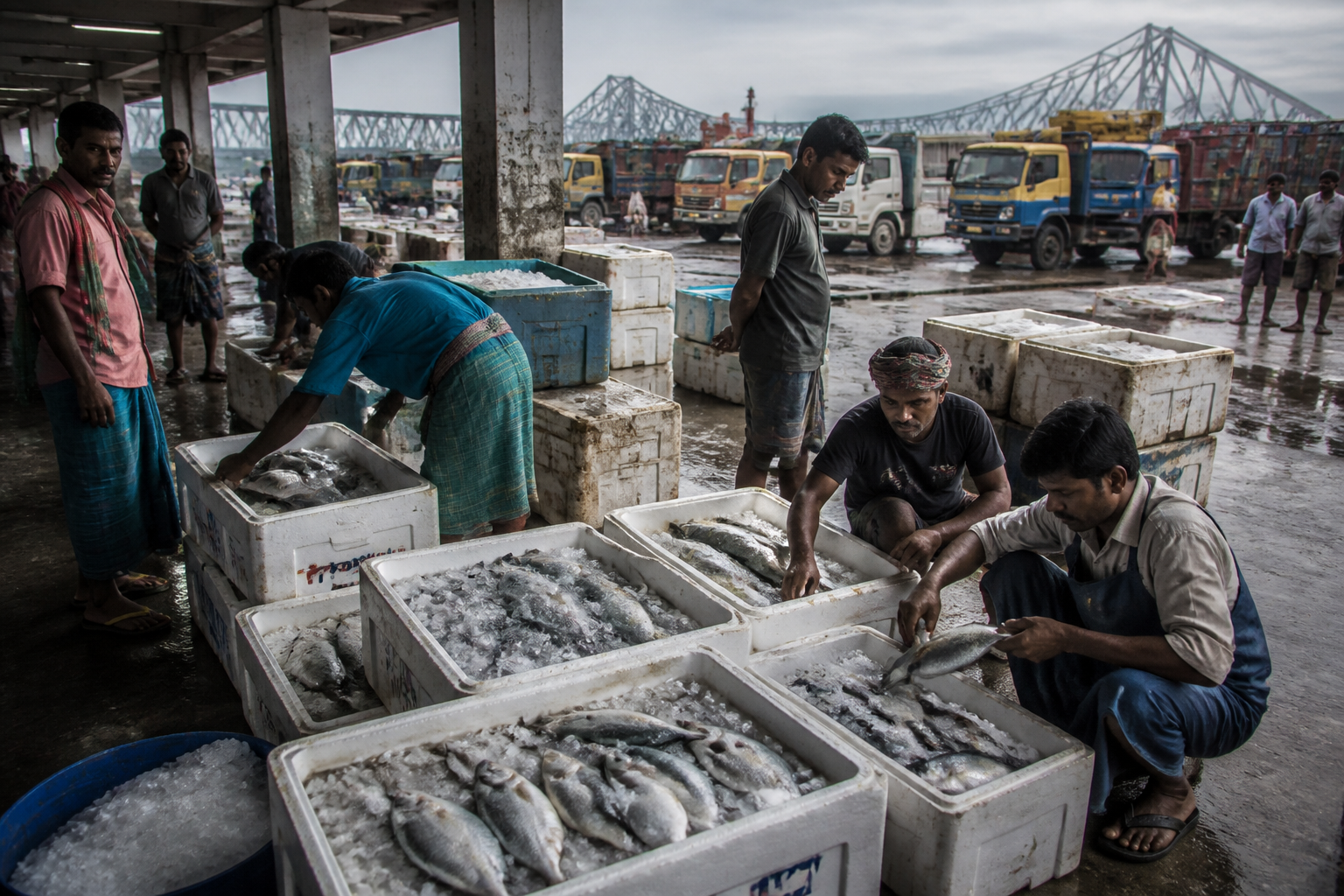
India’s planned export of 650-700 tonnes of hilsa to Bangladesh in 2026 is more than a reversal of a familiar trade route. It shows how a fish traditionally associated with Bengal and the rivers of Bangladesh is increasingly moving through a supply chain shaped by production in Gujarat, wholesale networks in Howrah, border infrastructure at Petrapole and demand from processing units in Bangladesh.
About 500 tonnes have already crossed into Bangladesh over the past couple of months, according to the Times of India report, with another 150-200 tonnes expected to move by the weekend. The exports began in early July, clearing agents at Petrapole said. The projected volume is more than four times the quantity India imported from Bangladesh last year, marking a significant change in the direction of trade.
The change has been driven by a reported shortage of hilsa in Bangladesh and the availability of a large catch in Gujarat. Most consignments entering Bangladesh have been sourced from Gujarat and shipped through Bharuch port. Some supplies were routed through the Howrah wholesale market, while nearly all the exports were handled by Howrah-based traders.
This geography is important. The fish is not moving simply from one neighbouring market to another. It is passing through a multi-stage chain that links fishing and landing activity in Gujarat with port logistics, wholesale trading in Howrah, cross-border clearance at Petrapole and processing centres in Chittagong, Sylhet and Cox’s Bazar.
That chain has emerged because the same characteristic that limits the Gujarat variety’s popularity in Kolkata has increased its value in Bangladesh. The fish has relatively high roe content. While this reduces its demand in the Kolkata fresh-fish market, Bangladeshi buyers, particularly processing units, are seeking the roe for extraction and further processing.
A Bangladeshi importer quoted in the report said the roe is extracted, while the meat is dried and salted rather than consumed as fresh hilsa. The processed products are then intended for export to Europe and the United States, where large Bangladeshi-origin communities create demand. The value of the fish is therefore being determined not only by local culinary preferences but also by an international processing and diaspora market.
The first major lesson from the development is that food supply chains do not always follow cultural associations. Hilsa is strongly identified with Bengal and Bangladesh, but the current trade flow is responding to availability, product characteristics and market demand. The fish can become commercially competitive in a destination where a particular part of the product—its roe—is more valuable than its conventional fresh-market use.
The second lesson concerns the role of urban wholesale markets. Howrah has acted as an intermediary even when the fish originates in Gujarat. Its traders already export species such as boal, rohu, parse and tangra to Bangladesh. That existing commercial knowledge, buyer network and cross-border familiarity enabled traders to test a new product when a large consignment arrived from Gujarat.
Syed Maqsood Anwar, secretary of the Howrah Wholesale Fish Market, said traders decided to send some of the Gujarat catch to Bangladesh after poor catches there created an opening. The shipment was reportedly well received, prompting additional exports. This suggests that wholesale markets are not only places where goods are bought and sold. They can also function as adaptive logistics and market-discovery institutions, connecting producers to buyers when trade conditions change.
Petrapole’s role adds another layer to the story. The border crossing is the principal gateway through which these consignments are entering Bangladesh. Clearing agents said the fish generally weighs between 700 grams and 1.5 kilograms, with prices ranging from Rs 500 to Rs 1,000 per kilogram depending on quality.
The consignments are also passing through formal compliance procedures. Kartick Chakraborty, secretary of the Petrapole Clearing Agent Staff Welfare Association, said the fish undergoes food-quality checks and requires a no-objection certificate from animal quarantine authorities before dispatch. The reported trade therefore depends not only on fish availability but also on the ability of traders, transporters and border agencies to move a perishable commodity through inspection and clearance systems.
For urban infrastructure, perishability changes the importance of time and coordination. A fish consignment must move from the source to the port, market or border without losing quality. The source report does not provide transit times, cold-chain capacity or rejection rates, so the performance of that infrastructure cannot be measured from the available evidence. But the trade itself demonstrates that a functioning combination of wholesale handling, transport, inspection and border clearance is supporting the flow.
The development also exposes the uneven relationship between domestic and international demand. Gujarat’s hilsa has limited demand in Kolkata because of its high roe content, yet that same quality is attractive to Bangladeshi processors. In other words, a product that appears less valuable in one urban market can become commercially important when connected to a different processing economy.
Pradip Dey, director of the ICAR-Central Inland Fisheries Research Institute, described the reverse movement as evidence that India can become a competitive supplier to neighbouring and international markets when domestic availability, quality and supply chains align with demand. His observation places the current export episode within a broader question about India’s capacity to convert regional production into organised market access.
That capacity is not automatic. It depends on whether supply remains available, whether quality requirements are met, and whether the border and logistics systems can handle the volume. The report confirms that a further 150-200 tonnes may be exported after another bumper catch of about 500 tonnes in Gujarat. It does not establish whether this level of supply will continue beyond the current season or whether the trade will become a stable commercial pattern.
The policy landscape is similarly divided across institutions. Fisheries and landing activity are linked to the production side; port and transport systems connect the source to wider markets; wholesale traders organise distribution; border and quarantine authorities regulate entry; and Bangladeshi processing units determine the final commercial use. No single institution controls the full chain described in the report.
The cross-border dimension also means that trade policy and diplomatic coordination remain relevant. While Indian traders continue exporting hilsa to Bangladesh, Anwar travelled to Bangladesh with other members of the trade and met Commerce Secretary Ataur Rahman Khan and officials from the Indian High Commission. The delegation requested that Bangladesh fix the quantity of hilsa to be exported to India from the Padma and Meghna rivers.
Anwar said the traders avoided requesting a specific time limit because only a fraction of the quantity reaches India before the deadline expires. This claim reflects a continuing concern within the trade over the predictability of the reverse flow. The available material does not specify the existing export arrangement, the deadline involved or the volume that ultimately reaches India, but it shows that traders see certainty of quantity and timing as important to the market.
The apparent reversal therefore contains two distinct stories. The first is the immediate movement of Indian hilsa into Bangladesh, supported by Gujarat’s catch and Bangladeshi processing demand. The second is the unresolved question of whether the traditional movement of hilsa from Bangladesh to India can be made more predictable for traders and consumers.
The numbers underline the scale of the present shift: 650-700 tonnes are expected to move from India to Bangladesh in 2026; around 500 tonnes have already crossed; another 150-200 tonnes are anticipated; individual fish generally weigh 700 grams to 1.5 kilograms; and reported prices range from Rs 500 to Rs 1,000 per kilogram. These figures establish the current commercial footprint, but they do not yet show a long-term trend.
What the evidence does confirm is that regional food trade is being reorganised by supply differences between neighbouring countries and by specialised demand further along the value chain. Gujarat’s fish, Howrah’s traders, Petrapole’s clearance system and Bangladesh’s processing centres are now part of one connected commercial route.
The development deserves attention not because it overturns a cultural association with hilsa, but because it demonstrates how urban markets and border infrastructure can redirect a commodity. The next indicators will be whether the projected shipments are completed, whether the trade continues after the current catches, and whether arrangements for hilsa moving from Bangladesh to India become more reliable.

