


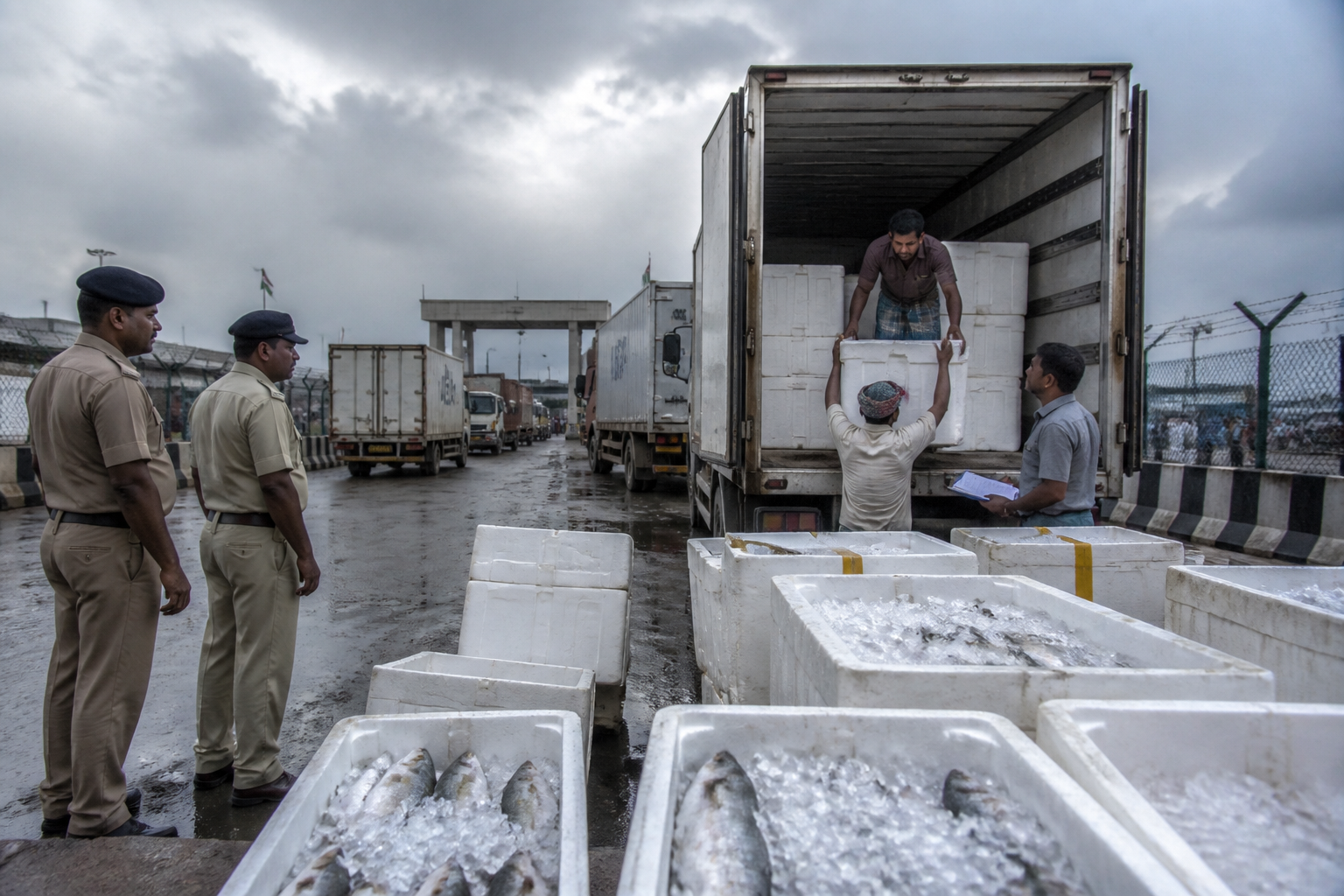
India’s hilsa trade with Bangladesh has reversed direction, with at least 450 tonnes of the fish shipped through the Petrapole land port in North 24-Parganas over the past two months. The movement is significant not only because Bangladesh is the world’s highest hilsa producer, but also because the shipments expose how weather, supply shortages, prices and cross-border policy can quickly reshape a food trade traditionally associated with one-way festive exports from Bangladesh to India.
Most of the Indian consignments originated in Bengal’s Diamond Harbour and Kolaghat, while others came from Gujarat and Mumbai. Two cargoes containing about 10 tonnes crossed Petrapole on Sunday. A senior official of the Land Ports Authority of India at Petrapole and a senior Customs official confirmed that the consignments did contain hilsa, after some exporters initially suggested that cargoes recorded under the hilsa export code might have contained other sea fish.
The reversal has emerged as Bangladesh faces uncertainty over whether it will allow hilsa exports to India before Durga Puja. Bangladesh has traditionally permitted such exports during the festive season as a goodwill gesture, although the volume that actually reaches India has often been much lower than the quantity approved. Last year, Bangladesh cleared 1,200 tonnes for export to India, but only 143.80 tonnes arrived. In each of the two preceding years, imports remained below 600 tonnes.
That gap between permission and arrival is important. A bilateral food trade depends not only on formal approvals, but also on prices, availability, transport arrangements, customs processing and traders’ willingness to accept the commercial risk. The figures reported from previous years indicate that even when export permission exists, the market may not produce a corresponding flow of fish into Indian cities.
The present movement in the opposite direction reflects shortages on both sides of the border. Fish traders attributed poor catches to erratic winds and rough weather, which affected fishing conditions and caused losses for fishermen. In Bangladesh, reduced supply pushed the price of a Padma hilsa weighing one kilogram or more to between Taka 2,500 and Taka 3,000. Some traders therefore turned to Indian supplies despite the difference in the fish’s origin and taste.
Syed Anwar Maqsood, secretary of the Fish Importers’ Association, said demand was particularly strong for egg-bearing hilsa in Chittagong and Sylhet. He said such fish was more readily available in Gujarat, encouraging Bangladeshi traders to source consignments from the western Indian state. Exporters also said medium-sized hilsa from Bengal had been sent to Bangladesh.
The geography of the trade shows how the supply chain is no longer confined to the two riverine regions most closely associated with hilsa. Cargoes are being assembled from Bengal, Gujarat and Mumbai and moved through Petrapole, one of the principal land links between India and Bangladesh. The port’s role in this trade connects fishing locations, wholesale markets, customs procedures and consumer demand across national borders.
The reported preference for fish from the Arabian Sea and the Narmada estuary also highlights the limits of substitution. One exporter said the fish looked similar but was not as tasty as sweet-water Padma hilsa and was comparatively cheaper. Scarcity, however, appears to have made that distinction less decisive for some buyers. When the preferred product becomes unavailable or unaffordable, traders begin to value appearance, size and price alongside origin and taste.
This is a familiar pattern in urban food markets: a disruption at the production end is transmitted through wholesale networks and eventually appears as higher prices or changed purchasing behaviour. In this case, the pressures are operating across two countries. Fishing conditions affect supply; supply affects prices; prices influence import decisions; and those decisions place new demands on land-port logistics and customs clearance.
The institutional uncertainty is concentrated around Bangladesh’s decision on the forthcoming festive-season trade. Fish importers in Calcutta have appealed to Bangladesh’s commerce minister to resume shipments, and Bangladeshi fish traders have reportedly made similar requests. The Tarique Rahman government had not announced a decision at the time of the report.
For traders in India, the uncertainty has two dimensions. The first is whether Bangladeshi hilsa will be permitted to enter the Indian market before Durga Puja. The second is whether the unusual Indian shipments to Bangladesh could affect the political and commercial environment for any later approval. Some Indian exporters initially avoided acknowledging the consignments because they feared a backlash in Bangladesh and possible damage to the prospects of future exports to India.
That concern illustrates the difference between a shipment being technically possible and a trade relationship being stable. The current exports were confirmed by officials and traders, but the movement has not replaced the traditional festive trade. Nor does it establish a permanent reversal. It shows instead that bilateral food flows can change direction when scarcity and price pressures become stronger than established commercial patterns.
Petrapole’s role is therefore more than that of a border checkpoint. It is the point at which a perishable commodity’s value depends on speed, documentation and coordination between agencies. The reported consignments required exporters, transporters, Customs officials and land-port authorities to process fish moving in an atypical direction. Any delay in such a chain can reduce quality and increase costs, particularly when the product is already being bought as a substitute for a scarce commodity.
The trade also carries consequences for fishing communities. Poor catches and rough weather have reportedly caused losses for fishermen, while scarcity has raised prices for consumers. The available account does not establish how much of the price paid by consumers reaches producers, or whether Indian shipments have improved fishermen’s earnings. It does, however, show that environmental and market disruptions are being experienced simultaneously by producers, traders and consumers on both sides of the border.
The numbers from the last three years provide a cautious context. Bangladesh’s approved export volume to India last year was 1,200 tonnes, but actual arrivals were only 143.80 tonnes. Earlier imports were below 600 tonnes in each year. Against that history, the reported 450 tonnes sent from India to Bangladesh over two months is notable, although the figures represent different directions of trade and should not be treated as a direct measure of market size.
The larger question is whether this year’s shortage will remain a seasonal disruption or expose a more persistent vulnerability in the hilsa supply chain. The supplied evidence confirms pressure from weather, catches and prices, but does not establish a long-term change in fish populations, export policy or consumer demand. It also does not show whether Bangladesh will permit exports to India before Durga Puja.
What is clear is that the hilsa trade is being shaped by more than cultural goodwill. It depends on ecological conditions, cross-border permissions, market prices and the operational capacity of land ports. The Indian shipments through Petrapole have made that system visible by reversing its familiar direction. The next decisive developments will be Bangladesh’s formal decision on festive-season exports and the volume of fish that ultimately reaches Indian markets.
