


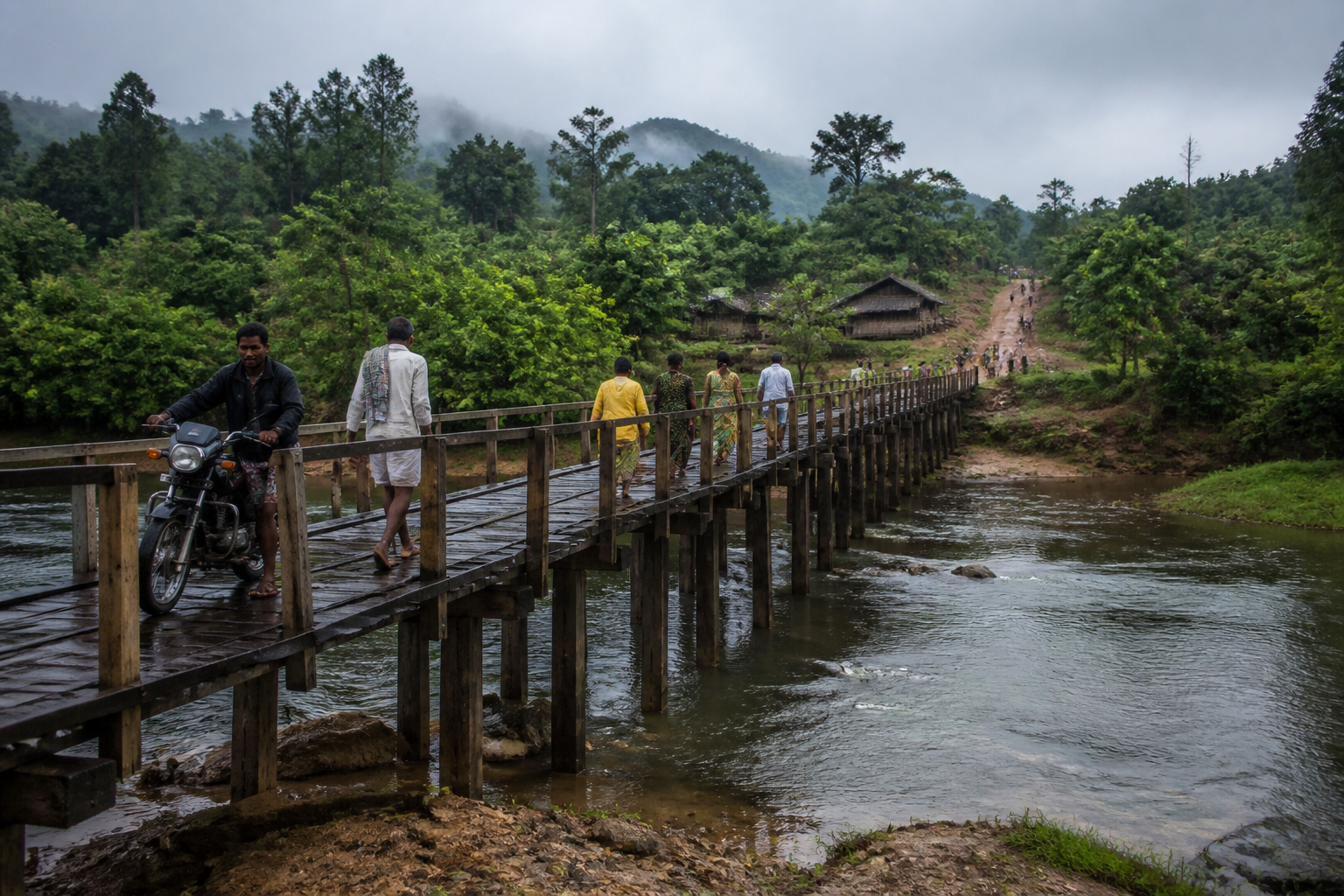
A 100-metre wooden bridge built by about 100 Adivasis in Andhra Pradesh’s Alluri Sitarama Raju district has exposed a basic infrastructure failure: communities in remote settlements are still having to create their own crossings after public bridges wash away or remain unreplaced. The bridge connects Lothugedda and Boyapadu in Chintapalli mandal and is being used by residents who depend on the route for schooling, healthcare and access to weekly markets.
The immediate event is striking because the structure was built without reported expenditure from the villagers. According to the account published by Deccan Chronicle, residents from Boyapadu, Vanajajula, Kappala, K. Bennavaram, Karakapalli, Godugumamidi, T. Korukonda and Mulagondi came together to construct it using wood from forest trees. Killo Suresh, a farmer from Boyapadu, said construction began on August 8 and was completed on August 15.
The bridge is not presented as a permanent engineering replacement for a formal public structure. Residents said it can carry motorcycles and auto-rickshaws, making it a functional response to an urgent access problem. Its significance lies less in the construction method than in the institutional gap it reveals: when a bridge disappears, the consequences are immediate for people whose daily movement depends on a single crossing.
A bridge failure becomes a mobility crisis
The original bridge across the stream was built years ago and was washed away in 2024, according to the report. The account says the state government did not replace it despite pleas from tribal residents. Without the bridge, children faced difficulty travelling to school, patients faced problems reaching hospitals and tribal residents found it harder to transport forest produce to weekly shandies.
That list shows how rural and tribal infrastructure operates as a connected system. A bridge is not only a transport asset. It links households to public services, livelihoods and markets. When the crossing fails, the disruption spreads across several parts of everyday life at once. The same physical gap can become an education problem in the morning, a health-access problem during an emergency and a livelihood problem on market day.
For residents of dispersed settlements, there may also be no practical alternative route. The supplied report does not provide the distance to the nearest usable crossing, the additional travel time after the bridge failed or the number of students and patients affected. Those gaps matter because they are the measurements normally used to determine the priority and design of a public infrastructure project. Yet even without them, the reported uses of the bridge establish that the crossing has a direct impact on essential movement.
The incident also demonstrates why infrastructure failure in agency areas cannot be understood only through project counts. A government record may show that bridges or culverts have been sanctioned, while residents continue to face an impassable stream. The relevant question for citizens is not simply whether a project exists in a file, but whether a safe and dependable connection is available on the ground.
Community construction and the limits of self-reliance
The villagers’ decision to build the bridge represents local problem-solving, but it should not be mistaken for proof that communities can permanently substitute for public works departments. The structure was made from forest wood and constructed in a short period by residents themselves. The report says it can bear motorcycles and auto-rickshaws, but it does not provide an engineering certification, design details, inspection record, load rating or information about its performance during heavy rainfall.
Those unknowns are important. A community-built bridge may restore movement where the formal system has failed to act, but its safety and durability cannot be assumed solely from its completion or current use. The report mentions that another bridge built by Adivasis last year at T. Korukonda remains strong and has withstood the vagaries of nature. That is an observation from an activist quoted in the report, not an independent structural assessment.
The distinction matters because emergency access and long-term infrastructure are different administrative responsibilities. Residents may be able to mobilise labour and locally available material. They cannot, by themselves, establish the standards, hydrological assessments, maintenance schedules and public accountability expected of a permanent bridge. Nor can voluntary construction resolve the question of who is responsible when a crossing fails again.
The episode therefore raises a broader governance issue. Community participation can help identify urgent needs and generate temporary solutions, but it should not turn into an informal transfer of the state’s infrastructure obligation to people with limited resources. The reported lack of expenditure by villagers is evidence of collective labour and material use; it is not evidence that the public cost of providing reliable connectivity has disappeared.
The gap between sanctioned projects and usable connectivity
Government records cited in the report show that several bridge and culvert projects have been sanctioned in ASR district. These include a bridge between Jajigonda and Bodidevulu in Paderu, a low-level causeway between Chamagedda and Nadimveedhi, and a four-vent slab culvert between Akuru and Badigunta. The report also cites a more recent example: a bridge costing Rs 1.89 crore on the Ganugurolu-Bangarubudi road in G. Madugula mandal.
These projects establish that bridge construction is present in official planning and expenditure records. They do not establish whether the projects are complete, operational, accessible during the monsoon or located close enough to serve the villages now reporting difficulty. The supplied material does not provide sanctioned dates, implementing agencies, tender status, completion deadlines or expenditure details for the listed works.
That missing implementation chain is central to understanding the infrastructure deficit. A sanctioned project can remain delayed because of tendering, land or forest permissions, design changes, contractor issues, weather or funding releases. None of those explanations is established in the supplied report. What is established is the coexistence of official project records and a community-built bridge serving a route where residents say a previous bridge was washed away and not replaced.
This is why the story is more consequential than a viral video of a wooden crossing. The video makes a local access failure visible, but the underlying issue is administrative visibility. Remote settlements can be included in plans while remaining difficult to reach in practice. The existence of approvals does not automatically produce last-mile connectivity, and a completed asset does not guarantee resilience if it is repeatedly damaged by rainfall or stream flows.
The report also mentions that a culvert at Chinna Gangavaram in Darakonda panchayat of G.K. Veedhi mandal was washed away by heavy rains on a Saturday. That example places the Lothugedda-Boyapadu crossing within a wider pattern of vulnerability, although the supplied evidence does not establish how many structures have failed across the district or whether the failures share a common design or maintenance problem.
Infrastructure in a geographically difficult district
ASR district’s agency areas present a demanding setting for public connectivity, as reflected in the report’s references to streams, forest settlements and roads linking villages to markets and services. However, the supplied material does not provide terrain maps, rainfall data or a detailed account of the district’s road network. It is therefore not possible to quantify the engineering challenge or compare ASR’s infrastructure performance with other districts.
The available evidence does show that ordinary connectivity is closely tied to resilience. A bridge that serves motorcycles and auto-rickshaws can be crucial even if it does not carry heavy vehicles. A low-level causeway or culvert may provide the only practical connection for a group of villages, but may also be more exposed to high flows. The report’s references to structures being washed away indicate the need to examine not only construction speed but also the suitability and maintenance of infrastructure in locations where streams regularly disrupt movement.
The administrative landscape is also fragmented across levels of government. The original bridge mentioned in the report was constructed by the Panchayat Raj department, while government records list multiple projects in different mandals and locations. The report does not identify the authority responsible for replacing the Lothugedda-Boyapadu bridge or explain how complaints from residents were processed. That absence limits what can be concluded about individual accountability, but it highlights the need for a clear chain from local demand to technical assessment, sanction, construction and maintenance.
Rama Rao Dora, convener of the AP Tribal JAC, described the continuing infrastructure deficit in agency areas despite repeated government assurances on road connectivity. His statement frames the issue as a persistent gap rather than an isolated failure. The available material does not specify the assurances, their dates or the projects linked to them, so those claims require documentary follow-up before stronger conclusions can be drawn.
What the episode establishes—and what remains unclear
The evidence establishes five points. A previous bridge between Lothugedda and Boyapadu was washed away in 2024. Residents from eight villages subsequently built a 100-metre wooden bridge. The bridge is being used for motorcycles and auto-rickshaws. Its absence had affected school travel, hospital access and the movement of forest produce. Government records contain several sanctioned bridge and culvert projects in ASR district, including a Rs 1.89-crore bridge in G. Madugula mandal.
The evidence does not establish whether the new wooden bridge has been inspected, whether a permanent replacement has been sanctioned, how many people use it each day, how the crossing performs during peak flows or when the government plans to restore a formal bridge. It also does not establish whether the listed sanctioned works are complete or whether they directly address the villages named in the report.
Those are not minor details. They determine whether the story is about a temporary community intervention, a delayed public project, a recurring design problem or a wider failure in planning for remote settlements. The next stage of reporting should therefore focus on official records for the destroyed bridge, the status of replacement proposals, the responsible department’s response and the safety assessment of the community-built structure.
The wooden bridge is a visible symbol of local initiative, but its larger meaning lies in the gap between having a route on a government plan and having a safe route that works for citizens. In ASR district, the infrastructure question is not only how quickly residents can build a crossing when the state does not. It is whether public systems can deliver dependable, resilient and accountable connectivity before communities are forced to do it themselves.
