


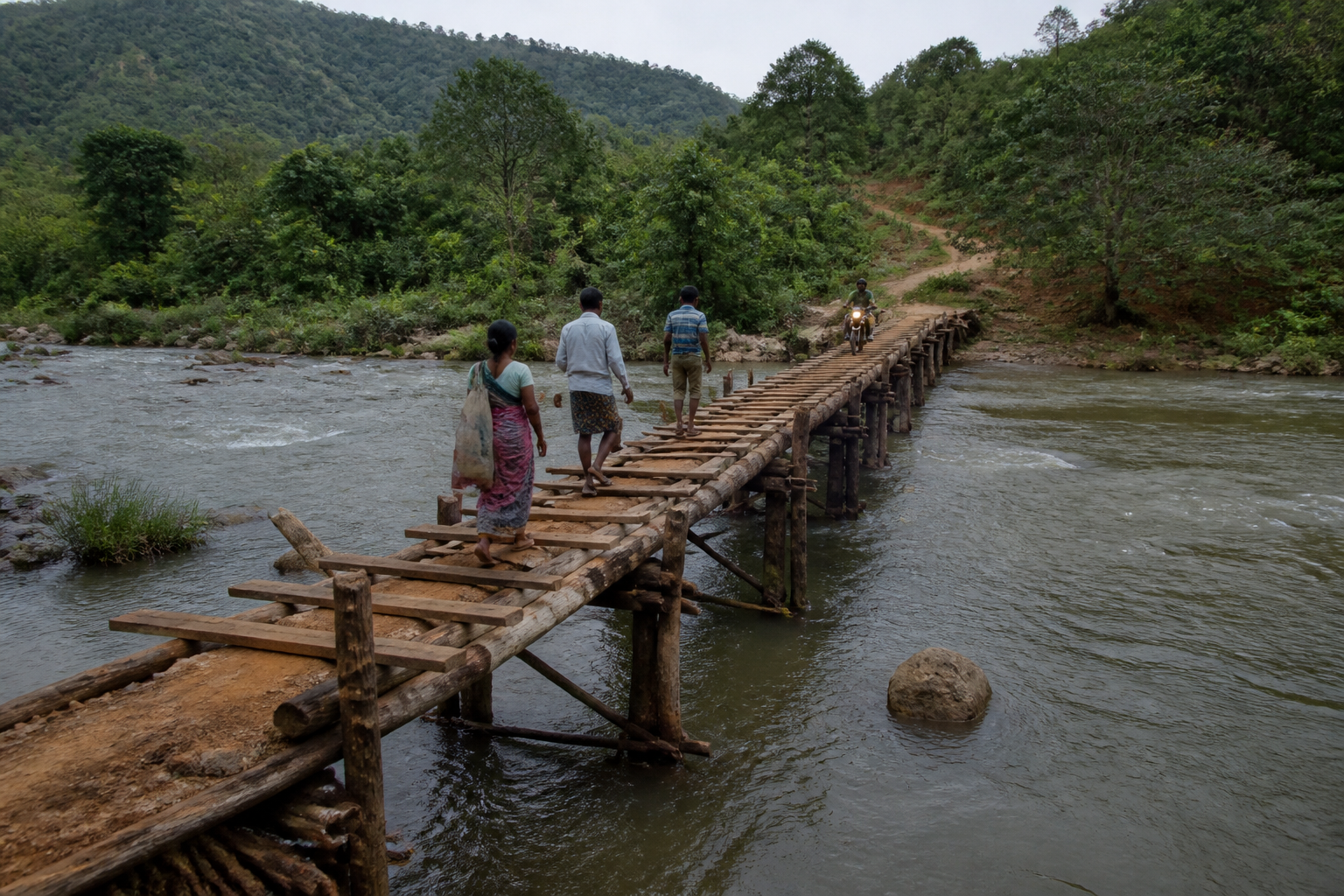
The 100-metre wooden bridge built by Adivasi residents between Lothugedda and Boyapadu in Andhra Pradesh’s Alluri Sitarama Raju district is more than an improvised crossing. It is evidence of how the absence of basic public infrastructure can shift responsibility for connectivity from the state to communities that already face difficult access to schools, hospitals and markets.
Around 100 residents from eight villages constructed the bridge across a stream after an earlier bridge was washed away. According to the report, the state government did not replace the original structure despite pleas from tribal residents. The new bridge was built between August 8 and August 15 using wood from forest trees, with residents saying they spent no money on construction. It can carry motorcycles and auto-rickshaws.
The construction is being presented as an example of community initiative. But the more important institutional question is why residents had to undertake the work themselves. A bridge is not only a physical link between two settlements. In a district where villages depend on roads, culverts and crossings to reach public services and markets, the failure of one structure can disrupt several parts of daily life at once.
The report identifies four immediate consequences of the missing bridge. Adivasi children faced difficulty travelling to school. Patients had problems reaching hospitals. Residents carrying forest produce to weekly markets faced an additional obstacle. Everyday movement between villages was also affected. These are not separate transport inconveniences; they are connected outcomes of a weak local mobility network.
The account also shows why infrastructure in agency areas cannot be assessed only by counting sanctioned projects. What matters to residents is whether a bridge remains usable after a stream rises, whether a road connects to a functioning crossing, and whether a public agency responds when a structure is washed away. A sanctioned bridge that has not been completed, or an old bridge that is not replaced, does not provide practical connectivity.
The original bridge on the Lothugedda-Boyapadu route was reportedly washed away before the community built its replacement. The report also states that a bridge constructed by Adivasi residents across the same stream at T. Korukonda last year remains strong and has withstood natural conditions. That claim is attributed to an activist from Chintapalli and would require an on-site engineering assessment before it could be treated as a technical measure of safety or durability.
That distinction is important. A community-built structure may restore movement in the short term, but it does not automatically meet the design, safety, load-bearing, drainage or maintenance standards expected of a permanent public bridge. The report says the structure can bear motorcycles and auto-rickshaws, but it does not provide an engineering certification, details of its foundations or information about how it will perform during future heavy rains. Those unanswered questions do not diminish the urgency that led residents to build it. They show the difference between emergency access and dependable public infrastructure.
The district’s geography and settlement pattern make that difference consequential. The villages named in the report—Boyapadu, Vanajajula, Kappala, K. Bennavaram, Karakapalli, Godugumamidi, T. Korukonda and Mulagondi—came together for a single crossing. Their collective action suggests that the bridge served a wider network than one isolated household or settlement. It also indicates that the cost of a missing link was distributed across education, health access, trade and local movement.
The report links this incident to a longer tradition of tribal communities constructing their own roads, culverts and bridges. That practice can be read as local resilience, but it also raises a governance concern: resilience should not become a substitute for public delivery. When communities repeatedly fill infrastructure gaps through unpaid labour and locally available materials, the state may appear present through schemes and assurances while remaining absent at the point where residents need a safe, functioning asset.
The institutional record described in the report is not empty. Government records show several bridge and culvert projects sanctioned for ASR district. These include a bridge between Jajigonda and Bodidevulu in Paderu, a low-level causeway between Chamagedda and Nadimveedhi, and a four-vent slab culvert between Akuru and Badigunta. A more recent example is a bridge on the Ganugurolu-Bangarubudi road in G. Madugula mandal, valued at ₹1.89 crore.
Those examples create a gap between administrative sanction and lived connectivity. The supplied report does not state the current construction status, expenditure, contractor details, completion dates or reasons for delay for these projects. It therefore cannot establish whether the sanctioned works remain pending, have been completed, or have encountered technical and environmental problems. But the contrast is still significant: while projects appear in official records, residents in another part of the district were constructing a temporary crossing after the loss of an earlier bridge.
This is where infrastructure governance becomes a question of monitoring rather than announcement. A project passes through several stages—identification, sanction, funding, tendering, construction, inspection and maintenance. A failure at any stage can leave a settlement without a usable connection. Public assurances about improving road connectivity address the policy intention, but residents experience the outcome at the stream crossing, on the approach road and at the point where a vehicle must pass.
The report refers to the Panchayat Raj department as the agency that built the original bridge at Chinna Gangavaram in Darakonda panchayat of G.K. Veedhi mandal. That culvert was washed away in heavy rains, according to the account. The same report also states that the original bridge on the Lothugedda-Boyapadu route was washed away in 2024. Together, the examples point to the exposure of local infrastructure to intense rainfall and the need to treat replacement and resilience as part of the same administrative responsibility.
However, the available material does not provide rainfall measurements, structural assessments, design specifications or details of the damage at either site. It would be inaccurate to conclude from the report alone whether the failures resulted from inadequate design, exceptional weather, poor maintenance, construction defects or other causes. What can be established is that the loss of crossings had direct consequences for residents and that replacement has not kept pace with need in at least the locations described.
The timing of the community bridge also reveals how infrastructure gaps are managed on the ground. Residents began construction on August 8 and completed it on August 15, according to Killo Suresh, a farmer from Boyapadu. The speed of that response contrasts with the uncertainty surrounding formal replacement. It shows that communities can mobilise quickly when the need is immediate. It does not show that they should be expected to assume responsibility for public works.
For children, patients and forest-produce sellers, the value of a bridge is measured in continuity. A school journey interrupted by a stream, a hospital trip made difficult by the absence of a crossing, or a market journey delayed by poor access can turn a short physical distance into a serious barrier. The report does not quantify missed school days, delayed medical treatment or lost income. Even without those figures, it establishes the categories of harm created by the infrastructure gap.
The wider lesson is that connectivity in remote districts is a network, not a collection of isolated projects. A bridge, culvert or causeway may be small in budget compared with a major highway, but its failure can disconnect an entire group of villages. Sanction lists and project values are necessary for public accountability, yet they are insufficient unless authorities also track whether residents can actually cross streams safely throughout the year.
The ASR examples leave several issues for public agencies to clarify: the status of the bridge destroyed in 2024, the response to pleas from the affected villages, the safety assessment of the community-built structure, and the progress of the projects listed in government records. The supplied report does not provide those answers. It does, however, document the central fact clearly: residents built a bridge because the public connection they depended on had not been restored.
That fact should shift attention from the symbolism of community construction to the administrative chain behind infrastructure failure. The next measure of governance in these villages will not be another assurance or another sanctioned project. It will be whether durable, safe and publicly maintained crossings are restored, inspected and kept usable when the next heavy rain arrives.
