


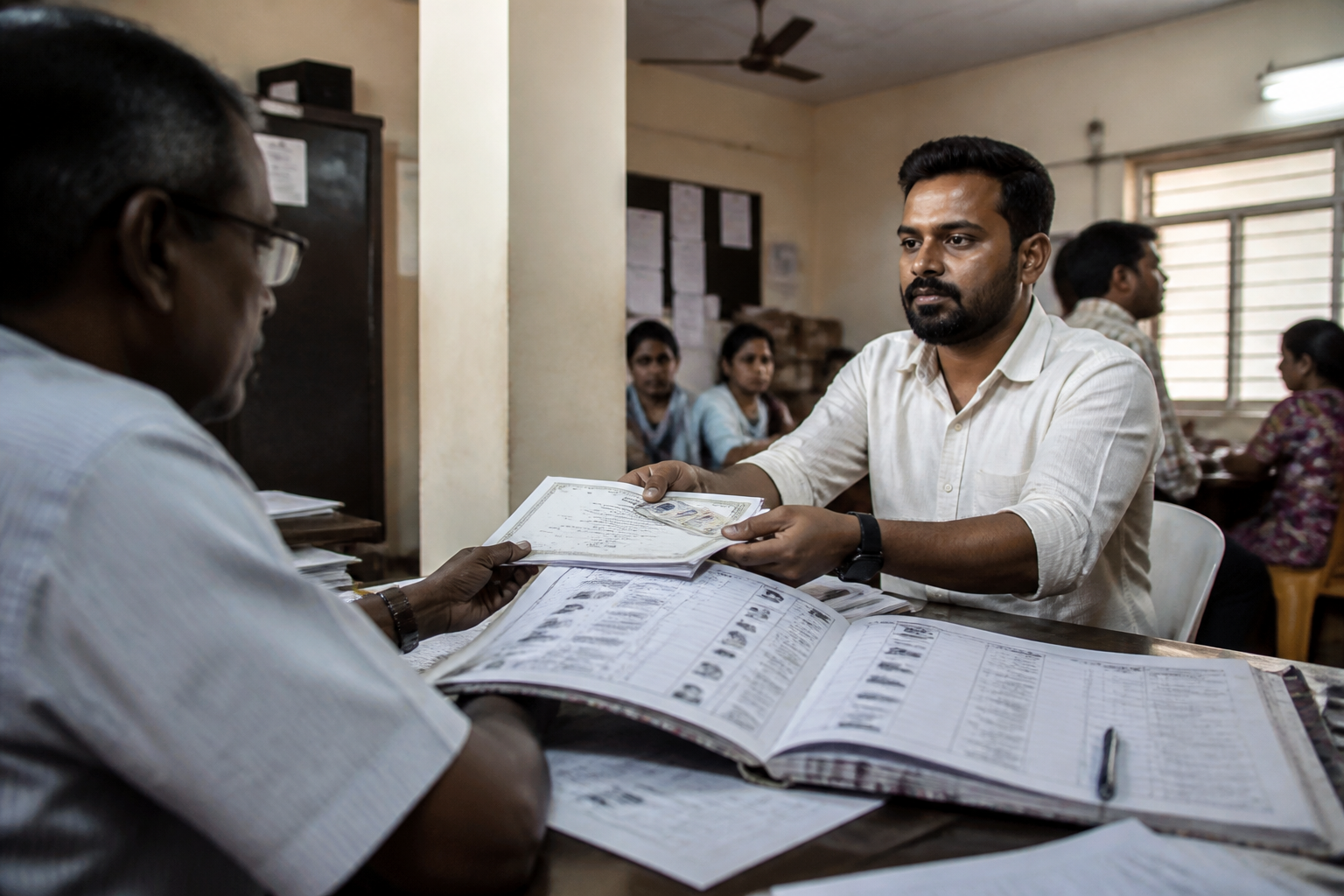
Bengaluru’s Special Intensive Revision (SIR) of electoral rolls has moved beyond a routine record-checking exercise, with 43.8 lakh voters required to establish their place and date of birth during the claims and notices period. The experiences documented in the process show that the central administrative challenge is not only whether a voter possesses identity documents, but whether present-day records can be linked convincingly to older electoral data.
The claims and notices period runs from August 24 to October 22. By Friday, 7 lakh voters had completed their hearings, according to the report. The scale of the exercise means that the quality of record matching, the consistency of hearings and the ability of voters to produce acceptable evidence will determine how smoothly the revision proceeds.
The cases reported from Bengaluru reveal several different forms of mismatch. In some instances, voters had not filled in their 2002 details in the enumeration form, making it difficult to establish a connection with the 2002 electoral roll. In others, the details had been entered but could not be matched with the old record. These problems turn the verification exercise into a reconstruction of personal and family identity across documents created at different times and for different administrative purposes.
One voter addressed the absence of 2002 information by producing a 10th marks card, birth certificate and passport. Another used a passport, bank passbook and CGHS medical card. A third relied on a passport, Aadhaar, PAN card and 10th marks card. The cases show that voters may need to assemble a combination of identity, age, birth and personal records rather than depend on one universally sufficient document.
That distinction is important for understanding how the process functions. A document may establish that a person exists and carries a particular name, while another may establish age or date of birth. A third may help connect the current voter to an older electoral entry. The evidence listed in the reported cases therefore performs different administrative functions: proving identity, establishing personal details and creating a link between current records and the 2002 roll.
The most complex cases involve family relationships and changes in personal details. In one instance, the age recorded in the 2002 record appeared to be the voter’s age rather than the father’s. The voter produced the enumeration form, a 2002 electoral-roll extract, Aadhaar and a passport showing the father’s name to establish the father-son relationship. In another case, the father’s name differed between the old and current records. The voter used a 10th marks sheet, the voter’s passport and the father’s passport to establish the family link.
These examples indicate that the older electoral roll is being used not simply as a historical reference, but as a record against which present information is being compared. When spellings, ages or family details vary, the hearing becomes a process of demonstrating that two differently recorded entries refer to the same person or family. The burden on the voter is consequently shaped by the quality of earlier records and by the ability of current documents to bridge gaps between them.
Name changes create another layer of difficulty. One voter’s maiden name appeared in the 2002 electoral roll, while her post-marriage name appeared in the current record. Documents showing both names were produced, including a 10th marks card with the maiden name and Aadhaar with the name after marriage. The date of birth also helped establish that both names belonged to the same person.
A spelling error can create a similar problem even when there has been no substantive change in identity. In one reported case, the voter’s name was misspelt in the 2002 electoral roll. The voter produced a passport and Aadhaar to establish that the person in the old roll and the current voter were the same individual. This is a reminder that electoral databases carry forward the effects of clerical errors, spelling variations and inconsistent naming conventions.
Taken together, the cases point to an administrative system in which a voter’s eligibility may be examined through a chain of records rather than a single database entry. The chain can include the enumeration form, the 2002 electoral-roll extract, passports, Aadhaar, educational certificates, birth certificates, bank records, PAN cards and medical cards. The source report does not establish that every document will be accepted in every case, but the examples show the types of records voters have used during hearings.
The scale of the exercise adds a second challenge. With 43.8 lakh voters covered in Bengaluru and 7 lakh hearings completed by Friday, the process involves a large volume of individual cases within a defined period. The claims and notices window closes on October 22, creating a fixed administrative deadline for hearings and submissions. The supplied report does not provide the number of notices issued, the number of names at risk of deletion or the criteria used to decide disputed cases. Those gaps limit what can be concluded about the final impact of the revision.
The process has also generated a parallel demand for public scrutiny. Actor Prakash Raj announced plans for a social audit of SIR across 10 districts from September 20 to 30, alongside civil society groups. The proposed exercise would involve visits to polling booths, comparisons between Election Commission records and deleted names, and collection of evidence from affected voters. District-level press meetings are also planned, with evidence expected to be presented at a gathering in Delhi on October 1 or 2 and taken to courts by October 15, according to the report.
This proposed audit does not constitute an official finding, and the allegations associated with it remain claims attributed to Prakash Raj. Its significance lies in the kind of evidence it proposes to collect: comparisons between official records and the experiences of voters whose names may have been deleted. That approach mirrors the core problem visible in the reported hearings—whether an administrative record accurately represents a person’s identity and electoral status.
The institutional question is therefore not limited to documentation. It concerns how electoral authorities manage older records, how discrepancies are communicated, what opportunity voters receive to respond, and how decisions are recorded when documents contain conflicting information. The reported cases show voters resolving discrepancies through multiple records, but the material supplied does not explain whether there is a standardised checklist, a common decision framework or an appeal mechanism for cases that remain unresolved.
The 2002 electoral roll has become a critical reference point in the cases described by the report. Yet the examples also show why historical records can be difficult to use as definitive identity documents. Names may change after marriage, spellings may be incorrect, family details may be recorded inaccurately and information may be omitted from forms. A verification system that relies on historical matching must therefore deal with the imperfections of the historical record itself.
For residents, the immediate practical issue is preparation for the hearing. The reported cases suggest that voters may need to bring documents covering identity, age, birth details, current particulars and family relationships, depending on the discrepancy involved. However, the source does not state that the documents listed are mandatory or exhaustive. That distinction matters because presenting examples as a universal requirement could create further confusion among voters.
The evidence currently confirms three facts: the SIR process covers 43.8 lakh Bengaluru voters; the claims and notices period runs until October 22; and 7 lakh voters had completed hearings by Friday. It also confirms that the reported disputes include missing or unmatched 2002 details, differences in fathers’ names, marriage-related name changes and spelling errors. What remains unclear from the supplied material is how many cases have been resolved, how many names have been deleted, what documents authorities formally recognise and how unresolved disputes will be reviewed.
Those unanswered questions will determine whether the exercise is experienced as a routine correction of electoral records or as a barrier for voters whose documentation does not align neatly across decades. The next significant developments are the completion of the claims and notices period, the proposed social-audit activities from September 20 to 30, and any official or legal response to the evidence collected during that process.
