


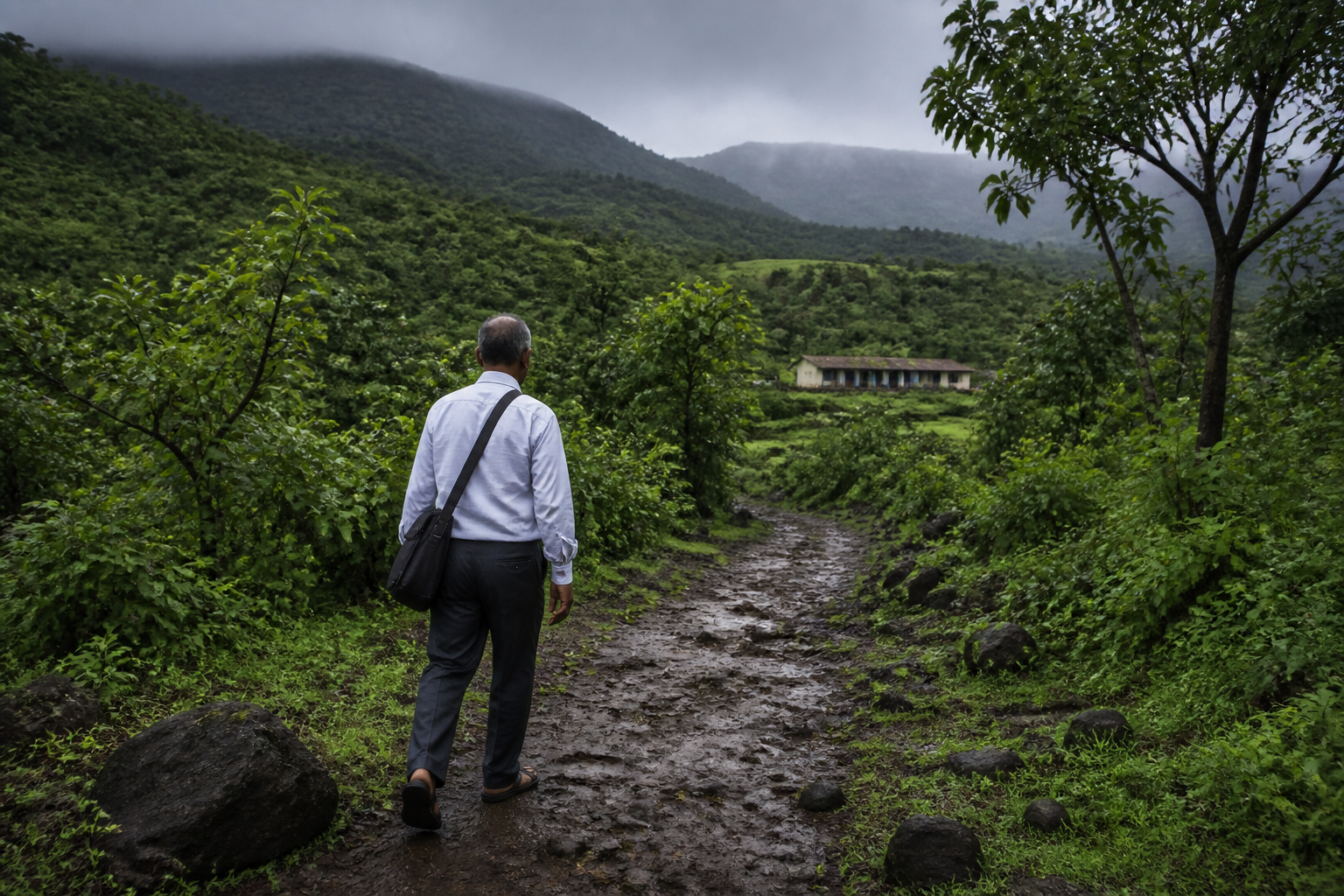
A Kolhapur remote school where a teacher walks five kilometres through forest every day to teach one official student offers a sharp view of how access to public education depends on infrastructure far beyond the classroom. The account of 55-year-old Zilla Parishad teacher Jivan Mithari is not only a story of personal commitment. It also records the consequences of migration, missing electricity, weak road access and the absence of a nearby alternative school for young children.
Mithari has been teaching at the school in Kawaltek Dhangarwada, in Kolhapur district’s Gaganbawada taluka, since 26 July 2013. The settlement is close to the Sindhudurg border and is described in the report as a remote location without electricity or a motorable route. The school is about 2.5 kilometres from the main road, leaving Mithari to cover roughly five kilometres on foot each day for the journey to and from work.
The route passes through dense forest, unpaved stretches and terrain where gaur and leopards are known to move. Mithari said villagers had taught him how to respond when encountering a gaur alone or in a herd. After a leopard killed a calf near the settlement, the Forest Department installed a camera trap, which recorded hundreds of images of the animal. Officials subsequently advised Mithari not to sit or stop anywhere along the route while travelling to or from the school.
These details make the road to the school part of the education system itself. A school may exist on paper, but its practical accessibility depends on whether teachers can reach it safely and whether children can travel to it throughout the year. In Kawaltek Dhangarwada, the answer appears to depend on a single teacher undertaking a hazardous daily walk. The report does not state that the government has classified the route as a formal access road, nor does it identify a funded plan to improve it.
The demographic change around the school is central to understanding why such a difficult arrangement has continued. Mithari said the Kawaltek and Anandur Dhangarwada area once had between 70 and 100 families and that the school previously had a considerably larger number of children. After 2000, residents began moving towards Kolhapur city in search of livelihoods. As families left, the number of children declined and the school’s enrolment contracted.
This is a familiar administrative problem in remote settlements: migration reduces the number of children served by a public facility, while the disappearance of the facility can make it harder for the remaining families to stay. The supplied report does not establish that school closure has been proposed or approved in this case. It does, however, document the practical effect that closure would have. The nearest alternative school, at Dhundawade, would require children aged between six and nine to walk 11 kilometres a day, according to Mithari. The report describes that journey as nearly impossible during the monsoon.
The school officially has one student this year, third-standard student Swara Bodke. Her younger sister also attends with her because the settlement has no anganwadi centre; the report says the younger child is expected to enter Class 1 next year. This means the school is currently serving not only a single enrolled child but also a younger child who does not yet have access to a local early-childhood facility.
The distinction matters because enrolment numbers alone do not capture the full public-service gap. The absence of an anganwadi removes an important local institution for younger children, while the lack of a nearby school increases the distance families would face if the Zilla Parishad school were shut. The source does not provide details about the reasons for the missing anganwadi, its administrative status or whether a proposal exists to establish one. What it does show is that multiple services are absent from the same settlement.
Mithari’s posting was also shaped by an institutional challenge. Before moving to the remote school, he had been president of the Kolhapur district primary teachers’ cooperative bank. He said colleagues had remarked that influential teachers often secured postings in accessible locations while ordinary teachers were sent to difficult areas. Mithari responded by arranging his own transfer to Kawaltek Dhangarwada, treating the criticism as a challenge.
That decision gives the story an unusual human dimension, but it should not obscure the administrative question. A public system cannot depend indefinitely on one employee’s willingness to accept exceptional personal risk. Mithari’s presence has kept the school operating for 13 years, yet the report offers no evidence of a broader staffing, transport or safety arrangement for the next teacher who may be posted there. Mithari is due to retire in May 2029, making continuity a clearly identified future issue, although the source does not record what the authorities plan to do after his retirement.
The case also exposes the limits of treating school access as a question of buildings alone. The report provides no information on the school’s classroom condition, drinking water, sanitation or teaching materials. It does say that the area has no electricity and that Mithari believes a strong compound wall is urgently needed around the school for safety. In a location where wildlife is part of the daily environment, a boundary wall is not simply an aesthetic improvement. It is a physical measure linked to the security of children and staff, though the report does not say whether a construction estimate or sanction has been issued.
For the education administration, the challenge is therefore spread across several responsibilities. The school must be staffed. The access route must be usable and safe. The campus requires protection suited to its location. Younger children need early-childhood provision. And any decision about retaining or consolidating the school must account for the actual distance and terrain between settlements, not just the straight-line location of the nearest alternative.
The available evidence also shows why a numerical threshold can be inadequate when applied without geography. One student is a small enrolment figure, but the nearest replacement school is 11 kilometres away by the daily round trip described in the report. The journey is especially difficult during the monsoon, when forest paths and unpaved routes become more challenging. The source does not state whether the administration uses a special access standard for such terrain, but the case demonstrates that distance has to be understood in relation to weather, wildlife, age and road conditions.
Migration is the longer-term force behind the school’s decline. The movement of families towards Kolhapur city after 2000 reduced the local child population, but the report does not establish whether this was part of a wider district trend or specific to these settlements. It also does not provide current population figures, transport data or a comparison with other remote schools. Those gaps limit what can be concluded about the scale of the problem. They do not diminish the significance of the documented case; they show what further administrative data would be needed to assess it properly.
The school at Kawaltek Dhangarwada therefore represents a difficult policy balance. Maintaining a facility for one official student may appear inefficient when measured only through enrolment. Closing it, however, could transfer the cost to a child through a long and potentially unsafe walk, particularly during the monsoon. The supplied evidence does not establish which option the authorities favour. It does establish that the consequences of either decision are shaped by the settlement’s isolation and by the absence of basic supporting infrastructure.
Mithari describes his daily walk as exercise and says that the number of children does not change his duty. His account explains why the school has remained open, but it also identifies the point at which personal endurance cannot substitute for public planning. With his retirement scheduled for May 2029 and the need for a strong compound wall still raised, the next steps will depend on whether the Zilla Parishad and other relevant authorities treat the school as an isolated low-enrolment facility or as part of a wider access problem involving roads, safety, early-childhood services and rural migration. The report confirms the immediate facts; it leaves the institutional response to be documented.
