


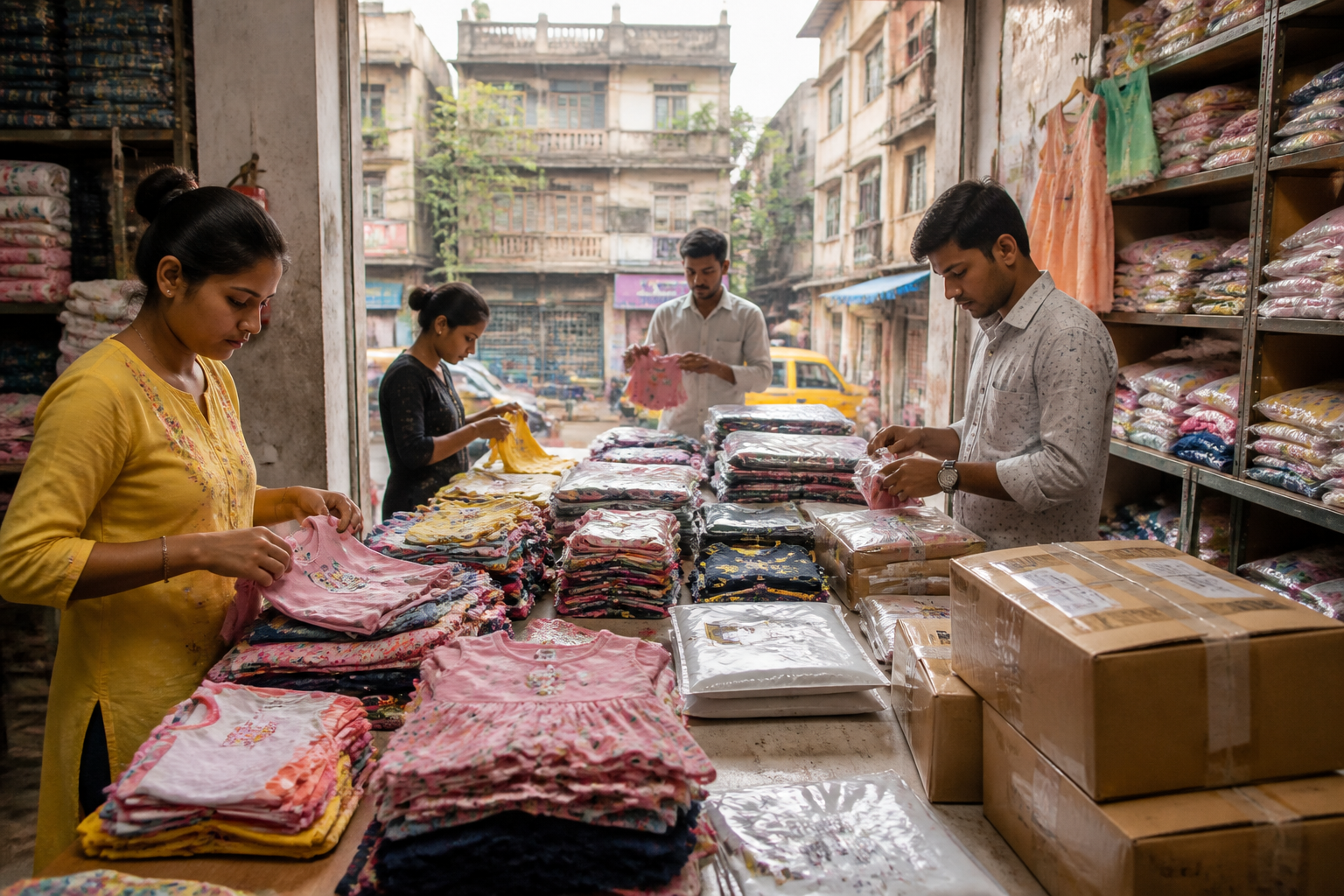
Kolkata kidswear sellers are gaining ground on Flipkart as digital commerce expands the reach of the city’s apparel makers beyond their traditional markets. The platform says Kolkata is now among India’s four largest hubs for kidswear sellers by sales and is the fastest-growing of the group, with seller numbers nearly doubling and sales rising by about 30 per cent year on year.
The development is significant because it links two parts of Kolkata’s commercial identity that are often discussed separately: its manufacturing and trading base, and its role as a gateway for regional products. The evidence in Flipkart’s account does not establish that online commerce has transformed the entire city’s apparel economy. It does show, however, that a large platform is seeing faster seller acquisition and stronger demand from Kolkata than from some competing centres in the kidswear segment.
Kapil Thirani, Flipkart’s vice-president for Marketplace and Shopsy, said Delhi, Tirupur and Surat were growing at a slower rate than Kolkata. The comparison places Kolkata within a national network of apparel production and distribution hubs rather than treating its growth as an isolated local trend.
Flipkart currently has around 5,300 kidswear sellers from West Bengal on its platform, according to the report. About 90 per cent of them are from Kolkata. That concentration matters. It suggests that the growth being recorded at the state level is substantially connected to the city’s seller ecosystem, even though the supplied figures do not specify how many of these businesses manufacture locally, operate as traders, or source products from elsewhere.
The platform also said it was acquiring nearly twice as many sellers from Kolkata as it had acquired previously. The statement points to a supply-side expansion as well as a demand-side one. The story is not only that existing sellers are selling more; it is also that more businesses are entering or becoming active on the platform.
That distinction is important for understanding how digital marketplaces can affect urban business clusters. A traditional commercial hub depends heavily on physical networks: suppliers, wholesalers, transporters, retailers and customers who know where to find particular products. An online marketplace adds another layer to that system. It gives sellers a common route to customers in other cities while shifting some of the work of discovery, ordering and payment into a digital platform.
The supplied evidence does not provide details on the sellers’ margins, delivery costs, returns, inventory risks or the proportion of sales that comes from outside West Bengal. Those missing details limit what can be concluded about the economic benefits of the growth. Higher platform sales do not automatically indicate higher profits or better working conditions. They do establish that Kolkata-based sellers are participating in a wider market with increasing sales visibility.
Demand is also becoming more occasion-led, according to Thirani. During this year’s Indian Premier League season, the platform recorded a 150 per cent increase in the number of children’s jerseys sold. Janmashtami clothing also performed strongly, with Kolkata sellers increasing their sales of such products compared with the previous year.
These examples show how online retail can connect local sellers to short-lived, event-specific demand. A physical retailer may rely on customers who live nearby or visit a particular market. A marketplace can aggregate demand linked to sports seasons, religious occasions and other calendar events across multiple locations. For sellers, that may create opportunities to test products and respond to demand without depending entirely on permanent shop traffic.
At the same time, occasion-led sales can make businesses more dependent on timing. Products must be designed, sourced, listed and delivered within a narrow period. The figures supplied by Flipkart show the scale of demand during particular events, but they do not indicate how much unsold stock sellers carry after those periods or whether seasonal sales translate into stable annual incomes.
Kolkata’s online growth is not limited to children’s clothing. The report says unbranded adult denim from the city is also gaining traction across India. This is another indication that the platform is identifying demand for products that may not carry the recognition of established national brands but can still find buyers when presented through a large digital channel.
The wider regional picture is visible in the report’s account of Santipuri sarees. Flipkart expects total sales of Santipuri heritage sarees through its marketplace to exceed ₹140 crore this year. Last year, those sales stood at around ₹70 crore. The company attributes the expected increase to a tripling of the seller count and strong demand, with Bengaluru and Delhi identified as the leading markets.
Santipur, a historic town in Bengal, has long been associated with handloom sarees, including Tant and Jamdani products. The report describes the craft as being passed down through generations of weavers. Its movement onto a national e-commerce platform changes the geography of access: products associated with a specific production centre are being marketed to buyers in cities that are far from the weaving cluster.
The seller-base figures are notable. The number of Santipur sellers on Flipkart has risen to around 780, compared with more than 250 in January 2026, according to the report. The increase indicates rapid onboarding within a defined craft ecosystem. It also shows that the platform’s institutional approach is not limited to listing finished products. Flipkart said it had adopted an on-ground initiative to provide institutional support to weavers and sellers of Tant, handloom and Jamdani sarees.
The nature and scale of that support are not detailed in the supplied material. It is therefore not possible to determine whether the initiative primarily involves training, onboarding, logistics, cataloguing, finance, marketing or another form of assistance. That distinction would matter in assessing whether digital access is strengthening producer control or mainly expanding the platform’s retail supply.
The Kolkata and Santipur examples point to two related but different models of urban and regional commerce. Kidswear sellers are using the marketplace to grow a commercially active category from a major city. Santipur weavers are using it to connect a geographically specific craft tradition to national demand. In both cases, the platform acts as an intermediary between producers and consumers, but the production systems behind the products remain different.
The figures also reveal how much market expansion can be concentrated among a small number of locations. Around 90 per cent of Flipkart’s West Bengal kidswear sellers are from Kolkata, while the saree sellers are concentrated in Santipur. This concentration may help the platform build specialised support and supply networks. It may also mean that the benefits of online demand are not evenly distributed across the state’s smaller towns and production centres.
For city policymakers, the evidence raises questions about the infrastructure that allows small businesses to participate in national digital markets. The report does not provide data on roads, warehouses, delivery capacity, packaging facilities, broadband access or credit. Yet all of these systems can influence whether a seller can fulfil orders reliably and absorb rising demand. The growth figures identify the market outcome, not the full urban infrastructure behind it.
They also raise questions about the institutional position of marketplaces in local economies. Flipkart is not only reporting sales; it is actively acquiring sellers and providing some form of institutional support to a heritage-weaving cluster. This gives the platform a role in shaping which producers become visible, which products reach national buyers and how traditional goods are presented to consumers.
That role can be economically useful without being sufficient on its own. Seller growth and sales expansion do not answer questions about producer bargaining power, incomes, quality control or the preservation of craft skills. The supplied report does not make claims on those issues, and they remain outside what the available figures can establish.
What the evidence confirms is narrower but still important. Kolkata has become Flipkart’s fastest-growing kidswear hub by the company’s account, with around 5,300 West Bengal sellers on the platform, roughly 90 per cent from Kolkata, nearly doubled seller numbers and 30 per cent year-on-year sales growth. Children’s jerseys and occasion-specific clothing are contributing to demand, while unbranded adult denim is expanding the city’s national market reach.
The Santipur figures show a parallel expansion in heritage textiles, with projected sales of more than ₹140 crore, up from around ₹70 crore last year, alongside a rise in the seller base from over 250 in January 2026 to around 780. The next question is not simply whether digital sales will continue to rise, but how this growth is distributed across sellers and how much of the value reaches the producers behind the products. The available report establishes the scale of the platform’s expansion; its longer-term effect on Kolkata’s commercial and craft ecosystems will require more detailed evidence on incomes, logistics and business sustainability.

