


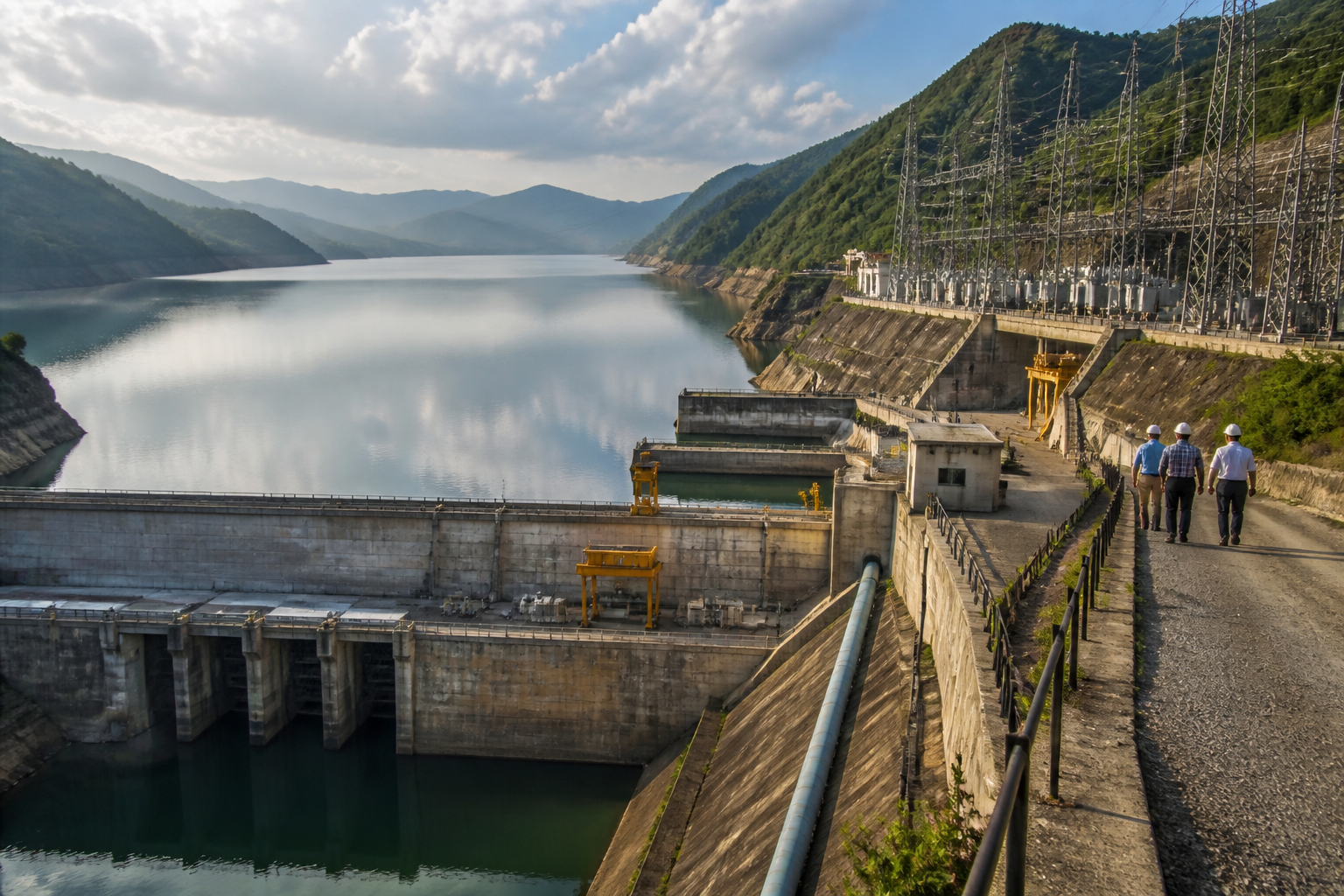
BHEL pumped-storage projects are emerging as one of the state-owned engineering company’s main routes beyond its long dependence on thermal power equipment. The shift follows a Centre assessment that raised questions over BHEL’s financial performance and Maharatna status, while the company faces a power sector that is creating new demand in hydro, storage and non-thermal businesses.
The immediate story is not that BHEL is abandoning thermal power. The company’s thermal business remains its principal revenue anchor, and its executable order book is estimated at around ₹2.60 lakh crore. The significance lies in the attempt to add new growth engines before the current order base stops being sufficient to support the company’s financial and institutional position.
For India’s urban and industrial systems, this matters because electricity infrastructure is increasingly being shaped not only by generation capacity but also by the ability to manage when power is available. The report does not provide a national estimate of pumped-storage demand or detail specific projects that BHEL has secured. It does, however, show a large public-sector engineering company repositioning itself around a segment linked to the changing structure of the power industry.
### From thermal anchor to a broader order book
BHEL has historically relied heavily on thermal power equipment and project execution. According to the Economic Times report, the company expects to commission fewer coal-fired power plants during the current financial year. At the same time, company executives said progress is expected in hydropower, pumped-storage projects and the renovation and modernisation of ageing hydro plants.
That combination creates a transition challenge. Thermal projects continue to provide the scale that supports BHEL’s order book, but the company is seeking additional work in sectors that can sustain growth as the power industry evolves. The stated strategy is therefore one of diversification rather than an immediate replacement of thermal activity.
The size of the existing order book is central to understanding this approach. BHEL has an executable order book of around ₹2.60 lakh crore, with thermal business still acting as the main revenue anchor. The figure indicates that the company is not starting its diversification effort from a position of having no work. Instead, it is attempting to use an established engineering and project-execution base to enter or expand in adjacent infrastructure segments.
The report also identifies an outstanding hydro order book of about ₹5,500 crore. That is considerably smaller than the overall executable order book, but it gives BHEL an existing base from which to pursue hydro-related work. The company says it can use its capabilities in hydro equipment and project execution for pumped-storage projects, equipment supplies, rehabilitation work and associated electrical systems.
### Why pumped storage is becoming strategically important
Pumped-storage projects are relevant to the power system because they combine generation infrastructure with a storage function. The supplied report does not provide technical details of BHEL’s proposed projects, their locations, capacities or commissioning schedules. It does establish that the company sees equipment supply, project participation and associated electrical systems as areas of opportunity.
That distinction is important. BHEL’s opportunity is not limited to manufacturing a single class of equipment. The company is also positioning itself for project execution, rehabilitation and modernisation. In infrastructure markets, the ability to participate across these stages can determine whether an engineering company captures only an equipment order or a larger share of the project’s value.
The same logic applies to ageing hydro assets. Renovation and modernisation work does not necessarily require the creation of an entirely new power station. It involves extending the usefulness of existing infrastructure and upgrading equipment and systems. For a company with established hydro capabilities, such work offers a route into the sector even when new project pipelines are uneven.
However, the report does not establish how much revenue or profit these businesses could generate for BHEL. Nor does it say whether pumped-storage work will compensate for a reduction in coal-fired plant commissioning in the near term. Those questions remain open and would require project-level information, including awarded contracts, execution timelines, margins and payment conditions.
### The Maharatna question adds institutional pressure
BHEL’s diversification push also has an administrative and financial context. The company’s latest initiatives followed a Centre reprimand after it failed to meet the criteria for Maharatna company status, according to the report. A June assessment found that BHEL had not met the criterion requiring average annual profit after tax of more than ₹5,000 crore over the previous three years.
The assessment raised the possibility that BHEL could be downgraded to Navratna status. The report does not state that a downgrade has taken place. That distinction matters: the company is responding to an assessment and the possibility of a change in status, not to a confirmed downgrade described in the supplied material.
The status issue turns a business strategy into an institutional performance question. BHEL’s position as a major state-owned engineering company is connected to its ability to generate sustained profits, execute large projects and remain relevant as government and industry priorities change. Its order book may be substantial, but the Maharatna assessment shows that order volume alone does not settle the question of financial health.
For public-sector infrastructure companies, the quality of an order book is as important as its size. The supplied report does not provide details on margins, cash flows, execution risks or receivables, so it cannot establish whether BHEL’s current book will translate into the profitability required for Maharatna criteria. It does show why the company is looking for businesses that can strengthen its financial performance over time.
### A test of whether diversification becomes executable growth
BHEL’s strategic shift will ultimately be measured not by the announcement of new sectors but by the conversion of those sectors into executable and profitable work. The company has identified coal gasification and coal-to-chemicals opportunities alongside hydro, pumped storage and modernisation. These activities sit at different points in the infrastructure and industrial value chain, which may broaden the company’s options but also requires it to manage multiple forms of project and market exposure.
The report gives more concrete evidence for the hydro opportunity than for coal gasification or coal-to-chemicals. BHEL has an outstanding hydro order book of about ₹5,500 crore and expects progress in hydro power and pumped-storage projects during the financial year. By contrast, the supplied material does not identify specific coal gasification or coal-to-chemicals contracts, customers, capacities or implementation dates.
That unevenness in the evidence is significant. A diversification plan can be strategically sensible while still being commercially unproven. For BHEL, the next stage will depend on whether identified opportunities become awarded projects and whether the company can execute them without weakening its existing thermal order book.
There is also an operational question around capability. The company says it has established hydro-equipment and project-execution capabilities. The report does not provide an independent assessment of those capabilities or compare BHEL’s position with competing suppliers. It therefore supports the conclusion that BHEL sees hydro and storage as areas of opportunity, but not a conclusion that the company has already secured a leading position in those markets.
### What the evidence confirms—and what remains uncertain
The evidence confirms four connected developments. BHEL continues to hold a very large executable order book; thermal business remains its principal revenue anchor; the company expects fewer coal-fired plant commissions during the current financial year; and it is pursuing hydro, pumped-storage, rehabilitation, modernisation, coal gasification and coal-to-chemicals opportunities.
The evidence also connects the strategy to institutional pressure. A Centre assessment found that BHEL did not meet the cited profit criterion for Maharatna status, creating the possibility of a downgrade to Navratna status. The company’s response is to seek additional growth engines rather than depend exclusively on thermal business.
What remains uncertain is the scale and timing of the transition. The supplied report does not provide the value of new pumped-storage awards, expected revenue from non-thermal businesses, project completion dates or the outcome of the Maharatna-status issue. It also does not establish whether BHEL’s new businesses will generate the profitability needed to change the assessment of its financial health.
The larger urban and infrastructure question is whether public engineering companies can adapt quickly enough as power systems require a broader mix of generation, storage, modernisation and associated electrical infrastructure. BHEL’s strategy offers an early view of that adjustment. Its progress will be visible through the conversion of its hydro and storage pipeline into contracts, execution milestones and financial results.
