


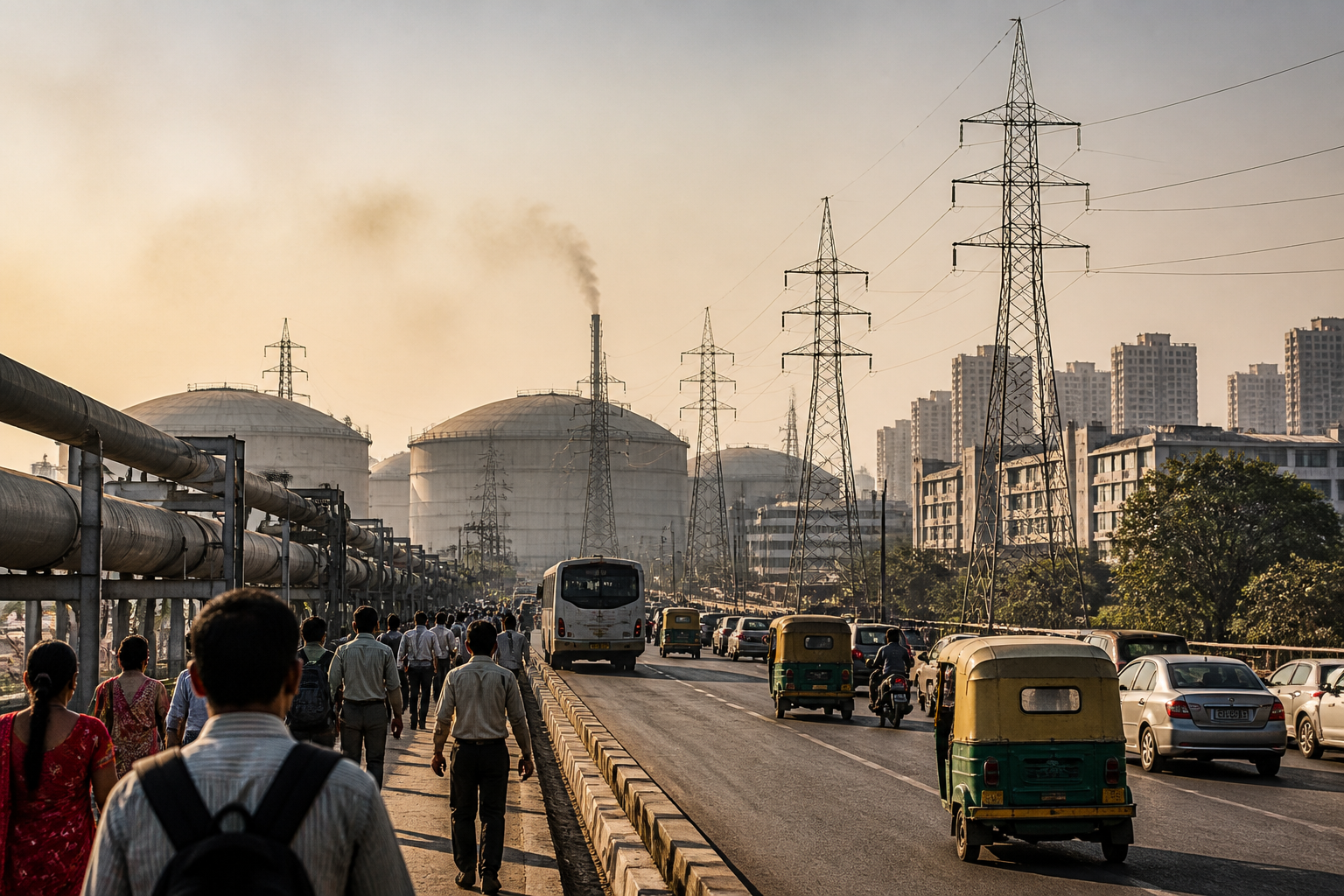
A fictional 2030 gas crisis described in material published by the Economic Times offers a pointed warning about how modern cities and industries can become vulnerable when energy systems depend on a narrow set of fuels, suppliers and infrastructure routes. The scenario is not a forecast of events that have happened. It is a constructed sequence in which slowing US shale production, extreme weather, rising liquefied natural gas exports and the electricity demand of artificial-intelligence data centres combine to create a global supply shock.
Its value lies less in the imagined political drama than in the urban systems it places under pressure. In the scenario, natural-gas prices rise sharply after domestic storage falls to record lows during a cold snap. Heatwaves then push prices higher again, while households, manufacturers, farmers and power generators compete for the same fuel. The result is not only an energy-market crisis. It becomes a crisis of affordability, industrial continuity, food production and political legitimacy.
That chain is familiar to cities because energy insecurity rarely remains confined to the energy sector. Gas can be used directly by households and factories, to generate electricity, or to produce inputs such as fertiliser. When its price rises, the effect travels through power bills, manufacturing costs, transport supply chains and food prices. The scenario’s central proposition is that a country can appear energy-rich while remaining exposed if its production, storage, export infrastructure and demand are not balanced.
The imagined crisis begins with a reversal of confidence in US energy abundance. Following earlier disruptions to European gas supplies and a separate fictional conflict affecting global LNG supply, the scenario assumes that the US fossil-fuel industry is expected to fill the gap. That expectation fails when shale growth slows, extreme weather affects the power system and LNG terminals allow foreign buyers to compete with domestic consumers.
This is an institutional question as much as a production question. LNG export terminals connect domestic gas markets to international prices. That can create revenue and strengthen a country’s position as an energy supplier, but it can also make local consumers part of a wider global competition for cargoes. The scenario imagines this tension becoming politically explosive when Americans accustomed to low-cost gas face rising bills and industries lose their cost advantage.
The scenario also highlights the difficulty of planning for competing forms of demand. AI data centres are portrayed as a rapidly growing source of fossil-fuel demand, particularly when clean-energy capacity and grid infrastructure cannot expand at the same speed. The source does not provide an actual 2030 forecast for data-centre consumption. Instead, it uses the data-centre boom as one element in a stress test: what happens when a new, concentrated electricity demand arrives while existing systems are already vulnerable to weather and fuel-market disruption?
For cities, the question is significant because data centres are not simply digital facilities. They require large and reliable electricity connections, cooling systems, land, water and network infrastructure. If their demand is met by gas-fired generation, their growth can intensify competition for fuel. If their electricity is supplied through constrained grids, they can also affect how utilities prioritise investment and how regulators assess new connections. The fictional scenario therefore links the digital economy to very physical urban questions about power plants, transmission lines, land and water.
Extreme weather is the other major pressure in the narrative. A polar vortex drives up heating demand, while later heatwaves increase electricity consumption for cooling. The imagined sequence shows how the same energy system can be strained from both directions. In winter, households and businesses need more gas for heating. In summer, power systems need more fuel to run air-conditioning and manage peak electricity demand.
That seasonal tension matters because energy security is not only about annual supply. It is also about whether infrastructure can handle short periods of exceptionally high demand. Storage capacity, transmission networks, generation reserves and demand-management systems determine whether a shock is absorbed or passed quickly to consumers. The source’s scenario uses low storage levels and successive weather events to show how limited buffers can turn a difficult season into a systemic crisis.
The social consequences in the imagined account are deliberately concrete. Farmers face sharply higher fertiliser costs. A glass factory closes, eliminating 2,000 jobs. An automobile plant removes a second shift, placing another 2,000 workers on indefinite layoff. In New Orleans, the scenario describes heat-related deaths after residents reduce air-conditioner use because electricity bills consume a large share of their incomes.
These events are presented as part of a fictional October 2030 setting and should not be read as verified occurrences. Their analytical purpose is to show how energy stress becomes unequal. Wealthier consumers may reduce demand through efficiency improvements or absorb higher bills. Lower-income households, older residents and energy-intensive businesses have fewer options. A power shock can therefore expose weaknesses in housing quality, cooling access, industrial resilience and public-health preparedness at the same time.
The source also places export policy at the centre of the crisis. In its imagined sequence, the US President signs legislation declaring an emergency and ordering LNG exports to be curtailed. That decision protects domestic supply in the short term but leaves import-dependent regions more exposed. European, Japanese and South Korean buyers then face a sudden loss of access, while geopolitical tensions limit alternative supplies.
This is the structural dilemma of globally traded gas. International trade can provide flexibility when one supplier fails, but the same interconnection can transmit shortages rapidly. Export restrictions may protect domestic consumers while undermining commercial and diplomatic relationships abroad. Importing countries, meanwhile, may believe that access to a global market is equivalent to security of supply, even though cargoes can be redirected, delayed or made unaffordable.
The scenario’s treatment of Europe and developed Asia contrasts them with poorer Asian countries, including Pakistan and the Philippines. It suggests that countries hit hardest by earlier energy crises accelerated investment in solar power, batteries and domestic energy sources rather than relying entirely on LNG. That contrast is not supported in the supplied material by a comparative dataset, so it should be understood as the source’s argument rather than an independently established ranking of national resilience.
Even so, the distinction points to an important planning principle: resilience depends on options. A system that has several generation sources, storage technologies, interconnections and demand-management tools may be better placed to absorb a disruption than one that relies heavily on a single imported fuel. Diversification does not eliminate risk, but it can reduce the number of ways in which one shock spreads across the economy.
The historical reference in the source is also relevant to governance. It recalls US restrictions on soybean and crude-oil exports during earlier periods of price pressure and notes that the crude-oil ban lasted until 2015. The lesson offered is that policy choices made during one period of scarcity can shape production, trade and expectations for decades. When restrictions are later lifted, a surge in supply or exports can create a new confidence that the underlying risks have disappeared.
That warning applies to infrastructure planning. New LNG terminals, pipelines, storage facilities and gas-fired power plants are long-lived assets. Their economic logic depends on assumptions about future demand, prices, geopolitics and climate conditions. If those assumptions change, cities and utilities may remain tied to infrastructure that is expensive to operate, difficult to retire or poorly suited to new energy requirements.
The fictional crisis also raises questions about who bears responsibility for reliability. Energy companies may point to production and market signals. Utilities may focus on generation and grid capacity. National governments control trade, fuel policy and strategic reserves. Local governments, however, deal with the consequences: heat emergencies, vulnerable households, industrial job losses and pressure on public services. A crisis that begins in international LNG markets can therefore become a municipal governance problem.
The supplied material does not establish that a gas crisis of this kind will occur in 2030. It does establish the components of a plausible stress scenario: volatile weather, concentrated supply, export dependence, industrial exposure, rising electricity demand and political pressure to prioritise domestic consumers. The strength of the scenario is its insistence that these risks should not be assessed separately.
For urban policymakers, the larger question is whether energy systems are being planned around average conditions or around periods of extreme stress. The answer will influence the reliability and affordability of housing, the competitiveness of manufacturing, the viability of data-centre expansion and the ability of cities to protect residents during heatwaves and cold snaps. The imagined events are not evidence that the crisis has happened. They are a reminder that energy security is ultimately a question of infrastructure choices, institutional coordination and the number of alternatives available when the expected supply fails.

