


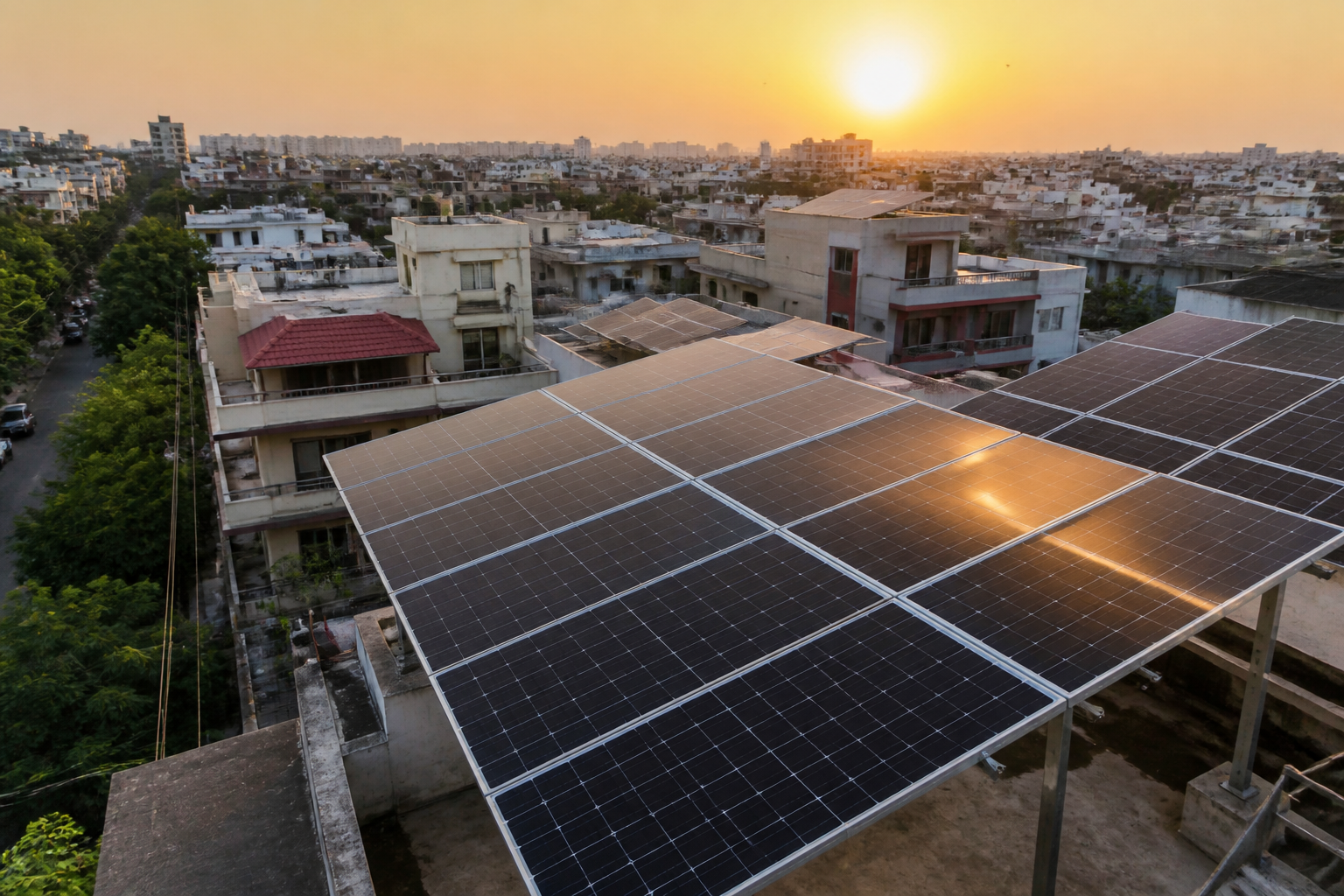
The Indian Solar Manufacturers Association’s projection that India’s rooftop solar market could reach 132 GW by 2030 turns attention from installation growth to the policy architecture needed to sustain it. The estimate, which compares the potential market with current installed capacity of about 17 GW, also highlights how residential solar is becoming a test of household affordability, electricity policy and domestic manufacturing capacity.
ISMA’s report, titled Market Sizing and Growth Outlook, estimates annual rooftop solar demand of between 9 GW and 15 GW until 2030. Its assessment is based on national residential electricity consumption, household housing characteristics and distribution utility tariffs. That methodology places rooftop solar within the everyday economics of urban and semi-urban homes rather than treating it only as a generation-capacity target.
The distinction matters because rooftop solar is installed on privately occupied buildings but depends on a wider public system. Households require suitable roofs, access to finance, reliable installation services and a mechanism for connecting systems to the electricity grid. Distribution utilities must process applications, manage two-way electricity flows and administer the tariff arrangements that influence whether a household sees solar as an affordable investment.
The figures supplied by ISMA indicate that the market remains at an early stage relative to its projected potential. Current rooftop solar capacity is reported at around 17 GW, while the potential market is estimated at 132 GW by 2030. The gap is not simply a question of available roof space. It reflects the interaction of household demand, electricity prices, subsidy support, installation capacity and the ability of the power system to absorb distributed generation.
The report’s reference to an “affordability effect” is particularly important. ISMA says rooftop solar adoption is increasingly expanding beyond states where project economics are naturally strongest. In other words, adoption is no longer determined only by the places where electricity tariffs, sunlight and household purchasing power make the financial case easiest. Policy support is helping bring systems within reach of households in larger residential markets where the economics may otherwise be less attractive.
The government’s PM Surya Ghar Muft Bijli Yojana is central to that shift. Launched in February 2024, the scheme aims to bring rooftop solar to one crore homes by March 2027. According to the information reported from the Ministry of New and Renewable Energy, 47.8 lakh rooftop solar installations have been completed, with total installed capacity of 16.8 GW. These installations are reported to have benefited nearly 56.9 lakh families.
The difference between the number of installations and the number of families cited as beneficiaries suggests that the scheme’s impact is being measured through more than one operational metric. The supplied report does not explain the precise relationship between the two figures, but both indicate a substantial expansion of residential rooftop solar since the programme began. The ministry has disbursed more than Rs 31,515 crore in central financial assistance, while several states are also operating separate subsidy schemes.
This makes rooftop solar a significant public-finance and implementation exercise. Subsidies can reduce the upfront cost for households, but the market also depends on the administrative process through which consumers apply, installers are selected, systems are commissioned and financial assistance is released. The larger the programme becomes, the more important these delivery arrangements are to consumer confidence and market continuity.
For cities, the programme is also a distributed-infrastructure intervention. Unlike a large solar park, rooftop systems are spread across homes and connected to local electricity networks. Their benefits can include lower dependence on grid electricity for participating households, but their deployment requires coordination between consumers, vendors, distribution companies, state agencies and the central ministry. The available material does not establish how individual utilities are managing these operational requirements, but ISMA’s demand projection makes the institutional question harder to avoid.
The manufacturing implications are equally substantial. ISMA says growth in rooftop solar will create demand for domestically manufactured solar cells, modules, inverters and balance-of-system components. This connects residential installation targets with India’s broader effort to build domestic supply chains for renewable-energy equipment. A larger rooftop market could provide a stable source of demand for manufacturers, but the scale of that opportunity will depend on whether policy support remains predictable and households continue to adopt systems.
The association’s concern is not about demand in the immediate term. Its general secretary, Amit Manohar, said the PM Surya Ghar scheme had helped expand residential rooftop solar, particularly in markets where project economics remain challenging. His request is for early clarity on the programme’s next phase, including consideration of PM Surya Ghar 2.0, preferably by December 2026, ahead of the current programme’s March 2027 deadline.
That request reveals the central policy issue behind the 132 GW projection. Rooftop solar markets require households and companies to make decisions with long payback periods, while manufacturers need visibility before investing in capacity and supply chains. If a subsidy programme has a fixed end date and its successor remains undefined, consumers may delay adoption and manufacturers may be cautious about expanding production. ISMA’s report therefore treats policy continuity as a condition for market growth, not as a secondary administrative detail.
The policy landscape currently combines a central scheme, state-level subsidies and electricity-distribution arrangements. The central government provides financial assistance through PM Surya Ghar, states may offer additional support, and distribution utilities remain essential to grid connection and tariff implementation. These layers can widen access, but they also create the possibility of different consumer experiences across states. The supplied report does not provide a state-by-state comparison, so it cannot establish where implementation is fastest or where bottlenecks are most severe.
The numbers also show why the March 2027 deadline is important. The scheme aims to reach one crore homes, while the reported installation count stands at 47.8 lakh. The programme has therefore made substantial progress but has not yet reached its stated household target. The remaining period will determine whether the pace of installation can be maintained and whether the market can continue growing after the existing programme ends.
The 9 GW to 15 GW annual demand outlook adds another layer to the challenge. Meeting the lower end of that range would require sustained annual additions; meeting the upper end would place greater demands on installers, equipment suppliers, financing channels and distribution utilities. ISMA’s projection does not by itself establish that these capacities will be achieved. It identifies a potential market based on electricity consumption, housing characteristics and tariffs, while actual deployment will depend on policy and implementation.
For households, rooftop solar is ultimately experienced through cost, reliability and the quality of service delivered by the installation ecosystem. A national capacity figure does not show how long a household waits for approval, whether a system performs as expected or how quickly subsidy support reaches the consumer. The supplied material provides national installation, capacity and assistance figures, but not the ground-level performance data needed to assess those experiences.
That evidence gap is important as the market expands. Capacity additions can demonstrate scale, but the durability of residential adoption will depend on whether consumers continue to find the systems affordable and dependable. ISMA’s affordability finding suggests that subsidies are changing the geography of demand. It also implies that withdrawing or redesigning support could affect markets where rooftop solar has not yet become economically compelling without public assistance.
The larger urban question is how India will integrate millions of small energy assets into its housing and electricity systems. Rooftop solar links building design, household finance, utility operations and industrial policy. It is therefore not only a renewable-energy programme; it is also a test of whether public institutions can coordinate a decentralised infrastructure transition at residential scale.
The evidence confirms that rooftop solar has expanded rapidly under PM Surya Ghar and that the industry sees substantial additional potential by 2030. It also shows that policy support has helped extend adoption beyond the strongest natural markets. What remains unresolved is how the next phase will be structured, how distribution utilities will manage rising volumes and whether domestic manufacturers will receive enough certainty to invest. ISMA is seeking clarity on a possible PM Surya Ghar 2.0 by December 2026, making that policy decision the next major milestone for the market.
