


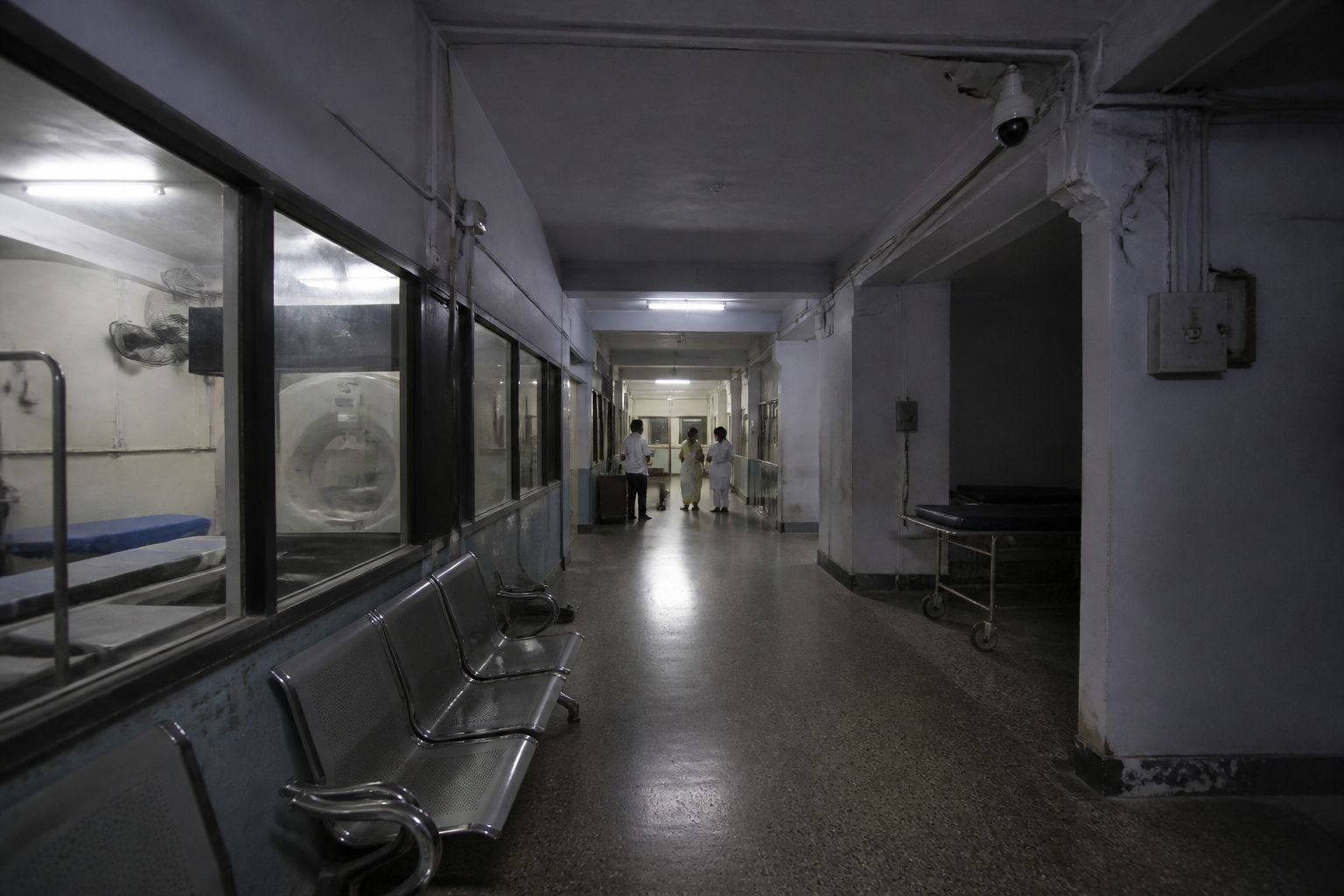
The SSKM Hospital missing patient case has moved from a family search to a police investigation, after a septuagenarian patient from New Barrackpur remained untraced for six days. The reported sequence raises a central institutional question: how does a patient receiving treatment leave a major public hospital after an examination without being promptly located, handed back to attendants or stopped from exiting the premises?
According to the report by Anandabazar, the missing man, identified as Sajol Das, was admitted to the medicine department of the Mackenzie Ward at SSKM Hospital. He had been taken for an MRI around midnight on September 7 by a young member of his family. The family alleged that Das did not return to the ward after the examination.
The available account contains two distinct versions of what happened after the MRI. The family alleged that Das suddenly assaulted the young relative accompanying him and ran out of the hospital. The hospital said its duty nurse contacted the MRI centre after the patient failed to return to the ward and was informed that he had completed the examination and left. The hospital also said calls to the family’s numbers went unanswered.
The sequence matters because responsibility for a patient’s movement was distributed across several points: the ward, the MRI centre, the accompanying relative and the hospital’s wider premises. The report does not establish precisely when the hospital staff first became aware that Das was missing, when he crossed the hospital exit, or whether a staff member accompanied him after the scan. Those details are now part of the investigation rather than established facts.
The hospital reportedly informed Bhabanipur police after Das failed to return to the ward. His son later submitted a written complaint, following which police registered a case and began an investigation. CCTV footage reviewed by police showed Das leaving the hospital. Investigators also found footage of him in the Kidderpore area, where he was reportedly seen for the last time. His whereabouts after that point remain unknown.
This makes the CCTV record the clearest documented trail described in the report. It establishes movement from the hospital to another part of the city, but it does not by itself explain the patient’s condition, whether he was oriented, whether he travelled alone, or what happened after Kidderpore. Police are also examining whether anyone may have confined him, although the report does not state that investigators have established such a possibility.
The six-day gap is significant not because it proves institutional failure, but because it shows how quickly a missing-person case can become dependent on fragmented records. The patient’s ward attendance, the MRI centre’s examination record, calls made by staff, CCTV coverage and footage from locations outside the hospital may each hold part of the timeline. The report does not say whether these records have been joined into a single minute-by-minute account.
The case also highlights the difference between a patient being accompanied to a diagnostic test and the hospital retaining operational visibility over that patient’s return. Das was reportedly taken for the MRI by his family members rather than hospital staff. Yet he was an admitted patient in a hospital ward, and his failure to return was detected by the ward. The available information therefore leaves open the question of how hospitals define responsibility when an inpatient moves between a ward and a diagnostic facility with an attendant.
That question cannot be answered solely through the family’s allegation or the hospital’s account. The family’s version describes a sudden departure after an altercation. The hospital’s version focuses on the patient leaving after the scan and on unsuccessful calls to relatives. Neither version, as reported, explains whether staff directly witnessed the departure, whether the patient appeared distressed or disoriented, or whether an immediate search was conducted across the hospital campus.
The case further shows why the first response to a missing patient is as important as the later police investigation. Once a patient is not found in the ward, the relevant locations include the diagnostic centre, corridors, lifts, entrances, exits and nearby roads. In this case, police CCTV review reportedly traced Das leaving SSKM Hospital and later placed him in Kidderpore. The report does not establish how much time passed between those sightings or whether footage from all intervening routes was available.
There is also an unresolved communication issue. The hospital said it called the family but received no answer, while the family subsequently approached police through a written complaint. The report does not provide call timings, the number of attempts, the person contacted or the point at which the family learned that Das had not returned. Without those details, it is not possible to determine whether the delay arose from a missed communication, a breakdown in ward-level escalation or circumstances outside the hospital’s control.
The institutional chain is nevertheless clear. The medicine ward was responsible for knowing that the patient had not returned. The MRI centre was the last hospital unit identified in the account as having seen him after the examination. The hospital administration notified Bhabanipur police. The family supplied the complaint and information about the patient. Police then used CCTV footage and began investigating both the route he took and the possibility that someone may have detained him.
What remains absent from the available account is equally important. There is no confirmed medical assessment of Das’s mental or physical condition at the time of his disappearance. There is no reported explanation of whether he had previously shown confusion, aggression or a tendency to leave care. There is no information about a formal hospital protocol being activated, nor about whether the hospital has reviewed its internal procedures after the incident. These gaps should not be filled with assumptions.
The incident should therefore be read as a live patient-safety investigation rather than proof of a single cause. It is possible to establish from the reported facts that an admitted patient left the hospital after an MRI, that the ward and family did not immediately bring him back, that CCTV later traced his movement to Kidderpore and that he remained missing six days later. It is not yet possible to establish whether the hospital breached a formal duty, whether the family’s conduct contributed to the disappearance, or whether another person became involved.
For public hospitals, the unresolved issue is how information moves when a patient leaves the expected care pathway. The report shows several hand-offs but no confirmed common timeline: admission in the medicine ward, transfer for MRI, departure from the hospital, appearance in Kidderpore and subsequent disappearance. Until investigators and the hospital reconstruct those stages, the case cannot support a definitive conclusion about accountability.
The next developments to monitor are the police investigation, the examination of additional CCTV footage and any confirmation of Das’s whereabouts. The hospital’s account of its notification to police and the family’s written complaint are already part of the reported record. The central unanswered question is whether the remaining evidence can explain the interval between the MRI, the hospital exit and the last sighting in Kidderpore.
