


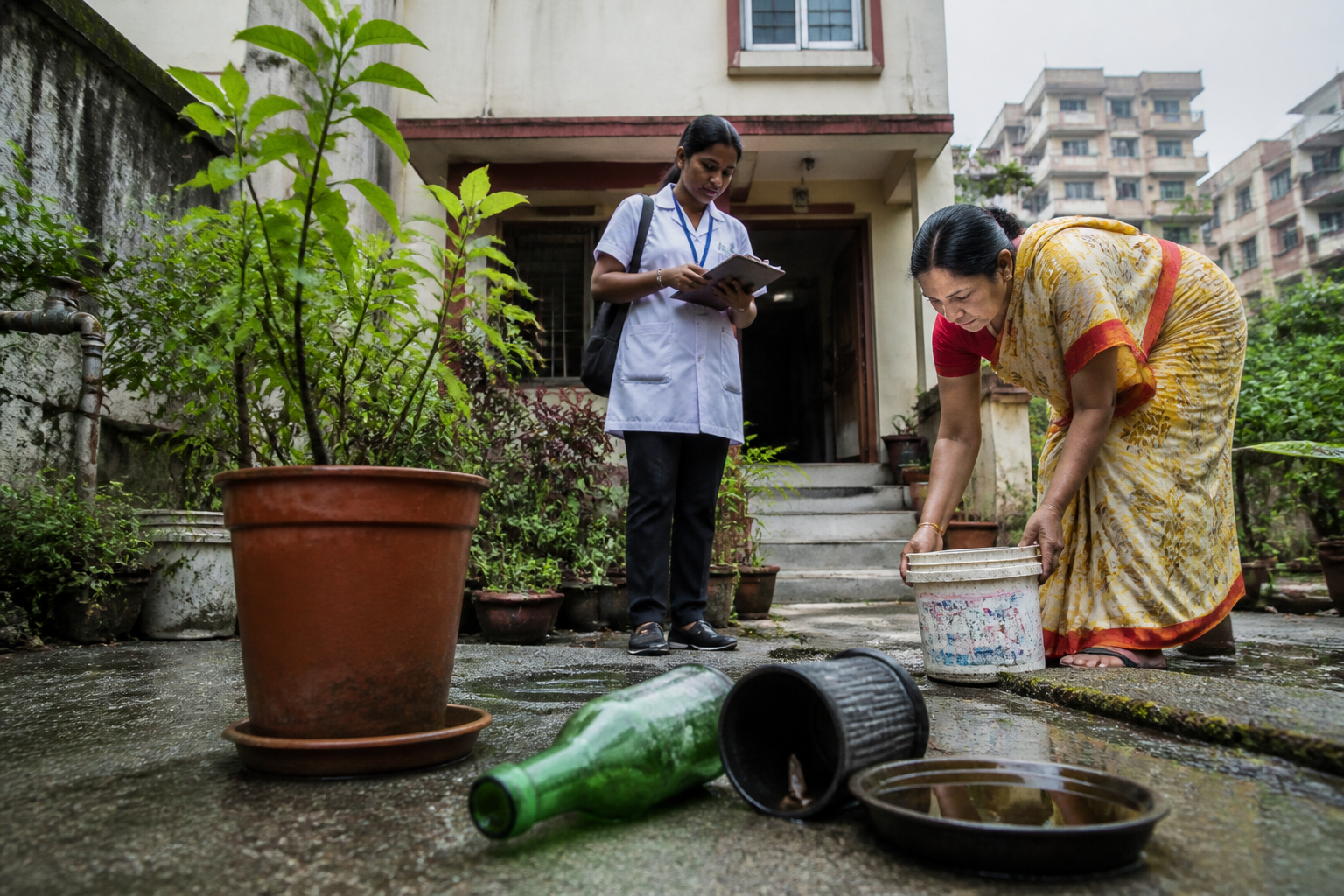
Dengue prevention must begin inside and around homes, ICMR director-general Rajiv Bahl said during a visit to Kolkata, warning that dengue-transmitting mosquitoes can breed in ordinary objects holding small amounts of water, including flower pots and discarded bottles.
Bahl, who is also secretary of the Department of Health Research, said the mosquito responsible for dengue can breed inside or close to houses. Even a flower pot containing mosquito eggs can become a breeding site when water is added, while a bottle with a small amount of water left outside a home can also allow mosquitoes to multiply.
His remarks came as Bengal recorded 6,026 dengue cases up to September 9. A state health department official said the figure was lower than the number recorded during the corresponding period last year. August and September are considered critical months for dengue transmission, according to experts cited in the report.
Bahl also urged residents to protect themselves from mosquito bites throughout the day. “It is a day-biting mosquito, so all through the day you have to be careful. Use mosquito repellents and ointments,” he said.
The warning places household practices alongside municipal and state-level vector-control work. Bahl said sustained measures, including spraying and preventing mosquito larvae from breeding, were essential to controlling dengue. The remarks point to a control challenge that differs from malaria management, because the mosquitoes that transmit the two diseases have different breeding patterns.
“Malaria-causing mosquitoes breed outside the house, and it is easier for the authorities to control them,” Bahl said. Dengue-transmitting mosquitoes, by contrast, can remain close to homes, making the removal of stagnant water from domestic and adjoining spaces an important part of prevention.
Bahl was in Kolkata to deliver a lecture, where he also provided an update on an ICMR dengue vaccine trial. The phase-III trial is being conducted across 20 centres and has enrolled 10,335 volunteers. Recruitment was completed in December last year, after taking about six months longer than expected because of difficulties in finding volunteers willing to be vaccinated.
The trial is now in its two-year follow-up phase, with almost one year completed, Bahl said. It is double-blind, meaning that neither participants nor researchers know which intervention each participant received until the trial is completed. Sources cited in the report said the vaccine is unlikely to be available before the next monsoon season.
For the current dengue season, the immediate measures identified by the ICMR chief are the removal of water-holding containers, prevention of mosquito larvae, spraying and protection from daytime bites. Further monitoring will focus on Bengal’s case numbers through the remaining critical months of August and September and on the completion of the vaccine trial’s follow-up period.
