


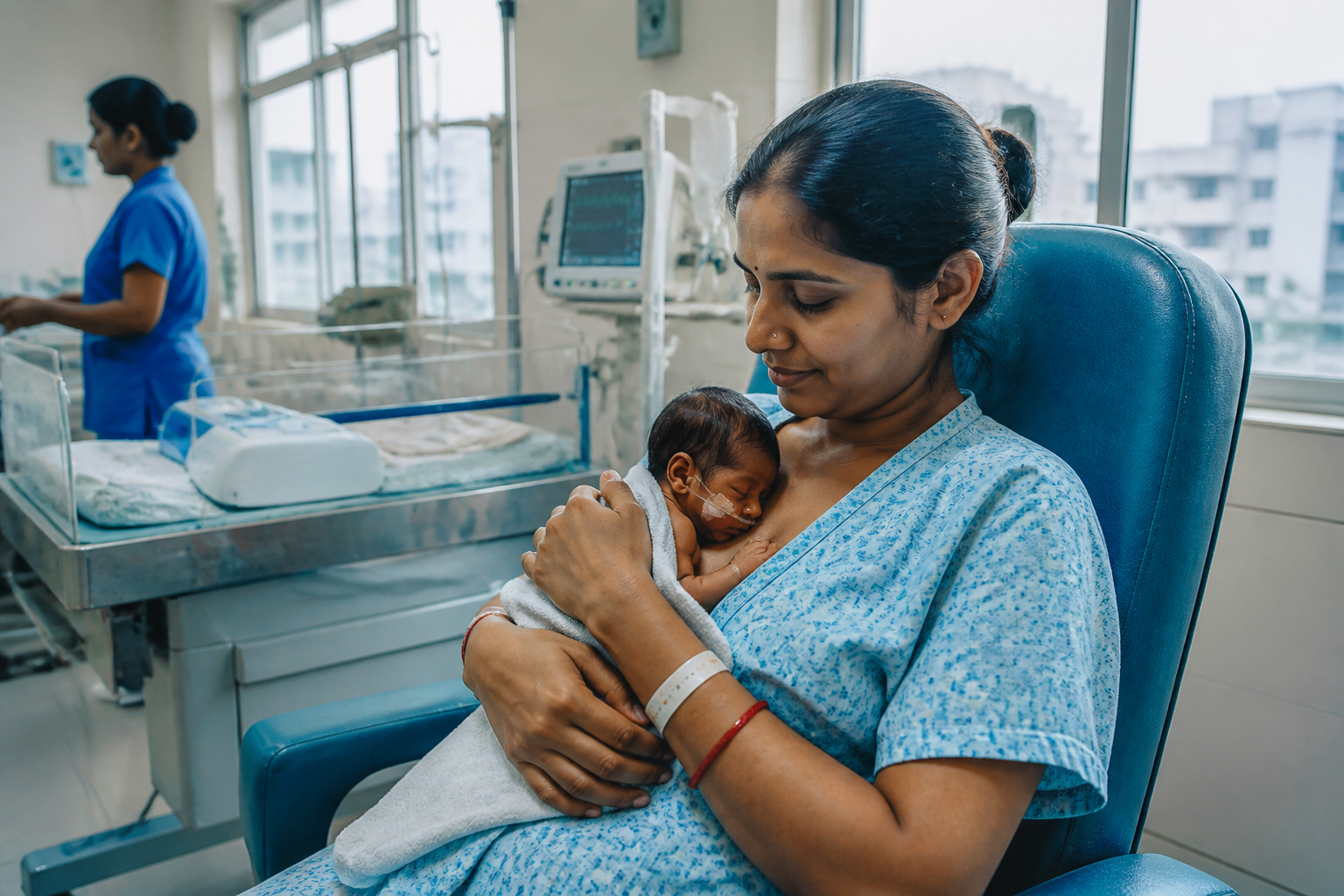
Mother-newborn intensive care units, which keep sick newborns with their mothers during treatment, have changed the care of low-birth-weight babies by ending separation during intensive care, Indian Council of Medical Research director-general Rajiv Bahl said at an event in Kolkata.
Bahl was speaking at the fourth Dilip Mahalanabis Oration, titled “Kangaroo Mother Care: Transforming Care for Small & Sick Newborns”, organised by Liver Foundation, West Bengal. He had led the trial that assessed the effectiveness of mother-newborn intensive care units and had earlier worked with the World Health Organisation.
The units allow mothers to remain with their babies while the newborns receive intensive support, including warmth, intravenous fluids, oxygen and continuous positive airway pressure, or CPAP. The baby remains on the mother’s chest while receiving the required support. If the mother becomes exhausted, a surrogate caregiver can take over.
Bahl said the approach reduced mortality from about 13 per cent to 9 per cent among a very high-risk group in developing countries, including in tertiary-care hospitals. He said mothers were comfortable being with their babies and that the model had led to the concept of “zero separation” from birth until discharge.
During the trial, babies received continuous kangaroo mother care from their mothers or surrogate caregivers, including grandmothers and aunts, until the mothers recovered from childbirth. This differed from the approach in nurseries, where babies received shorter kangaroo-care sessions after they became stable.
The design and operating arrangements of the units were also changed during the trial to allow mothers to stay with their babies. Nurses’ toilets were moved outside the unit, while toilets for mothers and a dining area were provided within it. The changes enabled mothers to remain near their babies throughout the treatment period.
Mother-newborn intensive care units were incorporated into World Health Organisation and national guidelines in India in 2025, according to Bahl’s remarks. The model builds on the Sick Newborn Care Units developed for low-resource settings.
Abhijit Chowdhury, chief mentor at Liver Foundation, said paediatrician Dilip Mahalanabis had innovated the Sick Newborn Care Unit model and demonstrated that newborn-care facilities could be established in smaller settings with limited equipment. Mahalanabis had started an SNCU in Purulia.
Chowdhury described the mother-newborn intensive care unit as an advanced version of the SNCU, evolving from the experience of keeping newborn care possible in peripheral and resource-constrained settings. The current model adds intensive treatment while allowing the child to remain with the mother during recovery.
