


Manipal Hospitals is pursuing a two-track expansion: adding hospitals and beds across several regions while building a digital layer intended to connect clinical, diagnostic and administrative operations. Its plans, disclosed in the company’s FY26 annual report, show how private hospital networks are becoming significant urban infrastructure providers, with growth now dependent not only on land and buildings but also on the systems that manage care inside them.
The group is evaluating strategic opportunities in Telangana, Keralam, Andhra Pradesh and Chhattisgarh, while continuing to assess inorganic growth opportunities across Karnataka, Maharashtra and Goa, including the Mumbai-Pune economic corridor, and in Eastern India. The proposed expansion is not limited to one regional market. It reflects a network strategy in which acquisitions, brownfield additions and greenfield projects are used together to increase reach and consolidate specialist healthcare capacity.
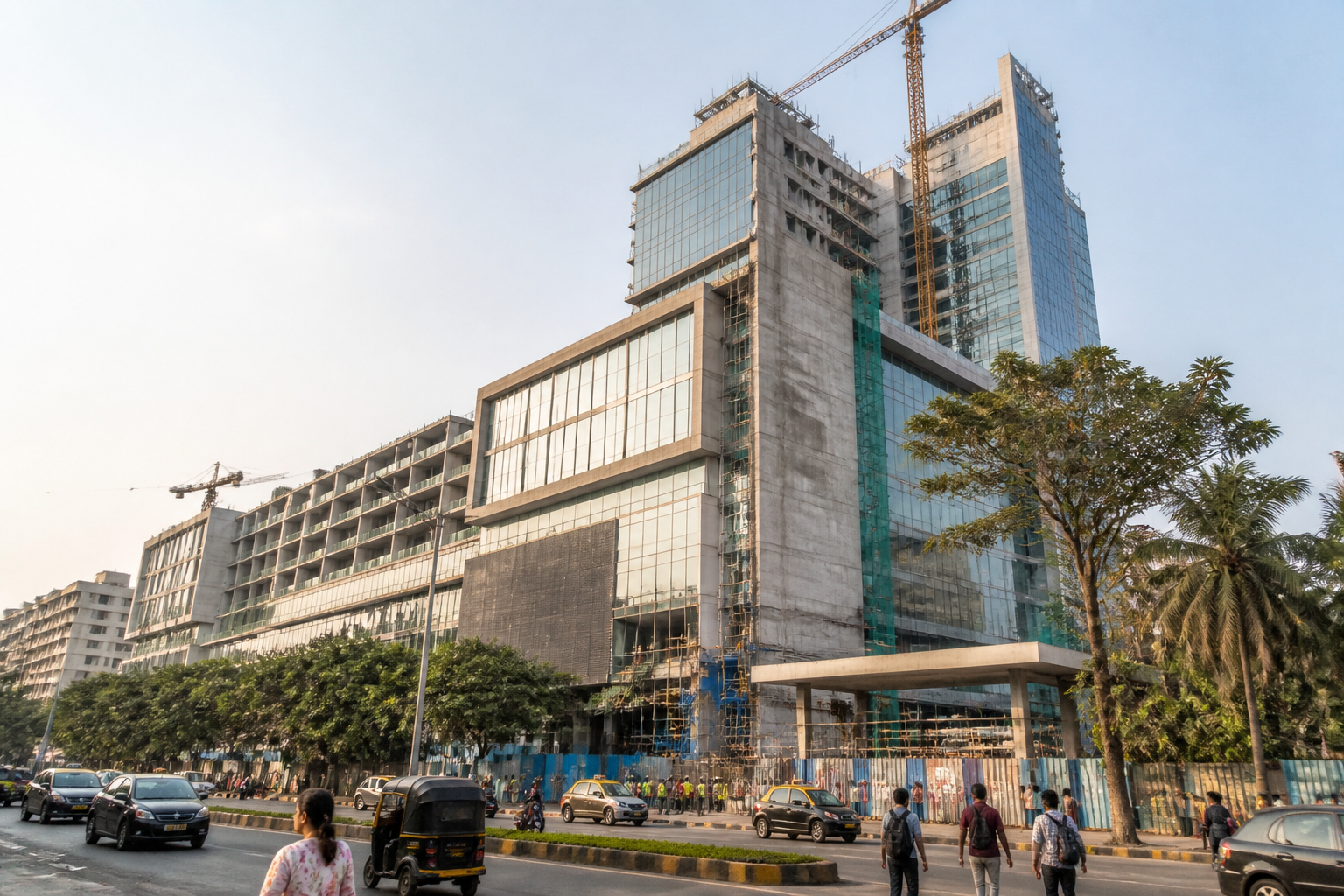
The most visible physical component is the greenfield project in Juhu, Mumbai. Manipal Health Enterprises recently completed the acquisition of the remaining land and building for the project for a total consideration of Rs 495 crore. Of this amount, Rs 130 crore is payable subject to the fulfilment of certain conditions. The transaction illustrates one of the central constraints in urban healthcare expansion: hospitals require large, strategically located sites, and the cost of securing those sites can be a substantial part of the infrastructure commitment before clinical capacity is added.
For cities, the location of new hospital capacity matters as much as the headline number of beds. A facility in an established urban area can connect to existing transport networks, residential catchments and specialist workforces, but it must also operate within a high-cost land market and a built-up neighbourhood. The annual report does not provide the Juhu project’s planned bed count, construction schedule or commissioning date. Those details will be important in determining how quickly the project can translate the land acquisition into additional healthcare capacity.
Across its network, Manipal Hospitals aims to add approximately 2,426 licensed beds by 2030. The planned additions comprise 483 brownfield beds and 1,943 greenfield beds. The split is significant: nearly four-fifths of the proposed additions are greenfield beds, indicating that the company expects a large share of future capacity to come from new facilities rather than only from expanding existing hospitals.
As of March 31, 2026, the network comprised 49 hospitals and 13,037 licensed beds across 14 states and Union Territories. It served more than 76 lakh patients during the year and added over 5,500 beds between 2020-21 and 2025-26, according to the annual report. The company described itself as the leading consolidator among private hospital chains in India by bed additions. The stated 2030 target therefore extends a capacity-building programme that has already substantially increased the network’s scale.
The expansion has also relied on acquisitions. The group reported the successful integration of Sahyadri Hospitals in Maharashtra and Medica Synergie in Eastern India during FY26. Such transactions can add beds more quickly than building entirely new hospitals, but they also require the integration of facilities, clinical teams, operating processes and information systems. The fact that Manipal Hospitals is pairing acquisition-led growth with a unified Hospital Information System points to the administrative challenge of operating a geographically distributed network.
The company is scaling a unified HIS to link clinical, diagnostic and administrative workflows across its hospitals. It is also investing in AI-enabled nursing handovers, wireless patient monitoring platforms and call centre automation through chat, voice and omnichannel assistants. AI-enabled nursing handovers have already been launched at 24 hospitals, according to the annual report.
These initiatives position technology as an operating layer for physical healthcare infrastructure. A hospital’s capacity is not defined only by the number of licensed beds. It also depends on how efficiently patients move through registration, triage, diagnostics, admission, treatment, monitoring and discharge. A common information system can give a multi-city operator a standardised method of managing those workflows. The supplied disclosures, however, do not establish the system’s effect on waiting times, clinical outcomes, staffing requirements or patient costs.
The technology strategy also highlights a distinction between automation and access. AI-driven assistants may help manage appointment requests and triage inquiries at scale, particularly for a network serving more than 76 lakh patients a year. But the annual report does not state how many interactions are handled through automated systems, how the systems perform across languages or what arrangements exist for patients who cannot use digital channels. Those questions remain relevant as private hospitals expand their digital front doors alongside their physical facilities.
Manipal Hospitals’ clinical strategy is centred on six complex specialties grouped under “CONGO-R”: cardiac sciences, oncology, neurosciences, gastro sciences, orthopedics and renal sciences. These specialties accounted for 64.3 per cent of gross inpatient revenue in FY26. The concentration indicates that the group’s capacity strategy is not evenly distributed across all forms of care. It is being shaped around high-complexity specialties that require specialised staff, equipment and supporting infrastructure.
The company is investing in robotic surgical systems, linear accelerators and PET-CT scanners to support this focus. These assets require substantial capital investment and depend on trained personnel, maintenance systems and patient volumes. Their deployment can strengthen a hospital’s role as a referral centre, drawing patients beyond the immediate neighbourhood. At the same time, the annual report does not provide a city-level breakdown of where these assets are being added or how capacity is distributed between metropolitan and non-metropolitan markets.
The financial results provide the basis for this expansion. Revenue from operations grew by 25.4 per cent to Rs 10,336 crore in FY26, while EBITDA stood at Rs 2,644 crore. The reported performance gives the group a larger operating base from which to fund acquisitions, new facilities and technology systems. It also shows why hospital networks are pursuing scale: physical expansion, specialist concentration and digital integration are being developed as parts of one operating model rather than as separate initiatives.
That model has an important institutional dimension. Hospital capacity is delivered by private operators, but it forms part of the wider urban healthcare system alongside public hospitals, medical colleges, diagnostic providers, emergency services and transport infrastructure. A new private facility can increase local treatment options and specialist capacity, yet its wider public value depends on factors that are not established in the supplied material, including pricing, insurance coverage, public-health referrals and access for lower-income patients.
The geographic spread of the proposed expansion also raises a question about how healthcare demand is being mapped. Manipal Hospitals is assessing markets in southern, western, central and eastern India, while its existing network spans 14 states and Union Territories. The company’s disclosures identify the locations under consideration but do not state which projects have received final approval, how many beds are attached to each opportunity or whether the expansion will be acquisition-led or greenfield in every market.
That distinction matters for implementation. Acquisitions can provide operational assets and established patient networks, while greenfield projects require land assembly, planning approvals, construction, equipment installation, staffing and commissioning. The Juhu transaction has crossed the land and building acquisition stage, but the timeline for opening and the final capacity remain unspecified. Similarly, the 2,426-bed target is a long-term objective rather than a list of immediately operational facilities.
The evidence therefore confirms a clear direction but not yet the full delivery path. Manipal Hospitals has expanded substantially since 2020-21, operates 49 hospitals with 13,037 licensed beds, and plans to add 2,426 more by 2030. It is combining acquisitions and new construction with a unified information system and AI-enabled operational tools. What remains uncertain is how quickly the planned beds will be commissioned, how the Juhu project will develop, and how the proposed technology will change patient and staff experience.
For urban India, the larger issue is the growing role of organised hospital networks in shaping healthcare capacity. Their decisions influence where specialised facilities are built, how patients move through care systems and how medical infrastructure is distributed between cities and regions. The next milestones to monitor are the confirmation of individual acquisition targets, project approvals and timelines, the commissioning of new greenfield and brownfield beds, and fuller disclosure of the operational results from the group’s digital and AI investments.
