


Manipal Hospitals’ expansion plans point to a broader shift in India’s private healthcare infrastructure: hospital groups are no longer competing only through individual facilities, but through regional networks that combine beds, specialised clinical services, digital systems and acquisitions. The company is evaluating opportunities in Telangana, Keralam, Andhra Pradesh and Chhattisgarh, while continuing to assess inorganic growth across Karnataka, Maharashtra, Goa and eastern India, according to its FY26 annual report as reported by Business Standard.
The scale of the plan is significant because it combines three forms of expansion. The first is geographic, through acquisitions and new projects in markets where the company sees room to deepen its presence. The second is physical, through the addition of licensed beds and specialised medical infrastructure. The third is digital, through a unified Hospital Information System, artificial-intelligence-enabled nursing processes and automated patient-access channels.
Together, these strands show how private hospital infrastructure is evolving from a collection of standalone buildings into an integrated operating network. For cities, that raises questions not only about how many beds are added, but also about where they are located, which specialities they support, how patients move through the system and whether technology can improve the use of expensive clinical capacity.
Manipal Hospitals ended FY26 with 49 hospitals and 13,037 licensed beds across 14 states and Union Territories. The network served more than 76 lakh patients during the year. It added over 5,500 beds between 2020-21 and 2025-26, and now plans to add approximately 2,426 more licensed beds by 2030. Of these, 483 are expected to come through brownfield expansion and 1,943 through greenfield projects.
That split matters for the urban geography of healthcare. Brownfield additions generally expand an existing hospital’s capacity, potentially allowing the operator to use established clinical teams, diagnostic systems and referral networks. Greenfield facilities, by contrast, create a new physical presence and can extend a hospital group into emerging or underserved urban markets. The company’s stated pipeline therefore combines denser expansion around existing platforms with the creation of new hospitals in identified markets.
The company has identified Telangana, Keralam, Andhra Pradesh and Chhattisgarh as markets where it is actively evaluating strategic opportunities. It is also assessing inorganic growth across Karnataka, Maharashtra and Goa, including the Mumbai-Pune economic corridor, and in West Bengal, Odisha, Jharkhand and Sikkim. The annual report does not establish that acquisitions have been completed in all these locations. It describes them as areas under evaluation, making the distinction between an announced pipeline and operational capacity important.
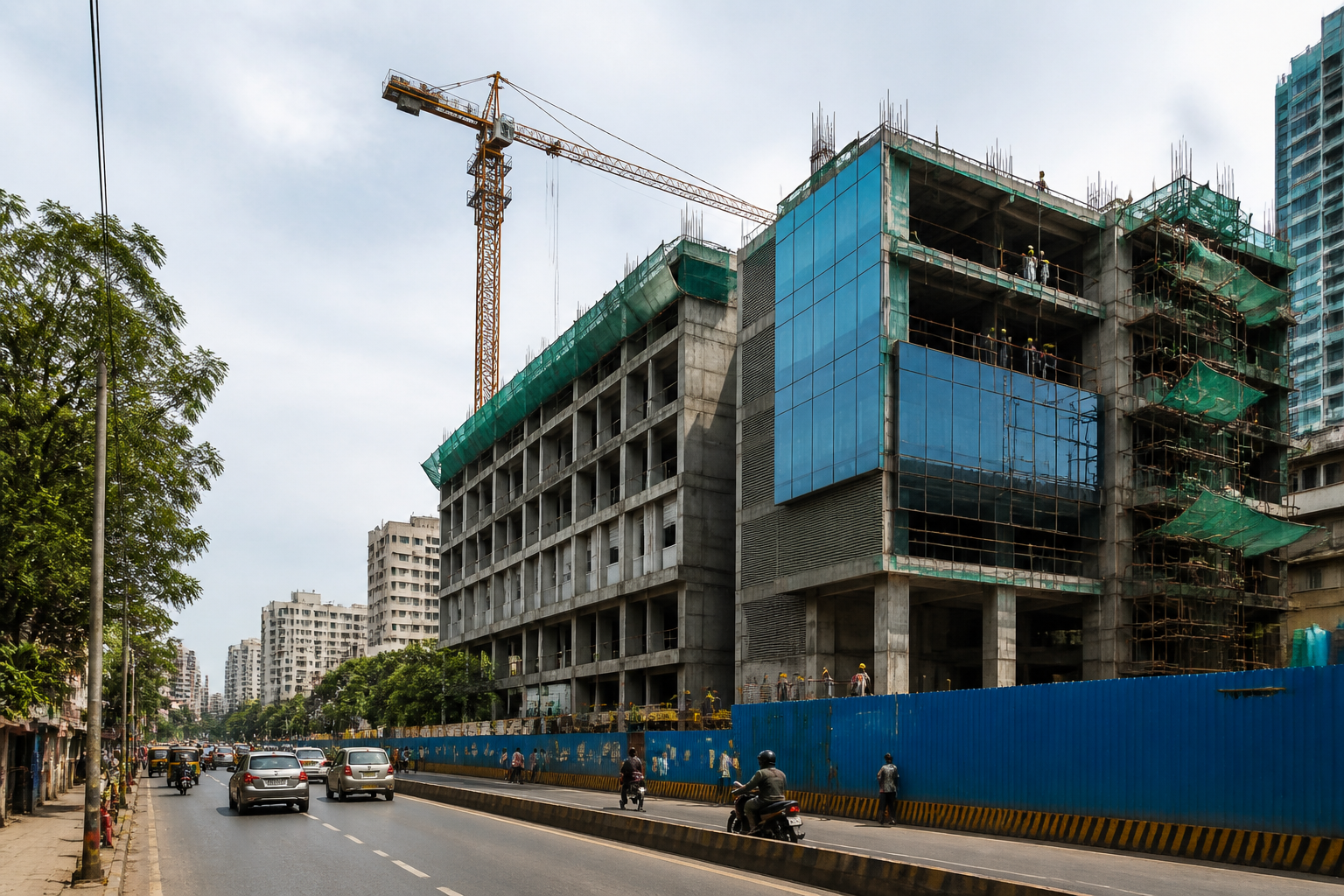
The clearest physical investment currently identified in the supplied material is the greenfield project in Juhu, Mumbai. Manipal Hospitals recently completed the acquisition of the remaining land and building for the project for a total consideration of Rs 495 crore. Of that amount, Rs 130 crore is payable subject to the fulfilment of certain conditions. The transaction gives the group control of the physical assets needed for a major hospital project in one of Mumbai’s established urban districts.
Juhu also illustrates why hospital expansion cannot be understood only through bed counts. A large healthcare facility requires land, road access, utility connections, emergency access, parking or drop-off systems, staff movement and links with surrounding residential and commercial areas. The supplied material does not provide the project’s final bed capacity, construction timeline or detailed mobility plan, so its eventual impact on the local urban system remains to be established.
The company’s expansion strategy is also tied to a concentration of high-value clinical services. Its clinical framework, described as “CONGO-R”, covers cardiac sciences, oncology, neurosciences, gastro sciences, orthopedics and renal sciences. These six specialities accounted for 64.3 per cent of gross inpatient revenue in FY26. The group is investing in robotic surgical systems, linear accelerators and PET-CT scanners to support these areas.
This concentration suggests that the capacity being built is not limited to general hospital beds. It is also intended to support complex procedures, advanced diagnostics and specialised treatment pathways. Such facilities typically depend on a wide catchment area because the demand for highly specialised care is distributed across districts and states. The company’s network model allows it to position hospitals as part of a larger referral system rather than as isolated local providers, although the annual report does not disclose patient flows or referral volumes between facilities.
The financial results provide the commercial basis for this infrastructure push. Revenue from operations rose 25.4 per cent to Rs 10,336 crore in FY26, while EBITDA stood at Rs 2,644 crore. The year also included the integration of Sahyadri Hospitals in Maharashtra and Medica Synergie in eastern India. These integrations show that acquisition-led growth involves more than buying physical assets. It requires bringing hospitals, clinical teams, administrative processes and technology platforms into a common operating structure.
That integration challenge is central to the company’s “physical plus digital” model. Manipal Hospitals is scaling a unified Hospital Information System intended to link clinical, diagnostic and administrative workflows across its network. The company has also launched AI-enabled nursing handovers at 24 hospitals and is implementing wireless patient-monitoring platforms. In patient-facing operations, it is developing AI-driven chat, voice and omnichannel assistants for triage inquiries and appointments.
The significance of these systems lies in coordination. A hospital network with facilities across multiple states generates large volumes of clinical and administrative information. A unified system can, in principle, connect patient records, diagnostics, appointments and internal workflows across locations. However, the supplied material confirms the deployment and stated purpose of these systems, not their measured impact on waiting times, clinical outcomes, staffing requirements or patient costs. Those indicators will be necessary to assess whether the digital layer improves capacity utilisation rather than simply adding another technology platform.
The stated strategy also reveals how private hospital groups are responding to the economics of urban healthcare. High-end clinical infrastructure such as robotic surgery systems, linear accelerators and PET-CT scanners requires substantial investment and a sufficiently large patient base. A multi-city network can spread brand, technology and management capabilities across more facilities, while acquisitions can provide faster entry into established markets than building every hospital from the ground up.
At the same time, the network is becoming geographically more complex. The company’s current presence spans 14 states and Union Territories, while its evaluation areas cover southern, western, central and eastern India. This makes standardisation a major administrative task. The annual report’s emphasis on people, clinical expertise, technology platforms and an integrated network indicates that management sees coordination as a central part of the next phase, not merely an operational detail.
The numbers show the direction of travel. The group added more than 5,500 beds over five years and plans 2,426 additional licensed beds by 2030. The planned additions equal roughly 18.6 per cent of its March 31, 2026 licensed-bed base. Greenfield projects account for about four-fifths of the planned additions, while brownfield projects account for the remainder. These figures indicate that the next phase is weighted towards creating new facilities rather than relying only on expansion within existing hospitals.
Yet bed capacity alone does not describe healthcare access. The location of beds, the specialities attached to them, the affordability of treatment, the availability of staff and the strength of referral systems determine how useful new capacity becomes. The supplied material provides detailed information on the company’s geographic priorities and clinical focus, but it does not provide a state-wise breakdown of planned beds, tariff levels, occupancy, insurance coverage or public-private access arrangements.
That gap is important for urban planning. Private hospitals are often concentrated in major cities and established economic corridors, where land values, specialist labour and paying demand support advanced facilities. The company’s focus on Mumbai-Pune, Bengaluru-linked markets, eastern India and selected states suggests an expansion pattern shaped by existing economic and clinical networks. Whether the strategy also improves access in smaller cities or mainly strengthens already-served markets cannot be determined from the annual report details supplied.
The wider urban question is therefore not simply whether Manipal Hospitals will become larger. It is whether hospital consolidation can create a more connected and resilient healthcare system while physical capacity expands. The company’s plans combine acquisitions, greenfield construction, specialist equipment and digital integration, but the public value of that model will ultimately depend on how these investments translate into accessible services, reliable patient pathways and sufficient clinical capacity across the markets where new facilities are built.
For now, the evidence confirms a substantial expansion programme backed by strong FY26 financial performance, a 13,037-bed network and a planned addition of approximately 2,426 licensed beds by 2030. The immediate milestones to watch are the development of the Juhu project, the outcome of the company’s acquisition evaluations, the integration of recently acquired hospitals and the wider deployment of its unified information and AI-enabled systems. The company’s next phase will be measured not only by the number of hospitals it adds, but by how effectively those facilities operate as one network.
