


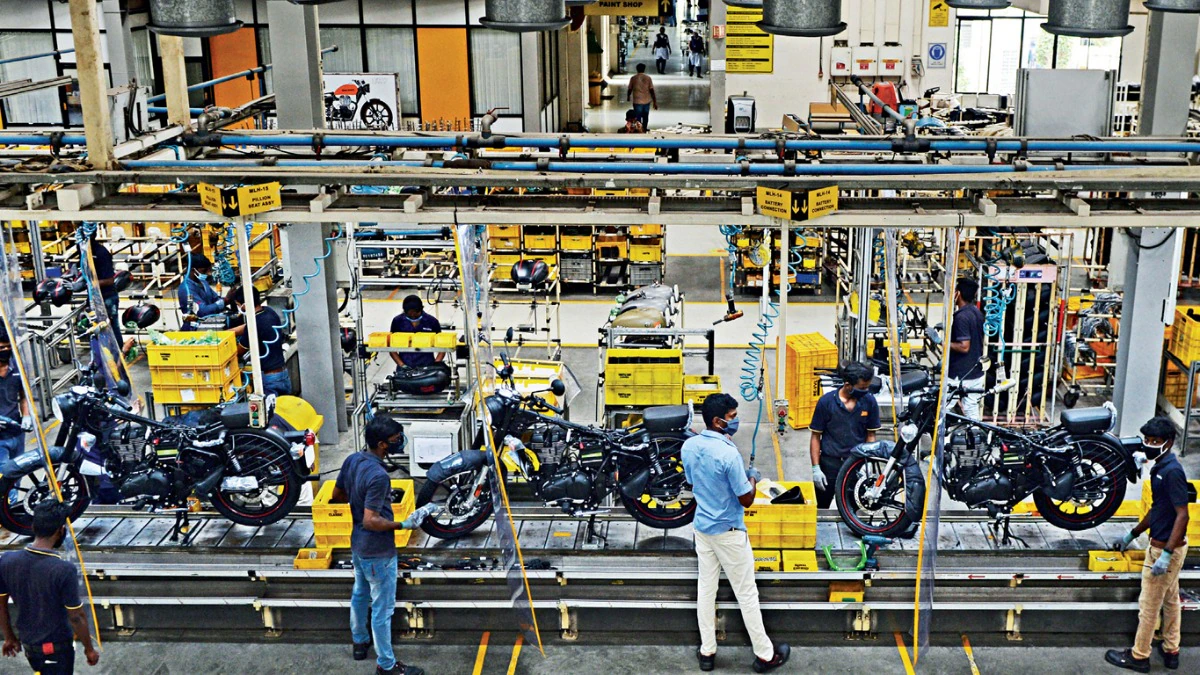
Tamil Nadu is entering the next phase of its industrial growth with a problem that is more demanding than attracting factories: it must ensure that new investment builds capabilities the state does not already possess. As the state government drafts a new industrial policy, industry representatives and policy experts are calling for a shift from assembly-led expansion towards design, research, engineering, intellectual property and higher-value manufacturing.
The timing is significant. Companies are exploring India for global capability centres, while global original equipment manufacturers are diversifying supply chains under China-plus-one strategies. Bengaluru, Hyderabad and Chennai are competing for these opportunities, even as emerging sectors such as semiconductors, electric vehicles, aerospace and advanced manufacturing attract fresh investment. Tamil Nadu’s challenge is therefore not simply to preserve its industrial base, but to deepen it before competing locations close the gap.
The Industrial Policy 2021 was designed for a different competitive environment. According to the report, it targeted Rs 10 lakh crore of investment and 20 lakh jobs by 2025. Manufacturing grew at an annual rate of 9-10% over five years, while the state strengthened its position in electronics, garments and footwear. The issue now is whether the next policy can convert that scale into greater local value.
Electronics illustrates both the progress and the limitation of the existing model. Tamil Nadu’s electronics exports rose from $5.37 billion in financial year 2022-23 to $14.65 billion in 2024-25. The state accounted for more than 41% of India’s electronics exports, and Kancheepuram became the country’s second-largest exporting district. These figures indicate that Tamil Nadu has become a major production location. They do not, by themselves, establish that the state controls the design, components, intellectual property or research behind those products.
That distinction is at the centre of the policy debate. P Ravichandran, chairman of the CII Southern Region, told the publication that the next phase should focus less on adding assembly lines and more on building design laboratories, precision toolrooms, engineering centres and intellectual property. For electronics, the potential areas identified include printed circuit boards, displays, connectors, semiconductor design, assembly, testing and marking, industrial electronics and research and development.
This is a shift from measuring industrial success through investment announcements to measuring what the investment enables local firms, workers and institutions to do. A factory can create jobs and exports while leaving high-value functions elsewhere. A broader industrial ecosystem would retain more of the engineering, supplier development, product development and commercial value within the state.
The same logic applies to the automotive sector. Tamil Nadu’s existing auto-component base could support battery cells, battery-management systems, power electronics, motors and vehicle research and development. The opportunity is not to abandon conventional manufacturing, but to use established supplier networks and production knowledge as a platform for electric mobility and other advanced segments.
The footwear industry offers a different example of how sector-building can work. Anchor investors including Hong Fu, Pou Chen, Feng Tay and Evervan Kothari have brought approximately Rs 6,550 crore of investment and more than 86,000 jobs across five districts, many of them held by women. The model described by Kearney senior partner Nithin Chandra involves identifying a sector affected by China-plus-one strategies, attracting two or three anchor investors and allowing the vendor ecosystem to develop around them.
The next challenge for that sector is to move beyond production into design, branding and higher-value materials. That progression is important because manufacturing competitiveness is not static. Locations that begin with labour-intensive assembly can lose advantage if they do not build skills, suppliers and intellectual property that support more complex work.
Global capability centres are the most immediate opportunity identified in the report. Chennai’s GCC headcount has roughly doubled since 2019. The city could differentiate itself through centres linked to engineering and manufacturing rather than treating GCCs only as corporate back-office operations. The model could also extend to Coimbatore, Madurai and Tiruchirappalli, giving the state a chance to distribute higher-value employment beyond its main metropolitan centre.
That possibility raises an institutional question. GCCs, advanced manufacturing and research operations depend on more than industrial land and fiscal incentives. They require engineering talent, reliable infrastructure, higher education links, specialised suppliers and administrative coordination. Ramkumar Ramamoorthy, partner at Catalincs and former chairman and managing director of Cognizant India, argued for an overarching body that could coordinate industry, information technology, micro, small and medium enterprises, higher education and skilling departments.
The concern about departmental silos is central to the policy’s implementation. A company seeking to establish a research or advanced manufacturing operation may need approvals and support from multiple departments. If these institutions work separately, the state can offer incentives without creating the connected ecosystem that high-value sectors require. The report does not establish whether the proposed policy will create such a coordinating body, but it identifies coordination as a major gap to be addressed.
Skills policy is another test. Prof Vidya Mahambare of the Great Lakes Institute of Management warned that industrial subsidies must be aligned with local skills. Otherwise, public money may subsidise jobs filled by migrant workers without sufficiently addressing youth unemployment within Tamil Nadu. Her point does not imply that migrant workers are a problem; it highlights the need to connect industrial investment with the capabilities available in the communities where projects are located.
This also complicates the use of sector-specific subsidies. Mahambare argued that such incentives can fail to create significant new employment and that broad-based infrastructure may deliver greater value. The policy choice is therefore not simply which sectors deserve incentives, but what combination of transport, power, education, industrial services and skills will allow several sectors to grow.
The debate over incentives provides another indication of how Tamil Nadu’s policy framework may change. Chandra cited Gujarat’s choose-your-incentive mechanism, under which investors select from options such as capital subsidies, interest subsidies or power-tariff relief. A similar approach could give companies greater flexibility, although the report does not provide an assessment of the comparative fiscal cost or outcomes of these models.
Incentives will also need clearer performance objectives. CII’s Ravichandran said the state should ensure that every rupee of public support creates more local value, technology, intellectual property and global market access. That suggests a shift away from investment totals as the primary success measure. The relevant questions would include whether local suppliers have upgraded, whether research functions have been retained, whether workers have gained new skills and whether companies have moved into more complex products.
Tamil Nadu’s emerging opportunities extend beyond electronics and electric vehicles. The state’s defence industrial corridor has attracted more than Rs 23,000 crore against a target of Rs 75,000 crore by 2032. Aerospace, advanced capital goods, heavy engineering, shipbuilding and the blue economy are also identified as areas with potential. Each depends on long development cycles, specialised skills and close relationships between government, industry and research institutions.
The state’s industries minister, S Keerthana, said the government was not moving away from manufacturing and would support sectors that generate employment at scale while creating a differentiated framework for newer, higher-value sectors. A Viswanathan, president of the Madras Chamber of Commerce and Industry, similarly argued that new-age sectors should complement existing industries rather than displace them. Traditional industries can supply emerging sectors and consume their outputs, creating links across the economy.
That complementarity is likely to determine whether the next policy becomes a list of priority sectors or a framework for industrial upgrading. Semiconductors, artificial intelligence, aerospace, space, advanced manufacturing, GCCs and research and development may attract attention, but they will depend on the depth of older industrial networks, the quality of urban infrastructure and the ability of institutions to coordinate investment.
The evidence presented in the report confirms that Tamil Nadu already has substantial advantages: a large industrial base, export experience, supplier networks and a growing presence in electronics and global capability centres. It also confirms that these advantages are no longer sufficient on their own. The state’s next policy must clarify how incentives, skills, infrastructure, higher education and industrial coordination will convert investment into capabilities. Its progress will ultimately be judged not only by how much capital arrives, but by what Tamil Nadu becomes able to design, engineer, manufacture and export after that capital is deployed.
