


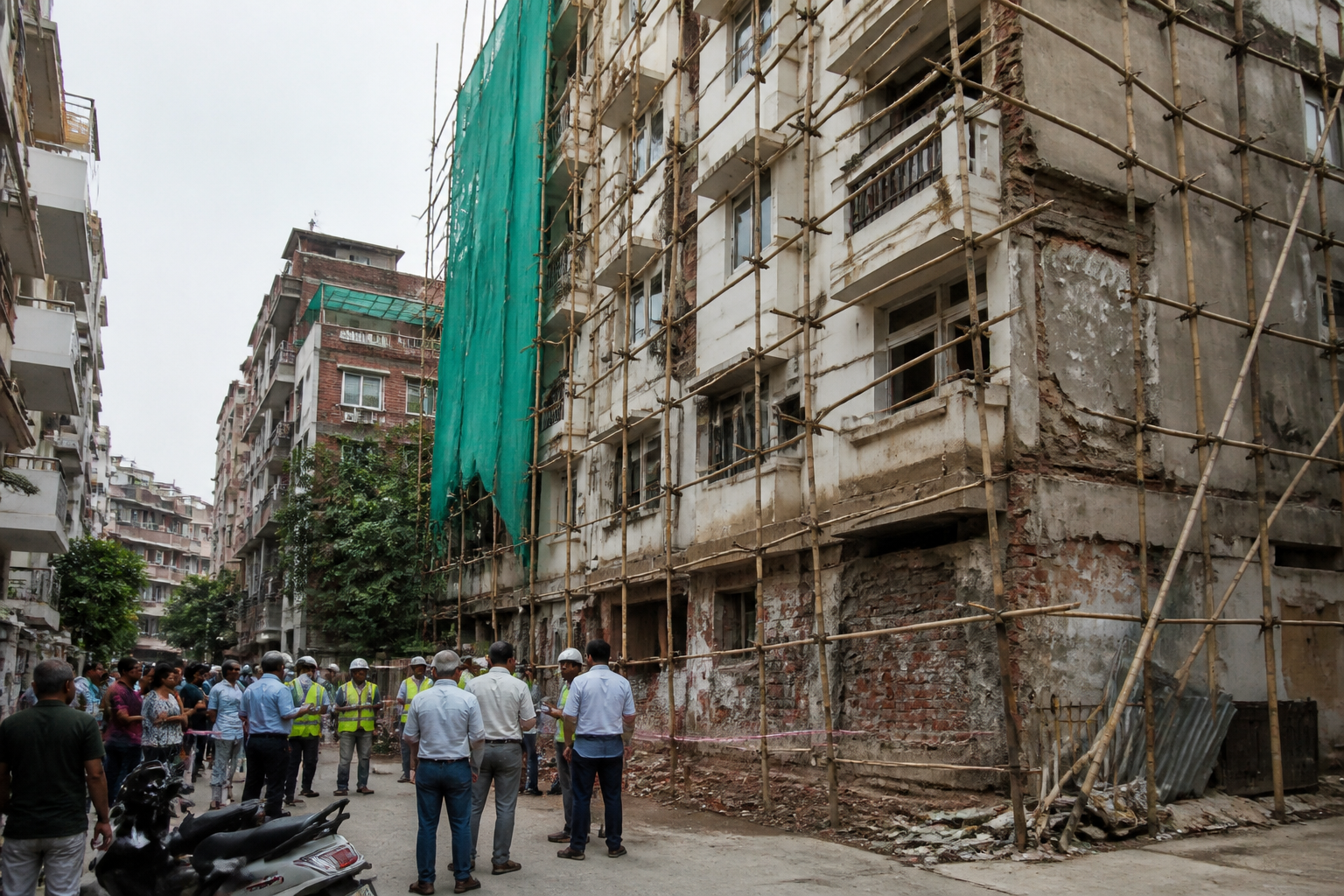
The Delhi High Court’s remarks on the Satya Niketan building collapse have moved the incident beyond the frame of an isolated construction mishap. The court linked the deaths of seven people, including four students, to what it described as “callous and criminal conduct” and questioned why Delhi has continued to depend on inadequate and weakly regulated accommodation for students arriving from across the country.
The building, a multi-storey boys’ paying-guest accommodation near Delhi University’s South Campus, collapsed on September 6 while repair work was underway. Several people were injured. The court is now considering the incident alongside a wider question: whether the city’s housing and regulatory systems have kept pace with the number of students who come to Delhi for higher education.
That question matters because the collapse did not occur in an unoccupied or peripheral structure. It took place in a form of accommodation that has become part of the city’s education economy. Students who cannot secure institutional hostel rooms depend on paying-guest facilities and private rental arrangements near campuses. The court observed that the shortage of hostels was not a new phenomenon, noting that students had been coming to Delhi from small towns for the last 20 to 25 years in the hope of building careers.
The court’s observation identifies a structural gap between Delhi’s role as an education destination and the housing infrastructure available to support that role. The immediate issue is the safety of one building, but the underlying system includes hostel capacity, private paying-guest accommodation, building permissions, repair practices, inspections and the responsibilities of municipal and government authorities.
The case arose from a public interest litigation filed by Aakarshak Danveer Rathi. The petition seeks an independent probe, inspection of paying-guest facilities, and a compensation and rehabilitation scheme for the victims and their families. These demands place both the individual collapse and the wider network of student accommodation before the court.
The Delhi High Court had already ordered a high-level inquiry by the Municipal Corporation of Delhi on September 7. It also said the government could not evade responsibility and expressed concern over inadequate housing facilities, including hostels operated by Delhi University or the government, as well as the safety and security of students. The court further criticised the measures used by the MCD and other authorities to regulate paying-guest facilities as inadequate.
This sequence is important. The September 7 order addressed the immediate administrative response after the collapse. The later hearing widened the focus to the conditions that make such accommodation necessary in the first place. The court’s comments suggest that an inquiry confined to the structural condition of the collapsed building may not fully answer the public-interest questions raised by the incident.
The institutional responsibilities are divided. The MCD is the authority identified in the report as responsible for a high-level inquiry and for regulating paying-guest facilities. Government agencies are responsible for broader housing and student-support measures. Delhi University and government-run hostels form part of the formal accommodation system, while private paying-guest buildings operate in the space created by limited hostel availability.
This division can make accountability difficult. A student may experience the accommodation as a single housing arrangement, but its safety can depend on several separate systems: the condition of the building, the legality and quality of repair work, the use of the premises, fire and emergency safeguards, municipal inspections and the availability of safer alternatives. The court’s remarks bring those connected responsibilities into the same frame without treating the collapse as merely a private dispute between occupants and a building owner.
The response outlined by Additional Solicitor General Chetan Sharma included proactive mapping and earmarking of land and other facilities for students. The statement indicates that authorities are considering measures beyond the collapsed property itself. However, the report does not establish the scale, location, funding or implementation schedule of those facilities. It also does not state how existing paying-guest properties will be inspected or what enforcement action will follow from the inquiry.
That absence of detail is significant because the city’s housing shortage cannot be addressed only through post-incident inspections. The court has pointed to a problem that has persisted for two to three decades, while the government response mentioned in the hearing concerns future mapping and earmarking. The material supplied in the report does not show whether the proposed steps will add hostel capacity, improve regulation of private accommodation, or do both.
The case therefore raises two separate but connected policy questions. The first is immediate: how should authorities establish what happened at Satya Niketan, identify responsibility for the collapse and provide compensation and rehabilitation to affected families? The second is systemic: how should Delhi provide safe, affordable and accountable accommodation to students when institutional hostel capacity is insufficient?
The facts in the report establish the scale of the immediate human cost: seven people died, including four students, and several others were injured. They also establish the institutional concern: the High Court has described the incident as more than an ordinary mishap and has connected it to student housing, safety and regulation. The report does not provide the total number of student hostels in Delhi, the number of paying-guest properties, inspection records, occupancy figures or the extent of the citywide shortage. Those gaps remain relevant to any broader assessment of the problem.
Without such information, the safety of student accommodation remains difficult for residents and families to evaluate. A paying-guest facility may be close to a campus and financially accessible, but the report shows that proximity and availability do not by themselves establish that a building is safe or adequately regulated. The court’s call for inspections reflects the need to understand conditions across this accommodation category rather than only at the site of one collapse.
The hearing also illustrates how urban housing failures can become safety failures. When formal accommodation is inadequate, demand moves into private buildings and informal or semi-formal arrangements. Regulation then has to operate across properties that may differ in ownership, use, construction history and maintenance. The supplied material does not establish which of these factors caused the Satya Niketan collapse, and the court’s inquiry is intended to address responsibility rather than assume it.
The next procedural step is clear. The High Court said the public interest litigation would be heard along with another pending petition on September 25. The MCD’s high-level inquiry, the proposed inspection of paying-guest facilities and the government’s plans for mapping and earmarking student facilities will determine whether the response remains centred on the single collapse or develops into a citywide housing and safety framework.
For Delhi, the central issue is not only how the Satya Niketan building failed. It is why students have had to depend on accommodation systems whose safety and oversight remain a matter of judicial concern after decades of demand. The court proceedings may now establish whether the city’s next response addresses the building, the regulatory process, the shortage of hostels or all three together.
