


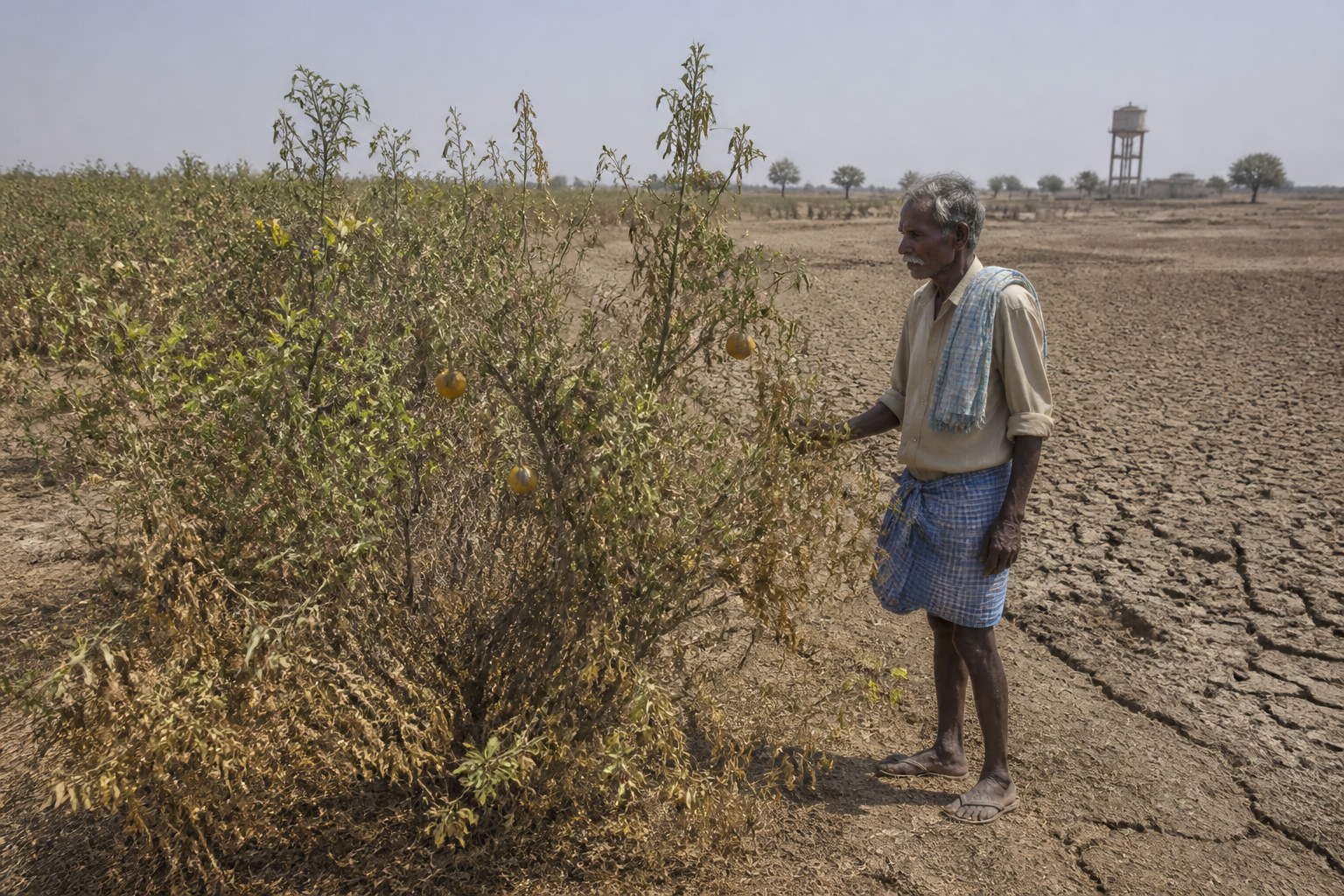
Rayalaseema’s drought crisis is not beginning with the latest El Niño warning. In Andhra Pradesh’s Anantapur and Sri Sathya Sai districts, recurring rainfall failure has repeatedly reshaped agriculture, groundwater use, migration, livestock ownership and household survival. The present warning has brought that history back into focus because the region is again facing a sharp rainfall deficit, high temperatures and the collapse of water-dependent crops and orchards.
The immediate evidence is severe. Rainfall deficiency has crossed 70 per cent in some Rayalaseema districts, while temperatures have remained above 40 degrees even in September, according to the report. Groundnut and red gram crops have suffered major losses, cotton has been damaged in black cotton soils, and orchards of sweet orange, banana and pomegranate have reportedly perished because borewells could not provide enough water.
These developments show why a drought in Rayalaseema cannot be understood only as a seasonal failure. The region’s agricultural economy depends on a fragile relationship between rainfall, groundwater recharge and crop choice. When rainfall does not arrive, the immediate loss is measured in fields and fruit trees. The longer-term cost appears in depleted wells, failed investments, livestock losses and the movement of people in search of work.
Historical accounts cited in the report place severe droughts in the region as far back as 1391-92 and 1396-97. An inscription at the Sri Lakshmi Narasimha Swamy temple in Kadiri, in Sri Sathya Sai district, describes starvation so extreme that human skulls were said to roll in the wind outside the temple. The period became associated with the Devi or Durgadevi famine.
The 19th century brought further drought episodes in 1832, 1837, 1854, 1860-61, 1868 and 1870-76. The most devastating was the 1876-78 Dhatukaru famine, also known as the Dokkala, Great or Mushti famine. The account describes people being reduced to skin and bones, with estimates that lakhs died of hunger in Rayalaseema. Twice as many milch animals reportedly died or were sold to slaughterhouses because fodder was unavailable.
The value of this history is not merely descriptive. It establishes that drought has been a recurring force in the region’s social and economic life rather than a one-off natural disaster. The report cites historian K Narayana’s observation that major drought episodes continued into the 20th century, including in 1901, 1905, 1907-08, 1911-13, 1917 and 1923-24.
After Independence, the region experienced the 1946-51 and 1948-53 famine periods. Government agencies, the Ramakrishna Mission and Communist organisations operated gruel centres during those crises. Their role points to an important institutional feature of drought response: when agricultural systems fail at scale, relief cannot be limited to farm support. Food distribution, livestock protection, employment and public health become part of the response.
The current crisis has a different physical and administrative setting, but the underlying exposure remains visible. In 2023, around 90 per cent of agricultural land in the region, mainly in Sri Sathya Sai and Anantapur areas, was affected by drought, with 49 mandals declared drought-hit. That figure indicates the breadth of the risk. Drought is not confined to isolated villages or a small number of failed wells; it can affect an entire district-level agricultural system.
Groundwater is central to this system because it acts as the buffer between irregular rainfall and crop production. But that buffer has limits. Groundwater department officials cited in the report said the Anantapur area needs at least 150 tmc-ft of water through rainfall to recharge its groundwater sources. Without sufficient recharge, borewells become deeper, more expensive and less reliable. Eventually, even additional drilling cannot guarantee access to water.
The accounts of farmers show how this technical problem becomes a livelihood crisis. A farmer in Bathalapalli reportedly broke down while cutting a 10-year-old sweet orange orchard that could not be saved after groundwater sources were deeply depleted. In the Madakasira area, a farmer identified as A Manjunath said water was unavailable even at a depth of 1,200 feet, leaving him unable to protect a 10-acre arecanut orchard.
These examples also reveal the uneven time horizons of drought damage. Annual crops such as groundnut, red gram and cotton can be lost within one season. Orchards represent a longer investment in land, planting, irrigation and waiting for maturity. When a 10-year-old orchard is cut down, the loss is not simply the value of one harvest. It is the destruction of accumulated capital and the loss of future production. The report does not provide a total monetary estimate, but the individual account shows the depth of the exposure.
The crop mix itself raises a question about how agricultural decisions interact with water availability. Sweet orange, banana, pomegranate and arecanut all require farmers to maintain water access over time, though the report does not quantify their relative water demand. When borewells fail, farmers cannot easily shift an established orchard to another crop. The result is that a rainfall deficit can damage both current income and the productive asset base of rural households.
The reference to black cotton soils adds another layer to the situation. The report says cotton sown in these soils suffered additional damage. This underlines that the effects of drought vary across crops and soil conditions. A uniform rainfall or drought declaration may not capture the different ways in which soil, crop stage, irrigation access and groundwater depth determine farm losses.
For governance, the challenge lies in moving from declaring drought to managing the water system that produces vulnerability. The report records that 49 mandals were declared drought-hit in 2023, but the supplied material does not establish what relief followed, how groundwater extraction was regulated, or whether recharge measures met official targets. Those are important gaps because administrative recognition is only the first step. The practical test is whether households receive timely support and whether water sources recover before the next crop cycle.
The historical record also shows that drought response has long required more than one institution. Earlier famine relief involved government agencies, civil society organisations and mission groups. Today, the relevant responsibilities would similarly cut across groundwater departments, agriculture officials, local administrations, disaster management authorities and rural welfare systems. The source does not detail the present division of responsibilities, but the region’s conditions make clear that no single department can address crop failure, drinking water, livestock, employment and migration separately.
The most important data point in the current account may be the contrast between rainfall recharge requirements and actual water availability. Anantapur reportedly needs at least 150 tmc-ft of rainfall-derived water to recharge groundwater sources, while farmers are already reporting wells failing at depths of 1,200 feet. Together, these figures describe a system in which groundwater extraction has moved far beyond a shallow, easily replenished resource. The missing information is equally significant: the report does not provide current reservoir levels, block-wise groundwater measurements, drinking-water supply data or the number of affected households.
That absence prevents a complete assessment of the present emergency, but it does not weaken the central conclusion. Rayalaseema’s drought vulnerability is structural. It has accumulated through repeated rainfall failures, dependence on groundwater, exposure of agriculture to heat and water stress, and the high cost of protecting long-lived crops. El Niño may act as the immediate trigger for renewed concern, but the consequences are shaped by conditions that predate the warning.
The region’s history also complicates the language of resilience. Communities have survived earlier droughts through relief kitchens, migration, livestock sales and institutional support. Survival, however, should not be mistaken for recovery. The historical accounts cited in the report show that drought can leave lasting changes in population, land use, household assets and local economies. A farmer forced to cut an orchard or sell animals may remain in the region, but with fewer assets to withstand the next failed monsoon.
What the supplied evidence confirms is a convergence of immediate climate stress and long-term groundwater vulnerability. Rainfall deficiency, temperatures above 40 degrees, crop losses and failed orchards are already affecting farmers, while the region’s drought history explains why the warning carries such weight. What remains unclear is the scale of current relief, the latest official groundwater position and the measures being taken to protect drinking water, livestock and farm livelihoods. Those indicators will determine whether the present episode remains a severe agricultural season or develops into a wider rural crisis.
