


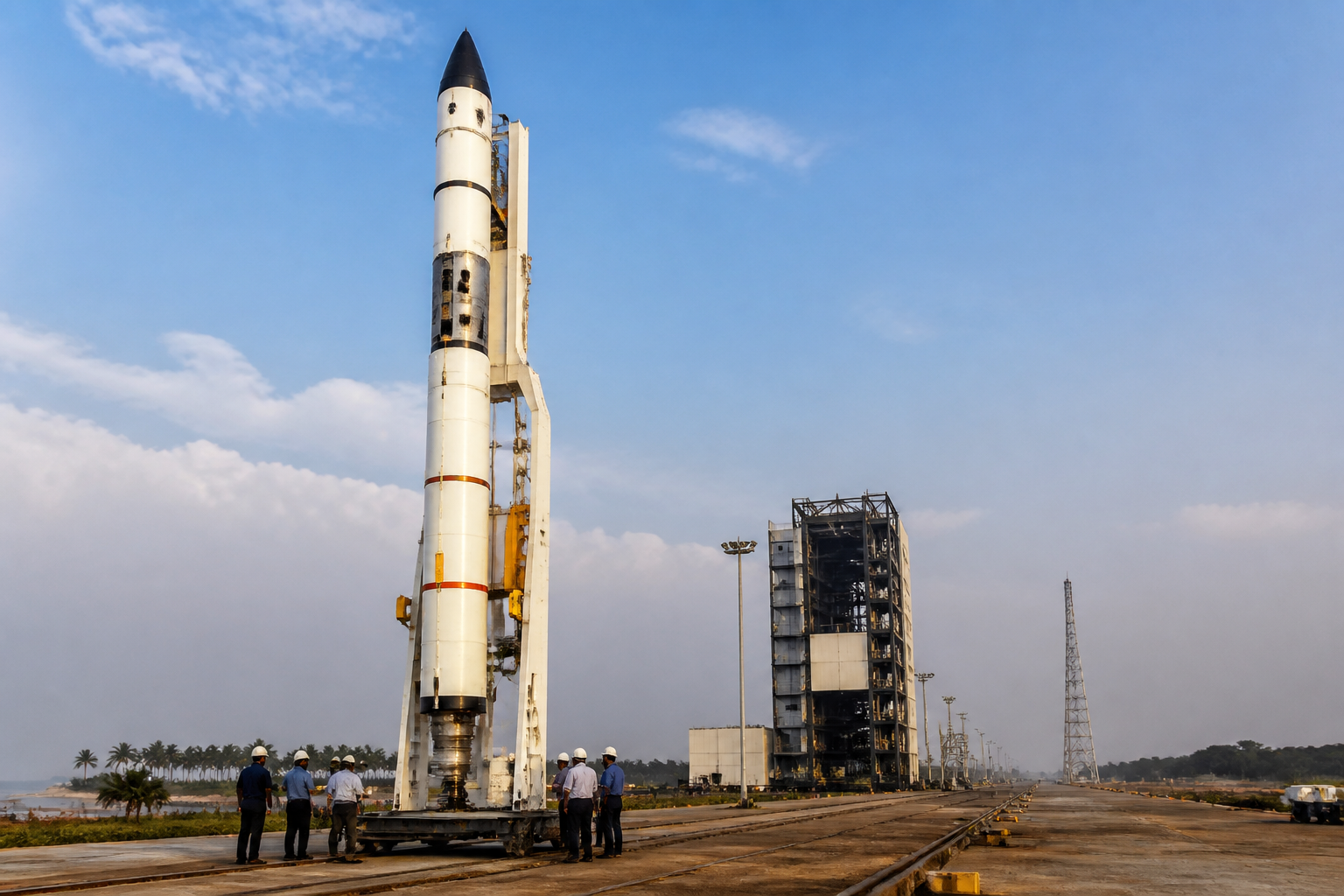
Agnikul Cosmos is receiving one to two launch enquiries every week, with a large share coming from international satellite companies seeking dedicated missions rather than rideshare launches. The Chennai-based start-up’s experience points to a larger shift in India’s private space sector: the challenge is moving from proving that a private rocket can fly to building the manufacturing, testing, regulatory and launch infrastructure needed for a repeatable commercial service.
The company’s co-founder and CEO, Srinath Ravichandran, said global satellite operators were increasingly looking for launches to specific orbital parameters. Rideshare missions can reduce the headline launch cost per kilogram, but they generally place several spacecraft into a shared or predetermined orbit. A satellite may then need its own propulsion, propellant and additional manoeuvres to reach its intended operational orbit.
That distinction changes the commercial calculation. A dedicated launch may cost more on a conventional per-kilogram basis, but it can place a spacecraft closer to its required orbit. This can reduce the propulsion hardware and fuel carried by the satellite, lower the complexity of orbital manoeuvring and potentially preserve more of the spacecraft’s useful mission life. Agnikul’s proposition is therefore based less on being the cheapest launch provider and more on offering precise deployment for small satellites.
This is an important distinction for India’s emerging space economy. Launch services are often discussed through vehicle price and payload capacity, but satellite operators ultimately buy an end-to-end mission outcome. The value of a launch depends on where a satellite is placed, how much onboard propulsion it requires, how long it can operate and how predictably the launch can be scheduled. A dedicated-launch market can therefore develop even when rideshare missions remain attractive for customers whose orbital requirements are less specific.
India’s position in this market has been built on the reliability associated with the Indian Space Research Organisation’s Polar Satellite Launch Vehicle programme and on reforms that opened more space activity to private companies. The source report does not establish the size of India’s total launch market or compare Agnikul’s pricing with competing providers. It does, however, show how the private sector is attempting to convert national launch credibility into a commercial operating model.
Agnikul is preparing to move from technology demonstration towards commercial operations. Its next major milestone is Mission 2, following its technology demonstration flight. The company has said that its progress towards a regular commercial cadence will depend on regulatory approvals and the successful validation of planned recovery operations.
The significance of Mission 2 is therefore broader than the performance of one vehicle. For a launch company, a demonstration flight can establish technical capability, but commercial operations require a chain of capabilities to work together. The company must manufacture vehicles, test them, secure approvals, prepare launch sites, manage mission operations and complete the inspection and qualification processes required between flights. A successful demonstration does not by itself establish that this entire system can operate frequently or economically.
Agnikul’s longer-term ambition is to scale its launch cadence to as many as 100 missions a year. The company expects individual reusable launch vehicles to be capable of 10 to 12 flights. These figures are ambitions rather than demonstrated operating performance in the supplied material, but they reveal the industrial scale the company believes will be necessary to compete in the dedicated small-satellite launch market.
Reusability is central to that calculation. In an expendable launch model, a substantial share of manufacturing activity, including the use of raw materials and components, is repeated for every mission. A reusable vehicle changes the recurring cost structure by shifting more of the work towards inspection, refurbishment, testing and re-qualification after each flight.
The economic benefit does not come simply from flying the same rocket again. It depends on whether the turnaround process can be made sufficiently repeatable, reliable and efficient. Every additional flight introduces requirements for inspection and certification, while recovery operations add their own technical and regulatory demands. Agnikul’s stated strategy indicates that it views reusability as an operating system for launch, not merely as a feature of the vehicle.
The company is also manufacturing multiple launch vehicles in parallel. This is intended to avoid a sequential model in which one vehicle is built, flown, analysed and only then followed by the next vehicle. Parallel production can help a company prepare for a higher launch rate, but it also creates a need for consistent manufacturing quality, testing capacity and supply-chain coordination. The source material does not provide details of Agnikul’s production volume, workforce, investment or supplier network, so the scale of this expansion cannot yet be independently assessed from the available information.
The physical geography of India’s launch infrastructure is also becoming part of the company’s strategy. Agnikul is expanding manufacturing and testing capabilities in Tamil Nadu, including infrastructure closer to the upcoming Kulasekarapattinam spaceport. It also plans to operate from multiple launch facilities, including Sriharikota. Multiple sites could support operational flexibility, but the supplied material does not establish the facilities’ readiness, allocation arrangements or the regulatory framework governing Agnikul’s use of them.
This highlights an institutional issue facing India’s private space sector. Commercial launch companies need more than permission to develop rockets. They require access to launch infrastructure, clear safety and range procedures, predictable approvals, testing facilities and rules that allow private operators to plan their schedules. As companies move towards frequent launches, the administrative system must handle not only individual missions but also recurring operations across manufacturing, recovery, testing and launch.
The policy transition began with reforms announced between 2020 and 2023 that opened the space sector to private participation. Many Indian space-tech companies are now moving from technology demonstration towards commercial deployment. Ravichandran expects this transition to become more visible around 2026–27, when satellite companies move beyond initial demonstrations and begin deploying larger commercial constellations and operational payloads.
That expected transition could affect the composition of Agnikul’s launch manifest. The company expects the Indian satellite ecosystem to become a more significant contributor over the next two years, even as it continues to receive international enquiries. This suggests that the domestic market may become an early customer base for private launch companies as Indian satellite firms progress from experimental missions to operational services.
The available evidence does not establish how many Indian satellite companies will require dedicated launches, how many missions they may order or whether Agnikul’s expected demand will convert into signed contracts. It does show, however, that launch demand is being shaped by the changing needs of satellite operators. As spacecraft become part of larger commercial constellations and operational systems, timing and orbital placement can become as important as the base price of the launch.
For cities and the built environment, the connection may appear indirect, but the space sector increasingly depends on physical infrastructure, industrial land, specialised manufacturing, testing facilities, transport links and regulated launch sites. Tamil Nadu’s role in Agnikul’s expansion places these requirements within a regional development context. The growth of a private launch industry can create demand for advanced manufacturing capacity, logistics and technical employment, but the supplied material does not quantify those effects.
The larger question is whether India’s private space infrastructure can develop at the same pace as its launch ambitions. A target of up to 100 missions a year requires more than a reusable vehicle. It requires vehicles to be produced consistently, recovery systems to be validated, turnaround procedures to be certified and launch facilities to support a much higher frequency of operations. It also requires satellite customers to generate sufficient demand for dedicated missions.
Agnikul’s current position captures this transition. Weekly enquiries indicate market interest, while Mission 2 and the company’s planned manufacturing expansion represent the next tests of execution. The evidence confirms that India’s private launch sector is moving towards commercialisation and that dedicated orbital deployment is becoming part of its market proposition. What remains uncertain is whether the company can convert enquiries into regular missions and whether the supporting industrial and regulatory infrastructure can sustain the launch cadence it envisions.
