


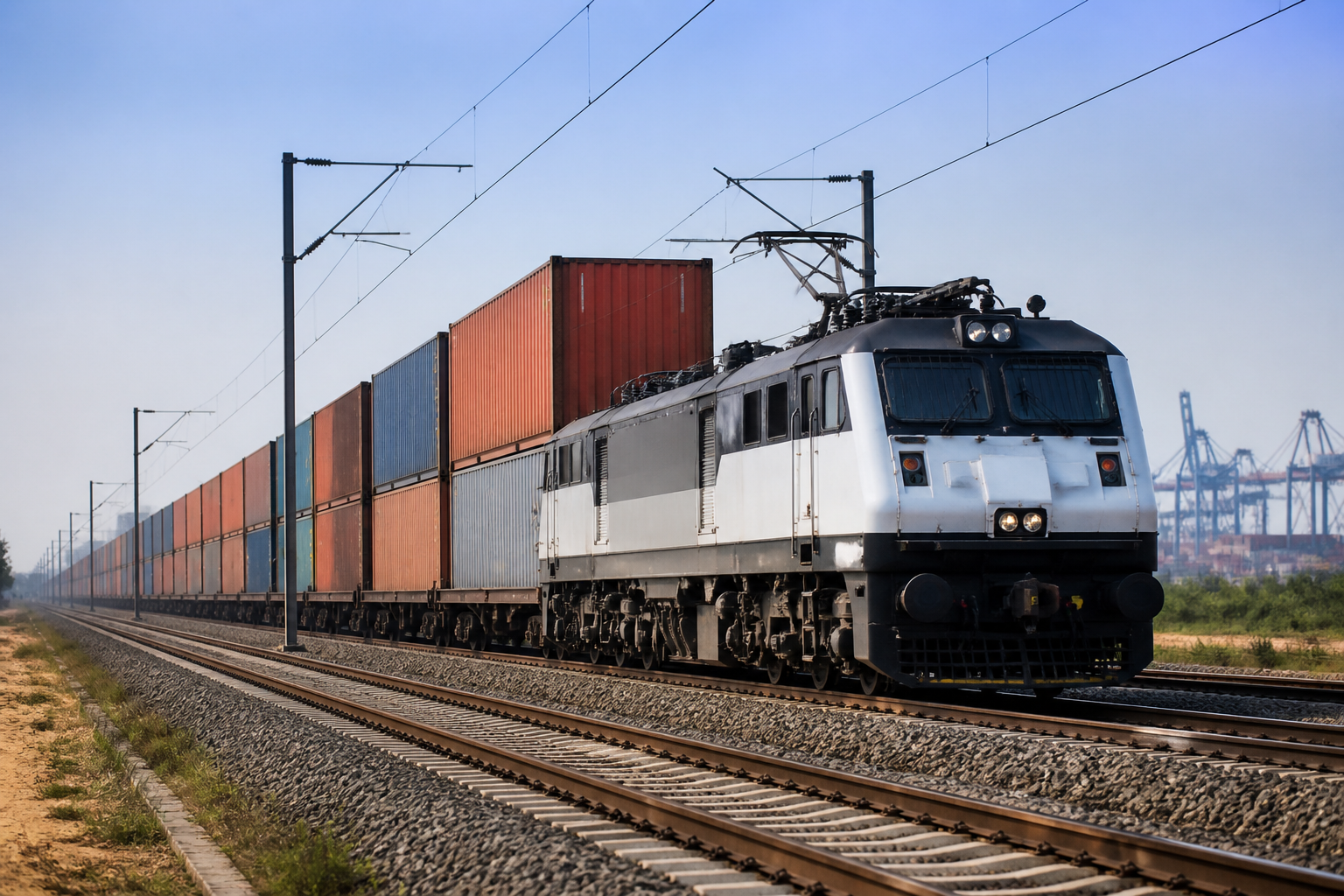
India’s Dedicated Freight Corridor network is now fully operational, completing a 2,843-km freight railway system designed to separate goods trains from passenger traffic on some of the country’s most congested routes. The milestone is significant not simply because a large railway project has been completed, but because it tests whether dedicated capacity can change the economics, reliability and spatial organisation of freight movement in India.
The completed network comprises the 1,506-km Western Dedicated Freight Corridor between Dadri and Jawaharlal Nehru Port Trust, and the 1,337-km Eastern Dedicated Freight Corridor between New Sahnewal in Punjab and New Sonnagar in Bihar. The final three sections of the Western DFC, covering 326 km, were inaugurated this week at a cost of more than Rs 20,700 crore.
The underlying problem is familiar across India’s railway system: passenger and freight services have been competing for the same paths on heavily used routes. The existing Howrah-Delhi and Mumbai-Delhi trunk routes were operating at between 115% and 150% of capacity, according to the supplied report. Under those conditions, more freight trains cannot simply be added without affecting passenger services, while goods trains face slower speeds and less predictable journeys.
The DFC model attempts to resolve that conflict through physical separation. Freight trains are moved onto dedicated tracks, allowing the conventional railway network to handle passenger services and other traffic with less competition for capacity. The result is intended to be more than a faster journey for an individual train: it is a restructuring of how the railway network allocates scarce track space.
## Dedicated Freight Corridor capacity changes the operating equation
The most immediate change is in train speed. Average freight speeds on the DFC network are reportedly above 50 kmph, about twice the average on non-DFC routes. More than 400 freight trains operate on the two corridors every day. These figures indicate that the corridors are already functioning as a separate operating system rather than serving only as unfinished construction assets.
The two routes also have distinct freight roles. The Western DFC links northern India with western ports and is particularly important for containerised cargo. The Eastern DFC serves freight flows from the mineral-rich eastern region and is more closely associated with bulk commodities. Together, they connect industrial and manufacturing centres with ports, logistics hubs and inland markets.
Double-stack container operations add another layer to the project’s capacity. By carrying more containers in a single train, the Western corridor can improve the productivity of long-distance rail freight. The benefit is not limited to the number of trains that can be operated. Higher wagon counts and greater payload per rake can also improve the use of locomotives, terminals, track and crew time.
Jagannarayan Padmanabhan, Senior Director and Global Head, Consulting at Crisil Intelligence, said the corridors improve rail productivity, asset utilisation and transport economics by enabling higher wagon counts, faster freight trains and double-stack container operations. He also linked the network to stronger connections between ports, industrial clusters, logistics parks and hinterland markets.
That connection is important because freight performance is determined across a chain, not on railway tracks alone. A train that moves quickly between two points can still be delayed by weak feeder roads, limited terminal capacity, inefficient cargo handling or poor port integration. The DFC therefore shifts the question from whether trains can travel faster to whether the surrounding logistics system can use that speed consistently.
## The rail-versus-road question remains unresolved
The completion of the corridors arrives as Indian Railways continues to compete with an extensive road and highway network for freight. Rail freight is described in the supplied report as costing around Rs 1.96 per tonne-km from terminal to terminal, compared with approximately Rs 2.3 per tonne-km in the United States and about Rs 4 per tonne-km for road transport. On those figures, rail has a substantial cost advantage for suitable long-distance cargo.
Yet rail accounts for only about 20% of freight movement, according to the report. The gap between cost advantage and modal share shows that price is not the only factor shaping freight decisions. Reliability, first- and last-mile access, terminal handling, route availability, delivery commitments and the ability to serve different cargo categories also determine whether goods move by rail or road.
The Western DFC’s rail coefficient is currently cited at 20%, meaning that roads continue to carry the majority of cargo in the corridor’s market. This makes the completion of the network a starting point rather than a final answer. Dedicated tracks create capacity, but that capacity must be translated into services that shippers consider dependable and commercially convenient.
Jaffrey Thomas, Partner for Transport and Logistics at PwC India, identified four factors that could strengthen the corridors’ wider impact: standardised and upgraded feeder connectivity, competitive pricing models such as GTKm-based pricing across cargo and container categories, assured transit slots, and Gati Shakti terminals and multimodal logistics parks with DFC-grade connectivity.
These requirements reveal an institutional feature of freight infrastructure. No single railway line can deliver a complete logistics reform. Indian Railways controls the core rail network, but cargo movement also depends on ports, state and local road systems, logistics park operators, terminal developers, industrial clusters and private freight customers. The performance of the DFC will therefore be shaped by coordination across agencies and modes.
## Capacity released on existing railway routes
The DFC’s second major promise concerns capacity that is released elsewhere. When goods trains shift to dedicated corridors, paths become available on the existing railway network for additional passenger and freight services. This could be particularly important on routes where trains previously competed for the same infrastructure.
The effect is operational rather than merely financial. A railway can increase services only when track paths, signalling capacity, terminals and rolling stock can support them. By moving a major category of traffic away from congested routes, the DFC can alter the timetable possibilities for both freight and passenger operations. The supplied report says the additional capacity should help Indian Railways introduce more innovative and competitive transit products in both businesses.
The extent of that benefit will depend on how the released capacity is planned and used. Faster freight corridors alone do not automatically create more passenger services. They provide the infrastructure conditions for such a change. The next stage requires timetable planning, rolling-stock deployment, terminal coordination and service design that take advantage of those conditions.
The same applies to the expected improvement in rolling-stock economics. More reliable and faster transits can allow assets to complete journeys and return to service more quickly. PwC India’s assessment, as reported, is that improved reliability could enhance returns from investments in rolling stock. That benefit depends on consistent operations rather than on isolated periods of higher speed.
## From railway project to logistics architecture
The DFC network also marks a shift in how freight infrastructure is planned. Its purpose is not only to connect two endpoints but to link a chain of production, storage, handling and export. The Western route’s relationship with ports and container traffic gives it a direct role in connecting the hinterland to international gateways. The Eastern route’s connection to bulk commodities links mineral-producing regions with industrial demand.
This geography matters for manufacturing. The supplied report argues that lower transit times, improved service reliability and expanded market access could strengthen supply-chain efficiency, manufacturing competitiveness and export performance. Those outcomes are presented as potential effects of the completed network and related reforms, not as results already established across the economy.
The distinction is important. The physical network is complete, but its economic performance will be measured through cargo volumes, transit reliability, terminal utilisation, modal share and the ability to attract freight that currently travels by road. The report does not establish that these broader outcomes have already been achieved. It identifies the mechanisms through which they could follow from the infrastructure.
The Union Budget has proposed another Dedicated Freight Corridor linking Dankuni in West Bengal with Surat in Gujarat through Odisha, Chhattisgarh, Madhya Pradesh and Maharashtra. The proposed 2,052-km route would integrate with the existing Western DFC and connect more freight flows to ports on the west coast. Other corridors have also been examined through detailed project reports, including an East Coast corridor between Kharagpur and Vijayawada, an East-West network between Palghar and Dankuni, an East-West sub-corridor from Rajkharsawan to Andal, and a North-South sub-corridor between Vijayawada, Nagpur and Itarsi. These projects have not yet been sanctioned.
That pipeline shows how the DFC is becoming part of a larger freight strategy. It also introduces a governance test: whether future corridors will be planned as connected networks with terminals and feeder links, rather than as isolated rail construction projects. The experts quoted in the report place particular emphasis on multimodal logistics parks, port-rail integration and first- and last-mile connectivity.
The completion of the existing DFC network therefore closes one phase but opens a more demanding one. Construction milestones are relatively clear: kilometres completed, sections commissioned and project costs recorded. The harder measurement concerns system performance. It will require tracking whether freight trains maintain higher speeds, whether transit times become more predictable, whether cargo shifts from road to rail, and whether the conventional network gains usable passenger capacity.
India’s 2,843-km Dedicated Freight Corridor network has solved a major physical constraint by creating separate freight capacity on key routes. Its larger promise, however, rests on what happens beyond the tracks. The evidence supplied confirms higher reported freight speeds, substantial daily train operations and stronger links between ports, industrial centres and hinterlands. It does not yet establish the full economic transformation projected by its supporters. That will depend on pricing, terminals, feeder connectivity, service reliability and the next decisions on expanding the network.
