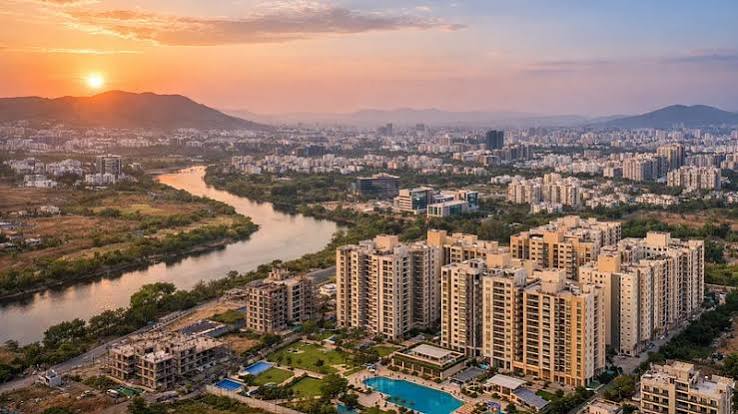
Pune’s housing market recorded one of its sharpest slowdowns among India’s major residential centres in the April-June quarter, with sales falling 20.8% year-on-year to 12,642 homes. The decline came even as overall housing prices remained firm, pointing to a market where buyers are becoming more selective while affordability and employment uncertainty increasingly influence purchasing decisions.
Across eight major cities, residential sales declined 6.1% to 91,729 units from 97,674 a year earlier, according to PropTiger’s Q2 2026 Real Insight Residential report. New launches, however, increased 6% year-on-year to 89,161 units. This divergence suggests that developers are continuing to bring projects to market even as demand has become less predictable. Pune housing sales fell from 15,962 units in the corresponding quarter last year. The contraction was substantially larger than the 6.1% decline recorded across the eight-city market. Bengaluru, another technology-led employment centre, saw sales decrease 9.2% to 14,186 units, while Ahmedabad registered a 20.2% decline. The weakness is particularly relevant to the middle of the market. The report linked softer demand in technology-focused cities to concerns around technology-sector restructuring and the effect of artificial intelligence on employment. For prospective buyers, uncertainty over future income can delay a large financial commitment even when borrowing conditions remain manageable. That makes the Pune housing market increasingly sensitive to employment confidence, not just property prices.
Yet the slowdown has not translated into a broad price correction. Across the eight markets, the sales-weighted average residential price increased 1% sequentially to ₹10,153 per sq ft, remaining above ₹10,000 for a second consecutive quarter. This combination of weaker transactions and firm prices suggests that developers have so far retained pricing power rather than responding through widespread discounting. The national picture is also uneven. Chennai recorded a 36% annual increase in sales, while Hyderabad rose 14.6%. MMR and Delhi-NCR, meanwhile, registered declines of around 7%. The contrast indicates that India’s housing cycle is not moving uniformly, with employment bases, infrastructure investment, supply composition and local affordability shaping individual markets.
For Pune, the next phase will test whether the slowdown is temporary or signals a deeper affordability problem. A healthier market will depend not simply on maintaining construction volumes, but on aligning new housing with household incomes, public transport access and everyday infrastructure. For a rapidly expanding city, that balance matters as much as the headline sales numbers.