


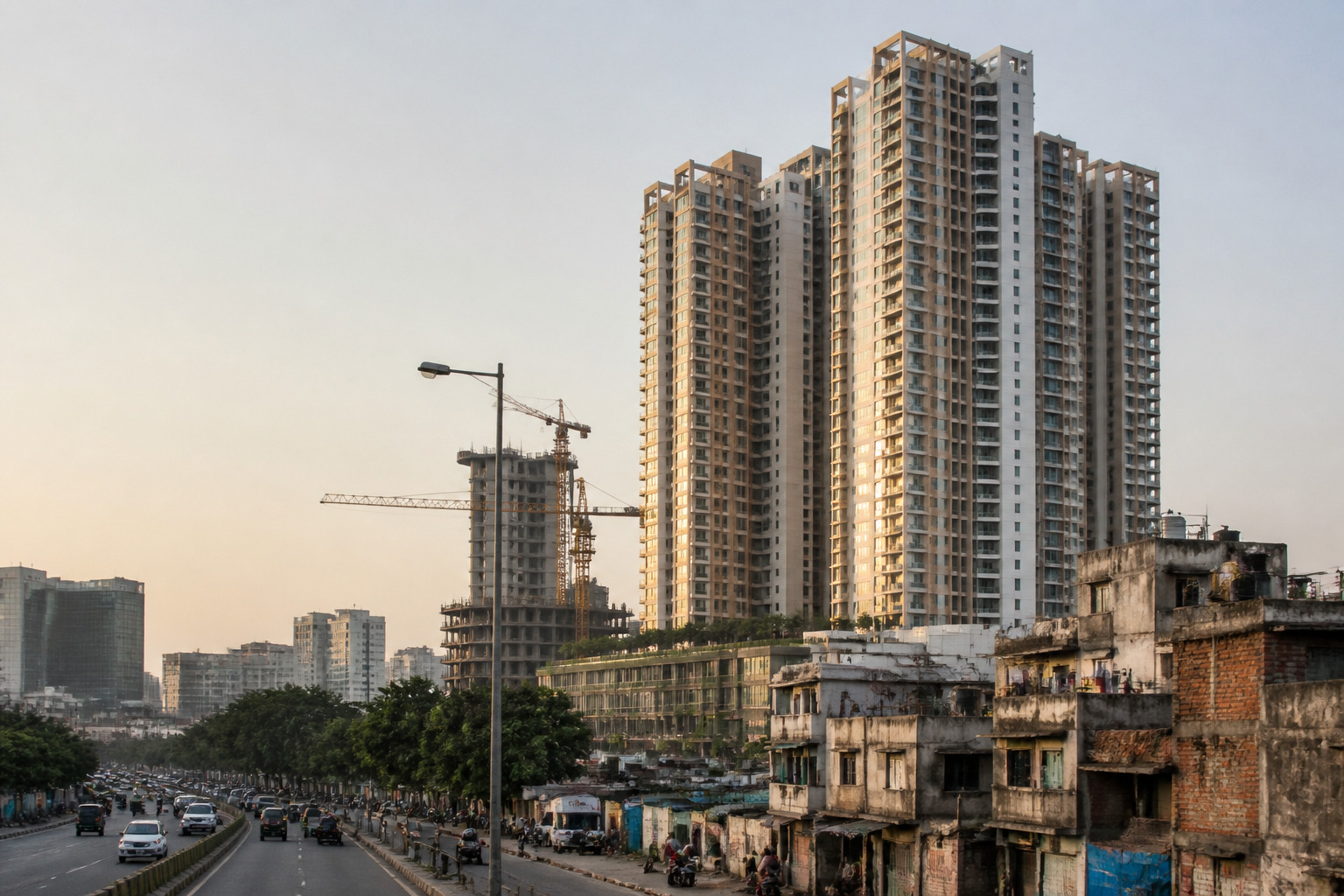
Luxury housing is expanding across India’s major urban markets even as a larger share of buyers continues to search for mid-income homes. The divergence is not simply a matter of changing consumer taste. It reflects how land prices, approvals, construction costs and project margins are reshaping what developers can build profitably in cities such as Delhi, Mumbai, Bengaluru and Gurugram.
The contrast is visible in the pricing of new supply. Affordable homes are defined in the supplied industry analysis as those priced below Rs 40 lakh, while mid-end homes fall between Rs 40 lakh and Rs 80 lakh. Yet developers are increasingly launching projects in the Rs 2 crore-Rs 10 crore range. According to CareEdge Ratings, homes priced above Rs 4 crore accounted for 9 per cent of new launches in the first quarter of 2026.
That figure does not describe the entire market, but it signals how premium housing has gained space within the pipeline. At the same time, the report identifies a continuing demand-supply gap in affordable and mid-income housing. The result is a residential market in which the segment with stronger purchasing power is receiving more attention, while the segment with wider unmet demand remains harder to serve.
The economics behind this shift are important. The report attributes pressure on affordable housing to higher costs of cement, steel and labour during the beginning of 2026. Land acquisition costs have also reduced the viability of lower-priced projects, particularly in locations where developable land is scarce. Premium projects are better placed to absorb these costs because their buyers are described as less sensitive to inflation and volatile property prices.
This creates a structural difference between demand and deliverability. A household may need a home within the affordable or mid-income range, but a developer must also account for land, approvals, construction, finance and the time required to complete and sell a project. When these costs rise faster than achievable selling prices, the lower-priced project becomes more difficult to launch, regardless of the size of the potential buyer pool.
Navdeep Sardana, founder of Whiteland Corporation, told NDTV that luxury housing is being supported by demand from high-net-worth individuals, non-resident Indians and first-generation wealth creators seeking larger homes, amenities and long-term value. He also pointed to scarce land in prime micro-markets and said developers are responding to the segments where demand is strongest and projects remain financially sustainable.
That explanation places the premium housing boom within a broader urban land problem. In established employment centres, land is not only limited; it is also connected to transport access, social infrastructure, commercial activity and perceived investment value. These factors make centrally located or well-connected sites expensive. Developers then face pressure to maximise revenue from each parcel, and higher-value housing becomes an easier financial proposition than homes with tightly constrained prices.
The meaning of luxury itself has also changed. The supplied report says that luxury was once associated mainly with marble floors and extravagant chandeliers. Post-pandemic demand has increasingly linked it to smart automation, sustainable features, practical design, larger spaces and premium amenities. In urban regions, low-density developments that combine quality and sustainability are attracting buyers who can pay for those features.
Adil Altaf, CEO of ANHAD Developers, similarly told NDTV that end-users and investors are seeking larger homes, premium amenities and long-term appreciation. His comments suggest that the premium market is not being driven solely by speculative buying. However, the supplied material does not quantify the shares of end-users, investors, HNIs, NRIs, CXOs or startup founders in total luxury transactions. Those distinctions matter because the housing requirements of residents and the investment preferences of buyers can affect how much new supply remains available for occupation.
The more direct explanation from developers concerns margins. Rajan Yadav, director of Roots Developers, said that higher land, approval and construction costs have made premium products more capable of protecting margins. He also acknowledged that mid-income buyers need better options, but argued that without lower land costs or policy support for affordable housing, developers will continue to favour segments where returns justify investment.
This is the central paradox: the market is responding rationally to its immediate financial conditions while producing an outcome that does not align with the broader distribution of housing need. Developers are not necessarily choosing luxury housing because affordable homes lack demand. They are choosing it because the revenue from premium homes is more likely to cover the cost of urban land and construction.
The situation also shows why housing affordability cannot be assessed only through the final sale price. The supply of homes depends on the full development chain. Land acquisition, permissions, infrastructure access, construction inputs and financing all influence whether a project can be offered at a lower price. If those costs remain high, a policy objective focused only on cheaper homes may not be sufficient to generate supply.
The report also places luxury housing within a changing investment and employment landscape. Cushman and Wakefield’s India Outlook 2026, as cited by NDTV, describes the real estate sector as positioned for growth, supported by global investors, real estate investment trusts and demand across multiple asset classes. The report identifies NRIs as another force supporting luxury housing. Employment and infrastructure growth are also cited as factors that could sustain demand in premium urban markets.
In cities such as Gurugram, the report links demand for amenity-rich homes to professionals in technology and business, including CXOs and startup founders. It describes this as contributing to a more polycentric urban landscape. That observation is significant because premium housing is not confined to traditional central-city locations. It can support new clusters around employment centres, business districts and infrastructure corridors, although the supplied material does not establish how these developments affect commuting patterns, public transport demand or access to social infrastructure.
A polycentric city can reduce the concentration of activity in a single core, but its benefits depend on how housing, jobs and transport are connected. If premium residential districts grow faster than affordable housing near employment, lower-income workers may continue to live farther away and spend more time and money reaching jobs. The supplied report does not provide commuting or household expenditure data, so the extent of this effect cannot be measured here. It does, however, identify the market conditions that could intensify the separation between where high-value homes are built and where affordable homes are needed.
This is where the policy landscape becomes decisive. The developer comments point to two broad interventions: a correction in land costs and policy support that improves the viability of affordable projects. The report does not specify a particular government scheme, subsidy, regulatory change or land policy, and therefore does not establish which instrument would close the gap. It does establish that developers currently see premium housing as the segment best able to absorb rising costs and deliver acceptable returns.
The data available in the report is limited but clear in direction. Homes above Rs 4 crore accounted for 9 per cent of launches in the first quarter of 2026, while affordable homes below Rs 40 lakh and mid-end homes between Rs 40 lakh and Rs 80 lakh face a stated supply gap. The report also identifies a much wider premium launch band of Rs 2 crore-Rs 10 crore across major cities. These figures should not be treated as a complete measure of national housing supply, but they show the contrast between the price points receiving developer attention and those associated with wider buyer demand.
The larger urban question is whether India’s housing market can expand at the top end without leaving the rest of the market further behind. Luxury projects may bring investment, improve local amenities and respond to genuine demand from affluent households. But a market dominated by the strongest purchasing power cannot, by itself, resolve the shortage of homes affordable to middle-income and lower-income residents.
The evidence currently confirms a market shaped by scarcity, rising costs and unequal purchasing power. It also shows why developers describe luxury housing as a financial necessity rather than merely a lifestyle choice. What remains unresolved is whether land costs, approvals, construction expenses or policy support will change enough to make affordable and mid-income projects viable at scale. Those factors will determine whether the present premium housing cycle becomes a broader expansion of urban housing supply or a deeper separation between what cities need and what the market can profitably deliver.
