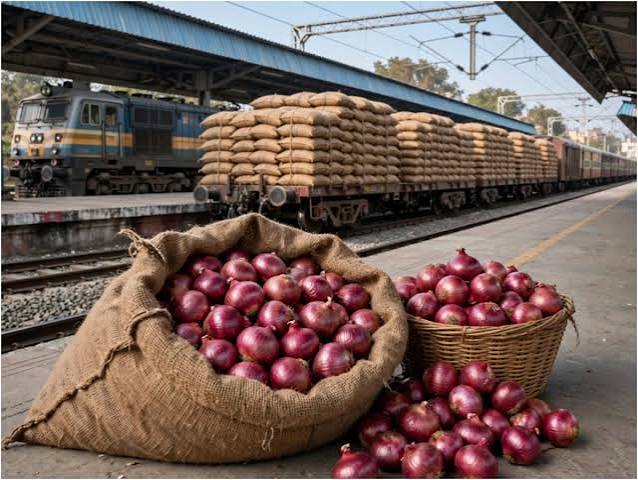
Pune’s onion market is facing a sharp supply squeeze, with daily arrivals at the Gultekdi wholesale market falling to less than half of the volume traders say the city normally requires. The disruption has pushed wholesale and retail prices higher, adding pressure to household food budgets and highlighting how weather shocks can quickly travel from farms to urban consumers.
Traders at the Agricultural Produce Market Committee (APMC) market estimate that Pune requires roughly 125 truckloads of onions each day. With each truck carrying about 10,000 kg, that represents around 1,250 tonnes of daily supply. Current arrivals are closer to 50 trucks, creating a substantial gap between available stock and city demand. The reduction in supply has already altered wholesale prices. Better-quality onions are being traded at around ₹35-40 a kg, while older or lower-grade produce is selling for approximately ₹30-35 a kg. Consumers are paying considerably more in neighbourhood markets, with retail prices reported in the ₹45-65-plus range depending on quality and locality. The present shortage has roots in the agricultural cycle rather than only in Pune’s wholesale market. Traders have linked the tighter availability to unseasonal rainfall in April, which damaged onion crops and reduced output. Such weather volatility is becoming a growing concern for agricultural supply chains because disruptions at the production end can quickly translate into higher food costs in cities.
For Pune households, onions are a relatively low-cost but frequently purchased food item, making sudden price increases particularly visible. The effect is also uneven. Families with limited incomes have less room to absorb increases in essential food items, while differences between wholesale and retail prices can further complicate the picture for consumers. The episode also exposes the dependence of a large urban market on a continuous flow of agricultural produce from surrounding growing regions. When arrivals fall sharply, traders and retailers have limited scope to compensate immediately. Storage capacity, transport availability and the timing of fresh crop arrivals can therefore influence how long elevated prices persist.
Urban planners and food-supply experts increasingly view reliable links between rural production and city markets as part of urban resilience. Better market information, improved storage infrastructure and more efficient logistics can reduce some of the pressure created by temporary supply disruptions. These measures cannot prevent crop losses caused by extreme weather, but they can help cities absorb the shock. For Pune, the immediate question is when arrivals will recover and whether retail prices follow. A sustained improvement will depend on fresh supplies reaching the wholesale market, while the longer-term challenge is making the food network more resilient to increasingly unpredictable weather.