


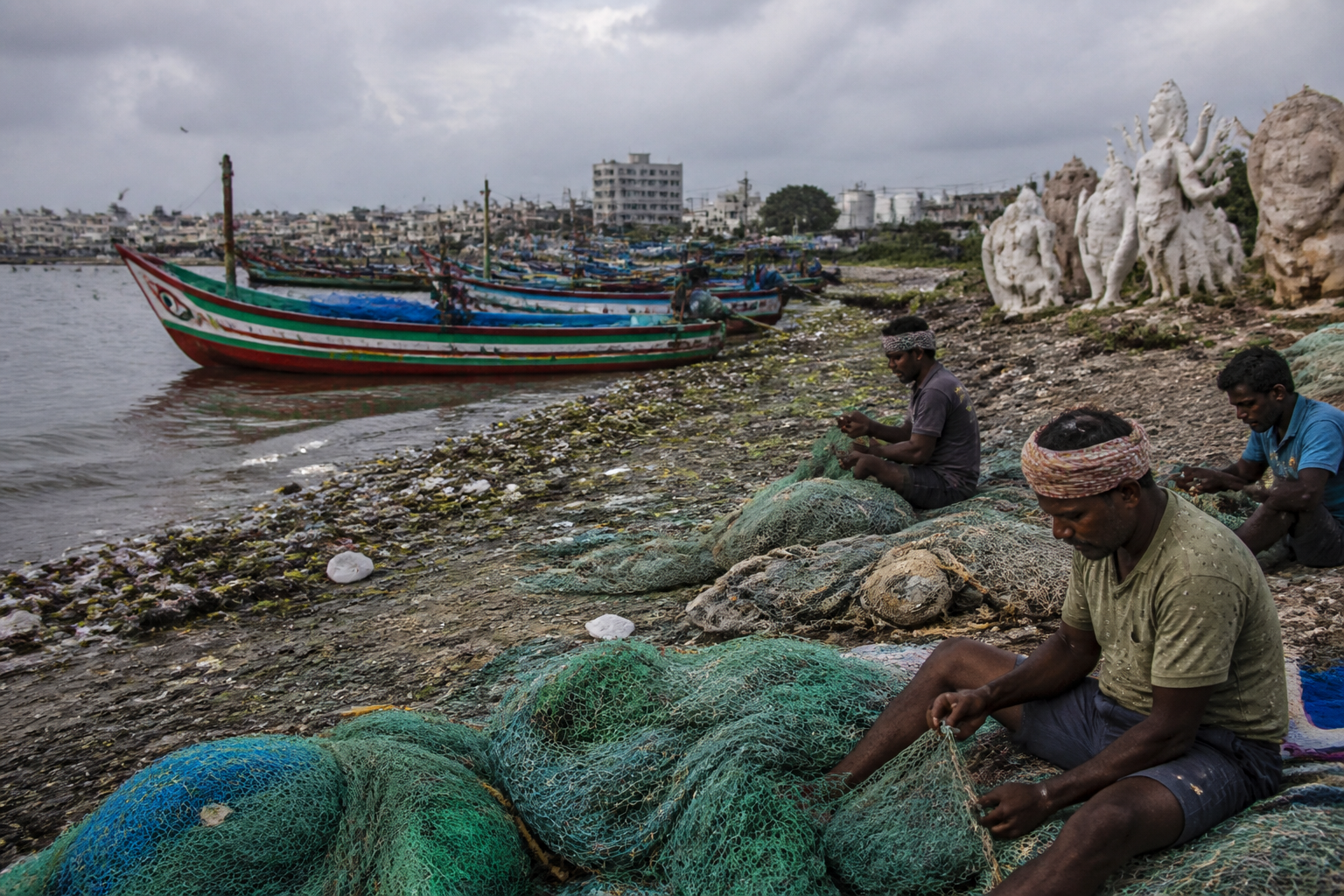
A representation by the Tamil Nadu Fishermen Trade Union Federation to the Chennai district collector has brought a larger urban management problem into focus: whether restrictions on idol immersion at southern beaches could shift thousands of idols to the already stressed Kasimedu and Ennore coasts. The dispute is not only about where a festival activity takes place, but also about how Chennai distributes environmental risk and protects the livelihoods of communities living beside its industrial waterfront.
The federation said a recent National Green Tribunal order in the southern zone banning idol immersion at Pattinapakkam and Neelankarai beaches, to protect turtle nesting sites and coastal ecosystems, could redirect large numbers of idols towards north Chennai. Its memorandum warned that Kasimedu and Ennore could become dumping grounds if alternative arrangements are not created across the city.
The central administrative question is therefore one of displacement. A restriction at one set of beaches may protect sensitive coastal locations, but the environmental burden does not disappear unless the city provides accessible, regulated and adequately distributed immersion facilities. In the account submitted by the federation, the potential consequence is a transfer of pressure from beaches identified as important for turtle nesting to a coast where fishing communities already report industrial effluent and other forms of pollution.
This is a familiar difficulty in urban environmental governance: a city may solve the immediate problem at a visible or protected site while moving the waste, congestion or ecological damage elsewhere. The representation suggests that North Chennai is at risk of carrying that burden because it has a working fishing harbour, coastline and communities whose economic activity is closely tied to marine conditions. The memorandum does not present the northern coast as an unused space. It presents it as an active livelihood landscape with existing environmental stress.
The federation specifically raised concerns about idols made from Plaster of Paris and coated with chemical paints. According to its submission, the immersion of such idols could pollute marine waters, damage coral reefs and endanger marine species. It also linked chemical toxicity to the depletion of local fish stocks. These claims were made in the federation’s representation to the district collector and form the basis of its request for decentralised facilities.
The material remains of idols create a second layer of risk. The federation said wooden frames, bamboo structures and iron rods can sink in the sea, create hazards for fishing vessels and tear fishing nets. For fishermen, the impact is not limited to an abstract environmental cost. A damaged net represents a direct financial loss, while submerged debris can interfere with boats operating in coastal waters.
The representation also reflects a conflict between two forms of public use. Beaches and coastal waters are being considered as locations for a large seasonal religious activity, while the same waters support fishing, marine life and shoreline ecosystems. When immersion facilities are concentrated in one part of the city, the resulting traffic, waste and debris can impose costs on communities that did not determine the location of the activity.
The federation’s proposed solution is to create large temporary artificial ponds in open grounds across different city zones. It has asked the Greater Chennai Corporation to provide eco-friendly immersion facilities closer to where idols are used, rather than requiring all communities to transport them to the north Chennai coast. The federation president, R Loganathan, also sought localised tanks or designated non-polluted water bodies for the purpose.
The proposal is significant because it treats immersion as a municipal service that requires planning, land, operations and monitoring. A temporary pond is not merely a substitute location. It would need to be identified, prepared and managed in advance, with arrangements for collecting idol remains and preventing the material from entering natural water bodies. The supplied report does not establish whether such facilities have been planned, funded or approved for the affected areas. That gap is central to the immediate policy question.
The division of responsibility is also important. The federation submitted its representation to the Chennai district collector, while its request for temporary ponds is directed to the Greater Chennai Corporation. The issue consequently involves more than one layer of administration: the district authority, the municipal corporation and the regulatory conditions arising from the National Green Tribunal’s order. The effectiveness of any response will depend on coordination among these institutions.
The tribunal’s reported intervention adds a further constraint. The ban at Pattinapakkam and Neelankarai is intended to protect turtle nesting sites and coastal ecosystems, according to the report. That objective places environmental protection at the centre of the city’s festival-management decisions. But the representation argues that protection cannot be assessed beach by beach if the result is to shift pollution and debris to another coastline.
This is where the North Chennai idol immersion issue becomes a broader planning question. Environmental regulation often creates protected zones and prohibited activities, but urban administration must also plan for the demand that those restrictions generate. If thousands of idols still require immersion, the city must decide whether to distribute the activity through controlled facilities, establish alternative water bodies or implement another system that prevents the burden from falling on natural coastal waters.
The available report does not quantify the number of idols expected to be immersed, the volume of Plaster of Paris involved, the number of fishing vessels or nets that could be affected, or the extent of existing contamination at Kasimedu and Ennore. It also does not provide a response from the district collector, the Greater Chennai Corporation or the National Green Tribunal. These details would be necessary to assess the scale of the risk and the status of any official mitigation plan.
What the representation does establish is the point of conflict. Southern beach restrictions have raised concern that north Chennai will receive a larger share of the activity. Fishermen’s organisations say the resulting debris and chemical pollution could harm marine species, fishing equipment and fish stocks. Their request for decentralised immersion infrastructure is an attempt to prevent a citywide festival from becoming a concentrated coastal waste problem.
The institutional test for Chennai is whether it treats the issue as an annual logistical exercise or as part of coastal and livelihood governance. A response limited to enforcing bans at selected beaches may address the protection of those locations but leave the city without a complete system. A response that provides distributed facilities, identifies suitable sites and manages the resulting waste would address the displacement problem identified by the federation.
The next stage will depend on how the district administration and the civic body respond to the representation. The key developments to monitor are whether temporary artificial ponds are created across city zones, whether localised tanks or designated water bodies are identified, and whether authorities issue guidance on immersion materials and post-immersion debris. Until those measures are clarified, the dispute remains a warning that protecting one part of Chennai’s coastline cannot come at the cost of transferring environmental and livelihood risks to another.
