


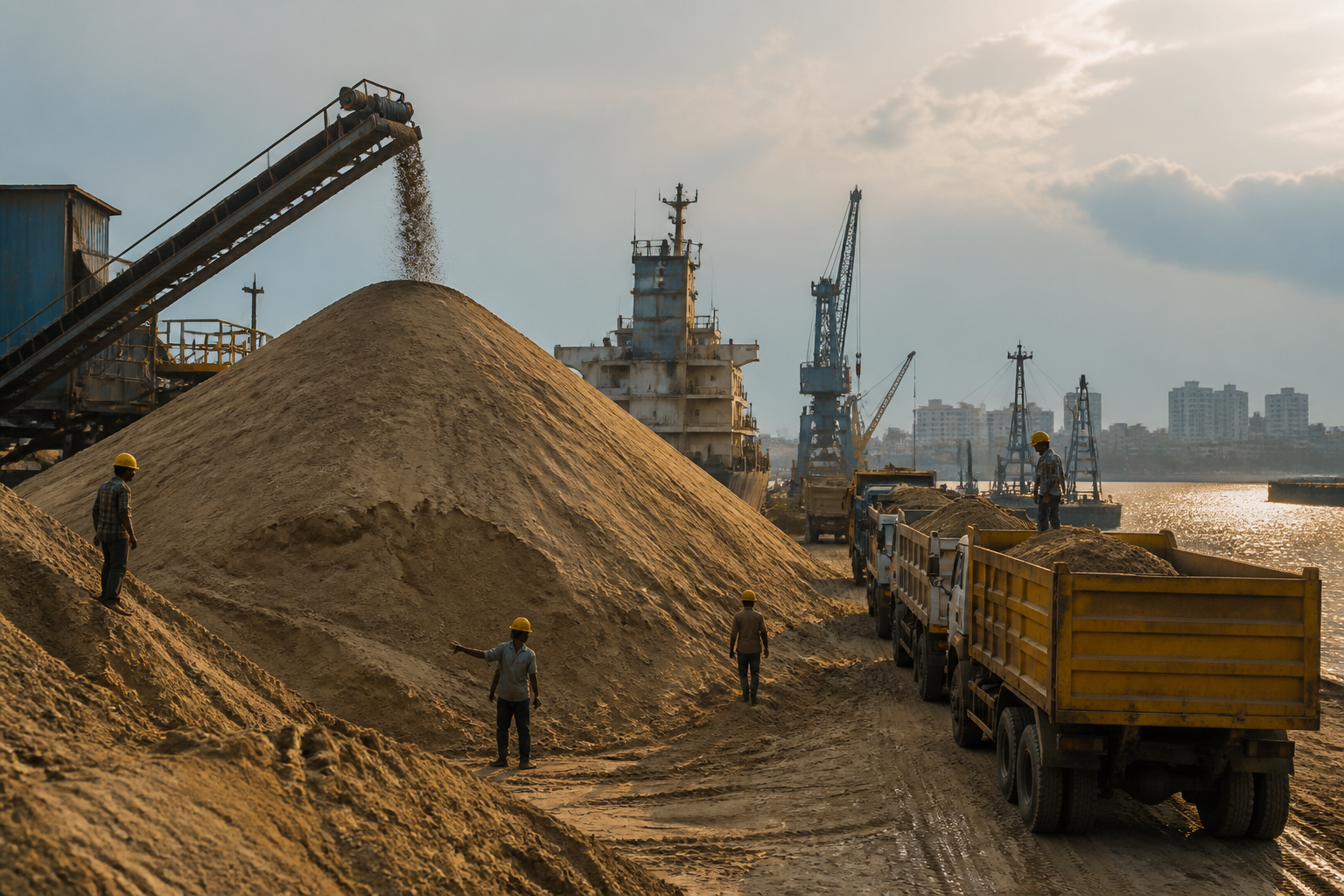
Tamil Nadu’s plan to import river sand from Malaysia is not simply a procurement decision. It is the latest response to a domestic supply system disrupted by quarry closures, stalled replacement capacity and unresolved questions over the quality and regulation of alternatives such as manufactured sand. The decision could bring another source of construction material into the market, but the supplied report indicates that price, distribution and regulatory design will determine whether it becomes a functioning public system or another short-lived intervention.
The report published by Dinamalar says the Tamil Nadu government has given in-principle approval to import river sand from overseas. Sand is expected to be sold through the ports of Thoothukudi and Ennore, while the government works on rules governing pricing and sales. The proposal is being examined in the context of practices followed by Andhra Pradesh and Karnataka, which the report says already import sand from foreign markets.
The immediate reason for the move is a domestic supply gap. According to the report, 13 sand quarries that had been operating in Tamil Nadu were shut in 2023 because of an Enforcement Directorate case. The government subsequently decided during the previous DMK administration to open quarries at 30 new locations. Although environmental clearances were obtained, the work did not progress because of problems involving contractors.
These figures show the scale of the institutional problem. The state did not merely lose a few extraction points; it lost an established network of 13 operating sites and then failed to convert an approved expansion plan into working capacity at 30 proposed locations. The result, as described in the report, is a construction-material market in which demand continues but legal and organised domestic supply has not been restored.
That distinction matters because sand is not an interchangeable commodity in the way a simple supply chart might suggest. The construction sector needs material that meets applicable requirements for building work, can be transported reliably and is sold through a system that gives buyers confidence about its source and quality. When an organised supply chain weakens, the pressure shifts to private sellers, substitute materials and informal procurement channels. The report’s account points to that transition without providing data on the size of the shortfall or the volume of material currently required by Tamil Nadu’s construction sector.
The state’s response has two linked parts. One is to reopen sand quarries and sell the material through an online system. The other is to use imported river sand while the domestic system is being reorganised. The government has reportedly ordered that the existing online sales mechanism be redesigned with newer technology. Work on that system is being carried out through the Water Resources Department and the Department of Geology and Mining.
The online-sales proposal is significant because it treats availability and administration as connected problems. A quarry cannot solve a supply crisis if buyers cannot access material transparently, if allocations are difficult to monitor or if prices vary sharply between locations. The report does not specify the technology being introduced, the proposed allocation rules, the number of users or the safeguards planned for the revised platform. It does, however, indicate that the government sees digital distribution as part of the answer rather than treating imports or quarry reopening as stand-alone measures.
The proposed import plan also has a previous Tamil Nadu precedent. The report says imported sand had earlier been sold through Thoothukudi and Ennore ports. That effort was disrupted because imported river sand cost more than river sand and M-sand available within the country. This earlier experience creates the central economic test for the current proposal: imported material may increase supply, but it will not necessarily become a practical alternative for builders or households if its delivered price remains higher than domestic substitutes.
The report does not provide the earlier import price, current domestic prices, shipping costs, handling charges or the price at which the government expects imported sand to reach consumers. Without those figures, it is not possible to establish whether the new proposal has solved the problem that weakened the earlier effort. The government is still framing rules on pricing and sales, according to the official statement cited by Dinamalar. Those rules will therefore be as important as the decision to import itself.
The concern over alternatives is another part of the policy challenge. Dinamalar reports that M-sand of poor quality is being sold by companies involved in crushing hard rock. It further reports an official concern that buildings constructed using such material could face a risk of collapse. These claims are attributed to the source report and should not be read as evidence that all M-sand is unsafe. The material issue is whether the state can distinguish compliant manufactured sand from substandard products and enforce those distinctions across a large and fragmented market.
This is where construction-material governance becomes a public-safety question. A shortage of river sand can increase demand for substitutes, but substitution requires standards, testing, traceability and enforcement. The supplied report does not identify the technical standards being applied to M-sand, the agencies responsible for testing, the number of non-compliant sellers or any confirmed building failures linked to poor-quality material. It establishes that the government is concerned about quality and is using that concern to justify renewed intervention in supply.
The proposed system consequently has three separate administrative tasks. The first is restoring legal domestic extraction by opening new quarries or reviving capacity where approvals and contracts permit. The second is creating a controlled import and port-distribution chain. The third is regulating the quality and sale of alternative materials, including M-sand. Treating only one of these as the problem could leave the underlying supply instability unresolved.
The institutional responsibilities are already spread across departments. The Water Resources Department and the Department of Geology and Mining are involved in the online-sales work, while environmental clearances and contractor arrangements have affected the opening of new quarries. Port-based imports will also require coordination between the state’s sales system and the logistics of receiving, storing and distributing material. The report does not set out the precise division of responsibility between these agencies, nor does it identify the proposed operator of the import programme.
The geography of the plan is important. Thoothukudi and Ennore provide maritime entry points, but sand imported through ports must still reach construction markets across Tamil Nadu. The cost and reliability of that movement will depend on handling and inland transport arrangements, none of which are detailed in the supplied report. A port announcement therefore cannot by itself demonstrate statewide availability. The practical test will be whether material reaches buyers beyond the ports at a price and speed that make it usable for construction.
The numbers available in the report describe administrative capacity rather than market demand: 13 operating quarries were closed in 2023, 30 new quarry sites were proposed, and two ports were identified for sales of imported material. No import quantity, delivery schedule, expected consumer price, quarry-opening deadline or construction-demand estimate is provided. These omissions matter because they prevent a direct comparison between the proposed intervention and the scale of the shortfall.
The reference to Andhra Pradesh and Karnataka also points to a wider regional pattern. States are looking beyond local extraction when domestic supply, regulation or environmental constraints make conventional procurement difficult. But the report provides no comparison of the two states’ import volumes, prices, distribution systems or regulatory outcomes. Their experience is therefore a reference point for Tamil Nadu’s policy design, not proof that the same model will work under identical conditions.
The larger urban question is whether Tamil Nadu can build a construction-material system that is simultaneously available, affordable, legal and safe. Quarry closures address environmental and enforcement concerns but can create a supply shock if replacement capacity is delayed. Imports can provide an additional source but may struggle against higher landed costs. M-sand can reduce dependence on river sand, but only if quality control is credible and consistently enforced.
The state’s in-principle approval is therefore an important policy signal, not yet evidence of a functioning import programme. The next decisive steps will be the publication of pricing and sales rules, the redesign of the online platform, the implementation of the 30-quarry plan, and the confirmation of how imported sand will move from Thoothukudi and Ennore to consumers. Until those details are available, Tamil Nadu’s sand strategy remains a response to a recognised supply failure whose administrative and economic outcomes are still unresolved.
