


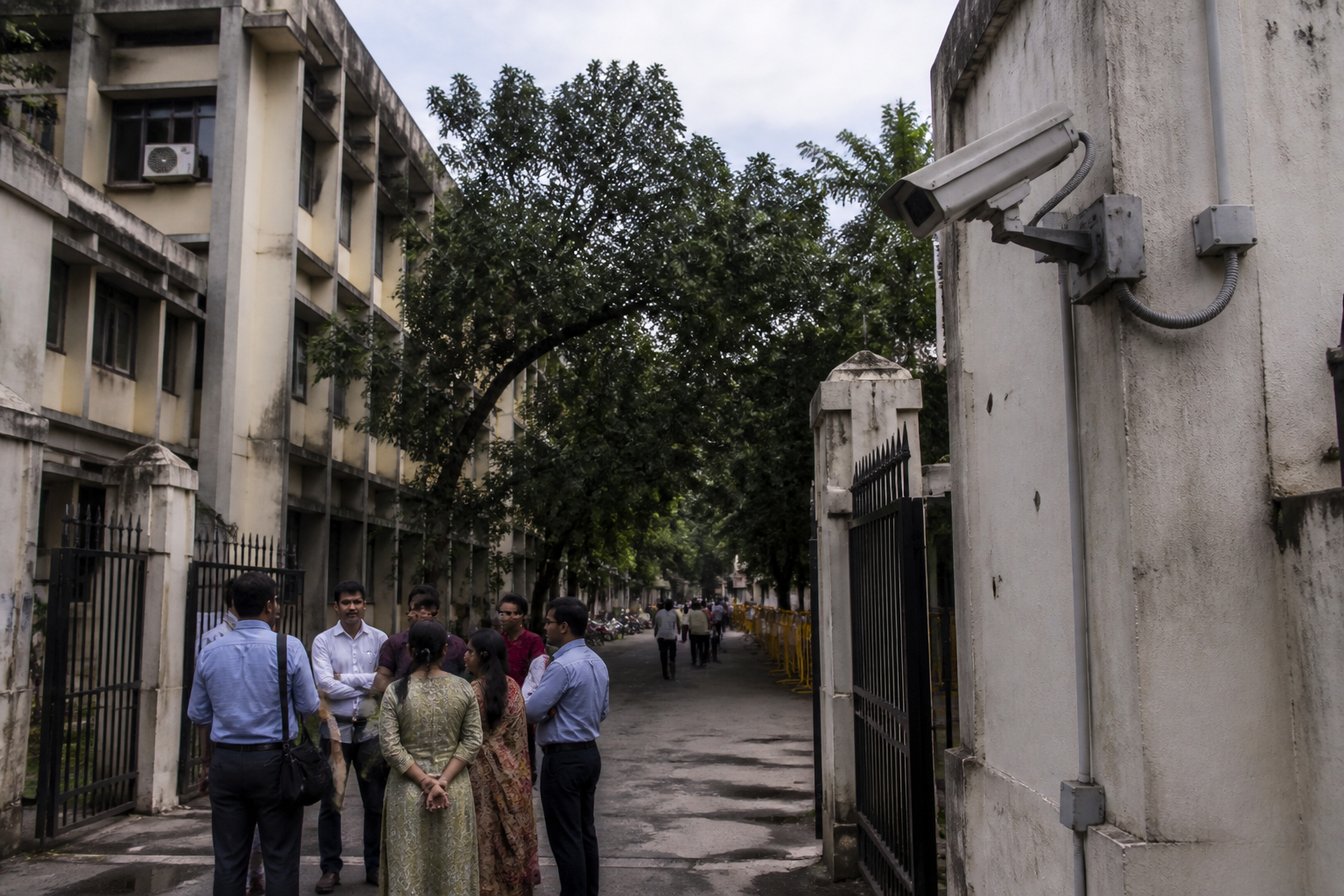
The Jadavpur University inquiry into the August 19-20 campus vandalism has moved into a contested phase, with the commission considering whether to examine a demand for an FIR over the alleged leak of CCTV footage. The development is significant not because it resolves what happened on campus, but because it shows how an institutional investigation can become a parallel dispute over evidence, access and accountability.
The inquiry commission met at the university’s Salt Lake campus almost a month after the violence. According to vice-chancellor Chiranjib Bhattacharjee, the commission is examining the events of August 19 and August 20 and has received a letter from the Akhil Bharatiya Rashtriya Shaikshik Mahasangh, or ABRSM, seeking an FIR against those who allegedly leaked CCTV footage to journalists. Bhattacharjee said the commission could record the depositions of anyone it considered necessary if it decided to examine the demand.
That position reflects the quasi-judicial character of the commission, but it also places the issue of evidence management at the centre of a wider institutional dispute. CCTV footage is potentially central to reconstructing movement, access and responsibility during a campus disturbance. At the same time, the report does not establish who allegedly leaked the footage, whether the leak breached a specific legal provision, or whether the commission has decided to investigate that question. Those matters remain subject to the commission’s process.
The university official quoted in the report said a list of people had been prepared on the basis of statements, video footage and documents submitted by people with knowledge of the events. Nineteen people are expected to depose by the end of the month. The commission had earlier issued a public notice inviting evidence from anyone with knowledge of the incidents.
This sequence matters because an inquiry is not simply a record of competing claims. It is also a mechanism for deciding which evidence is admissible, who is heard and how an institution establishes a credible account of an event. The university’s decision to appoint a retired Calcutta High Court judge as head of the commission gives the process a formal structure. However, credibility will depend on whether the process is seen as sufficiently independent, timely and comprehensive by the groups affected by the violence.
The commission’s composition has already been contested. The university appointed the retired judge after the teachers’ Mahasangh opposed the appointment of former vice-chancellor Subha Shankar Sarkar. Abul Hasnat, a university deputy registrar, was also dropped from the commission following objections from the association. The vice-chancellor said the start of the probe was delayed because the composition had to be changed, rejecting allegations that the commission was deliberately slowing the inquiry.
The delay has become a source of frustration among a section of students. Rijupalika Mukherjee, an undergraduate student quoted in the report, said the university had filed an FIR at Jadavpur police station on August 21 and provided CCTV footage, but alleged that the police had not taken action against those responsible for the vandalism. She also argued that the discussion over who leaked footage could divert attention from the violence itself.
The competing claims show the institutional problem facing the inquiry. For students who experienced or witnessed the violence, the central question is whether those responsible will be identified and held accountable. For the teachers’ association, the alleged selective release of sensitive footage during a police investigation is itself a possible criminal matter. Both questions can exist at the same time, but they require different forms of examination and cannot be resolved through political or institutional assertions alone.
The reported events of August 19 and August 20 involved multiple allegations. The trouble reportedly began with the alleged assault of ABVP unit president Nikhil Das by Left supporters on the evening of August 19. Early on August 20, attackers allegedly threw fireballs at students behind a locked grille near the portico of the administrative headquarters and threatened to outrage their modesty. Later that afternoon, suspected ABVP supporters allegedly tried to scale Gate No. 4 and damaged the university emblem designed by Nandalal Bose.
The report also refers to footage that allegedly showed Buddhadeb Sau, a former Jadavpur University vice-chancellor and member of the teachers’ Mahasangh, speaking with ABVP central committee member Subhabrata Adhikari near Gate No. 4. The account does not establish what the conversation meant or whether it demonstrated involvement in the violence. That is precisely why the inquiry’s handling of video evidence, witness testimony and documentary material will be important.
The dispute has also acquired a wider political and institutional context. A student quoted in the report alleged that attention had been shifted towards anti-national graffiti on campus and that the university had moved quickly to whitewash it. The report says the chief minister visited Jadavpur University after the vandalism and criticised students over the graffiti. These allegations and responses form part of the competing narratives surrounding the incident, but they do not by themselves establish responsibility for the violence.
The university therefore faces two accountability tracks. The first is the substantive inquiry into the vandalism, alleged attacks, property damage and the conduct of people present on campus. The second concerns the chain of custody, confidentiality and public release of CCTV footage. Treating the second issue as proof that the first is being avoided would go beyond the evidence available. Equally, allowing the footage dispute to consume the inquiry before the underlying violence is examined could weaken public confidence in the process.
The institutional design of the investigation offers a way to keep these questions separate. The commission can identify the events it is examining, call witnesses connected to each allegation and distinguish direct evidence from interpretation. It can also clarify whether the demand for an FIR over the alleged leak falls within its inquiry and what material would be required before recommending further action. The police FIR filed on August 21 represents a separate law-enforcement process, and the report does not establish its current status beyond the student’s allegation that no action had been taken.
The numbers currently associated with the inquiry are limited but important. Nineteen people are expected to depose by the end of September, while the commission’s work began nearly a month after the August incidents. The university has already received statements, video footage and documents, and has invited further evidence through a public notice. These details indicate that the inquiry is moving from evidence collection towards testimony, but they do not yet demonstrate whether it will produce findings accepted by the principal parties.
For universities, the episode illustrates the difficulty of governing campuses where security systems, political activity, student mobilisation and public communication intersect. CCTV cameras can document events, but footage is not self-explanatory. Its interpretation depends on timestamps, completeness, context and testimony. Questions about who accessed or shared it can be legitimate, particularly where a police investigation is pending, but restricting public discussion without explaining the evidentiary process can also deepen distrust.
The deeper urban governance issue is the accountability of large public institutions during periods of disorder. Jadavpur University is not only an educational campus; it is a complex physical and administrative environment with gates, buildings, security systems, student groups, employees, visitors and public authorities. When violence occurs, responsibility is distributed across the university administration, police and the individuals involved. A credible inquiry must therefore establish not only what happened at particular locations, but also how access, security, reporting and institutional response functioned that night.
The commission’s next steps will determine whether the inquiry remains focused on reconstructing the August 19-20 events while addressing the separate question of the alleged CCTV leak. The immediate milestones are the depositions of the 19 identified people and any decision on whether additional individuals should be called. Until those proceedings produce findings, the allegations concerning the vandalism, the footage and the conduct of individuals remain matters for examination rather than established conclusions.
