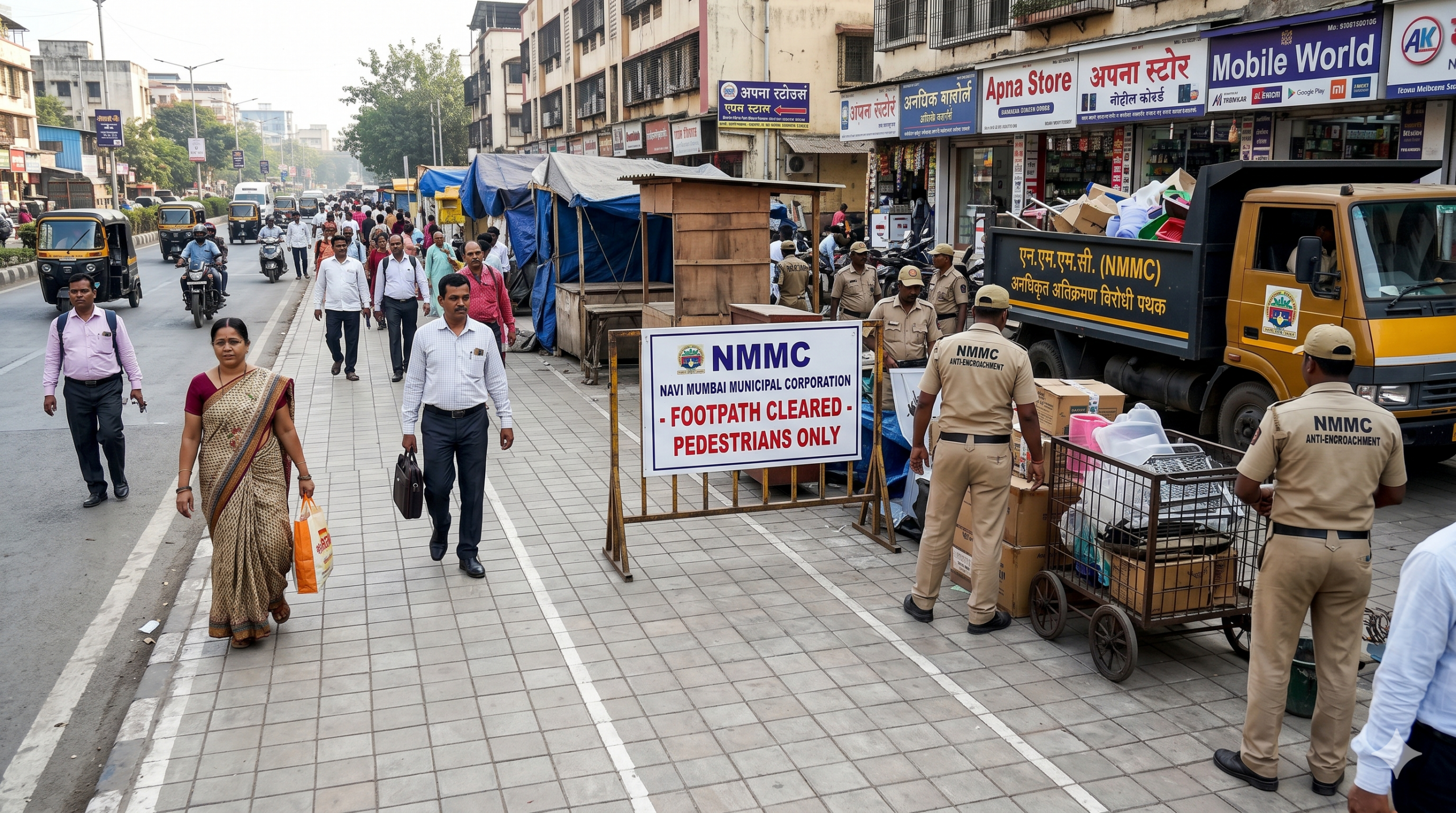
A sustained enforcement campaign in Navi Mumbai has led to the removal of thousands of unauthorised street vendors, significantly altering pedestrian access and traffic movement across key transit and commercial zones. The initiative, led by the civic administration, aims to restore public spaces while responding to mounting judicial and civic pressure to prioritise pedestrian rights in one of the region’s fastest-growing urban centres.
The Navi Mumbai hawker crackdown has been particularly focused on high-density areas surrounding railway stations and arterial roads, where footpaths had long been obstructed. Multi-shift operations have been deployed to ensure that cleared areas remain accessible, with civic teams maintaining a continuous presence to prevent re-encroachment. Officials indicate that the effort is part of a broader strategy to improve urban mobility and safety. The scale of the Navi Mumbai hawker crackdown reflects the depth of the challenge. Over recent months, tens of thousands of unauthorised vending instances have been addressed across multiple nodes, with concentrated action in commercial and transport hubs. Major corridors linking industrial and residential areas have also seen clearance, improving traffic flow and reducing bottlenecks.
Urban planners note that reclaiming pedestrian infrastructure is critical to building inclusive and climate-resilient cities. Walkable streets reduce dependence on motorised transport, lower emissions, and improve public health outcomes. In dense urban clusters, unobstructed footpaths are essential for safe mobility, particularly for women, elderly citizens, and children. However, the enforcement has also brought into focus the socio-economic dimension of street vending. Informal retail plays a significant role in urban economies, providing livelihoods to thousands while offering affordable goods and services to residents. Experts emphasise that long-term solutions must balance enforcement with rehabilitation, including designated vending zones, licensing frameworks, and access to basic infrastructure.
Civic officials maintain that action is being taken against those operating outside authorised systems, with a focus on restoring order in public spaces. At the same time, the administration faces the challenge of implementing national street vending regulations that call for surveys, identification, and protection of eligible vendors. The absence of fully operational vending plans often leads to cycles of eviction and return, limiting the effectiveness of enforcement drives. The impact of the current campaign is already visible in several neighbourhoods, where improved walkability has eased commuter movement and reduced conflicts between pedestrians and vehicles. Yet, certain high-activity markets continue to experience congestion, pointing to the need for targeted planning interventions rather than uniform enforcement.
As Navi Mumbai continues its transition into a major urban and economic hub within the Mumbai Metropolitan Region, the Navi Mumbai hawker crackdown underscores a broader governance question: how cities can equitably manage limited public space. The next phase will likely depend on integrating enforcement with inclusive urban design, ensuring that both mobility and livelihoods are accommodated within a structured and sustainable framework.
NMMC Hawker Crackdown Reclaims Footpaths Across City Zones