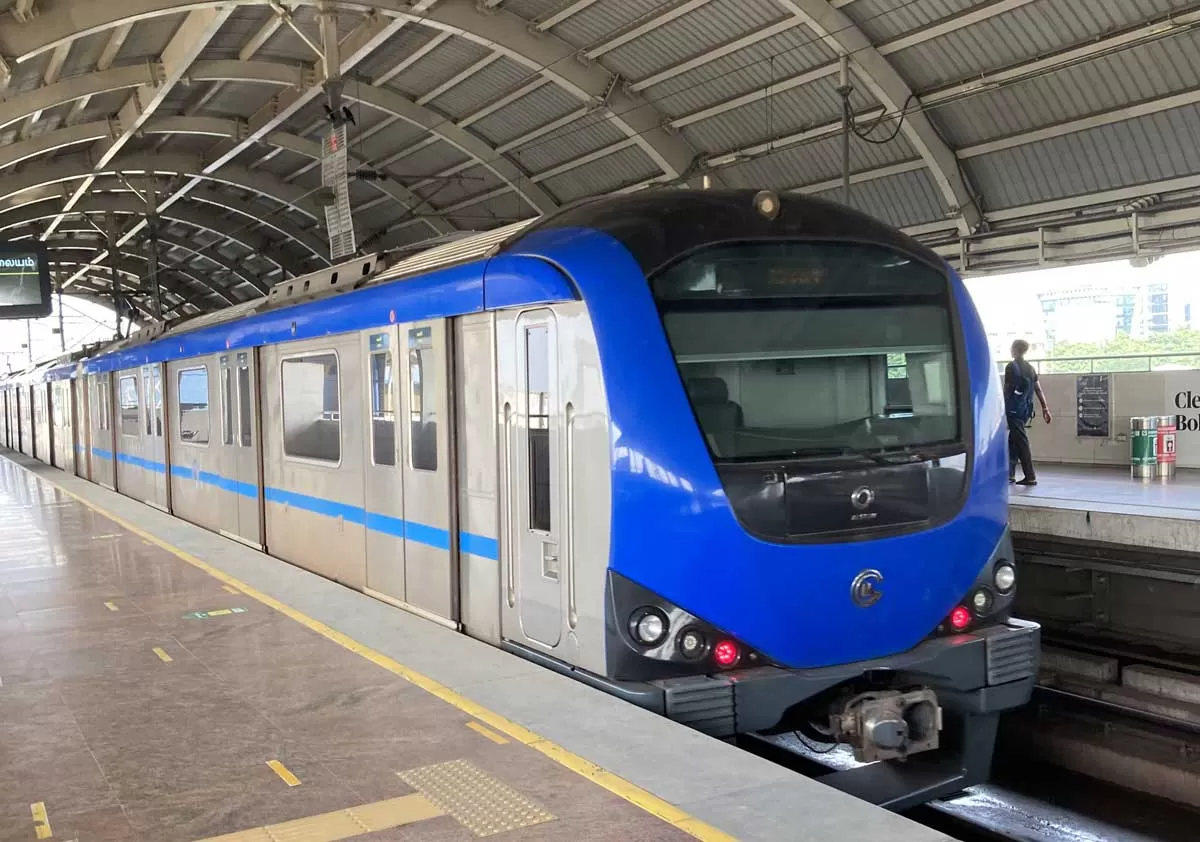
Chennai’s long-awaited Metro Phase II rollout is moving into its final regulatory stage, with authorities preparing to operationalise the first completed corridor connecting Poonamallee and Vadapalani. The opening of the stretch is expected to significantly reshape daily mobility patterns in the city’s western suburbs while easing pressure on some of Chennai’s most congested arterial roads.
The nearly 15-km operational segment forms part of the larger 118.9-km Chennai Metro Phase II programme, one of India’s most ambitious urban transit expansions currently under execution. Officials familiar with the process indicated that safety clearances for the remaining portion of the corridor are in advanced stages, following compliance work linked to inspection observations. Transport planners say the launch carries implications beyond mobility. The corridor passes through rapidly urbanising neighbourhoods where residential and commercial growth has intensified over the past decade. Improved transit connectivity is expected to reduce travel time between peripheral residential zones and employment centres, potentially altering commuting choices for thousands of daily passengers.
The Chennai Metro Phase II project has also become central to the city’s broader climate and infrastructure agenda. Urban mobility experts note that Chennai’s increasing dependence on private vehicles has contributed to traffic bottlenecks, rising fuel consumption, and deteriorating air quality along major corridors such as Arcot Road and Poonamallee High Road. Expansion of mass rapid transit systems is increasingly viewed as essential to limiting transport-related emissions in dense metropolitan regions.
According to infrastructure analysts, the western corridor’s launch could trigger a fresh wave of transit-oriented development, particularly around station zones. However, experts caution that Metro-led growth must be accompanied by pedestrian-friendly access, last-mile connectivity, and affordable housing safeguards to prevent uneven urban expansion and rising land speculation. The Chennai Metro Phase II network is designed to connect several underserved areas that previously lacked high-capacity public transport infrastructure. Urban researchers point out that equitable transit access remains critical for improving economic participation, particularly for lower-income workers who spend a disproportionate share of earnings and time on daily travel.
The project’s phased opening comes at a politically significant moment for Tamil Nadu, with a new administration expected to assume office shortly. Large-scale infrastructure launches often shape the early governance narrative of incoming governments, especially in cities where transport delivery is closely tied to public perception of urban management. While the first operational section is nearing readiness, the larger challenge for Chennai Metro Phase II lies in integration. Experts argue that seamless coordination with buses, suburban rail, non-motorised transport systems, and accessible station design will determine whether the network can meaningfully reduce private vehicle dependence over the long term. As the city prepares for the first trains to begin operations on the new stretch, attention is likely to shift toward execution timelines for the remaining corridors and whether Chennai can leverage mass transit investment to build a more sustainable and commuter-focused urban future.