


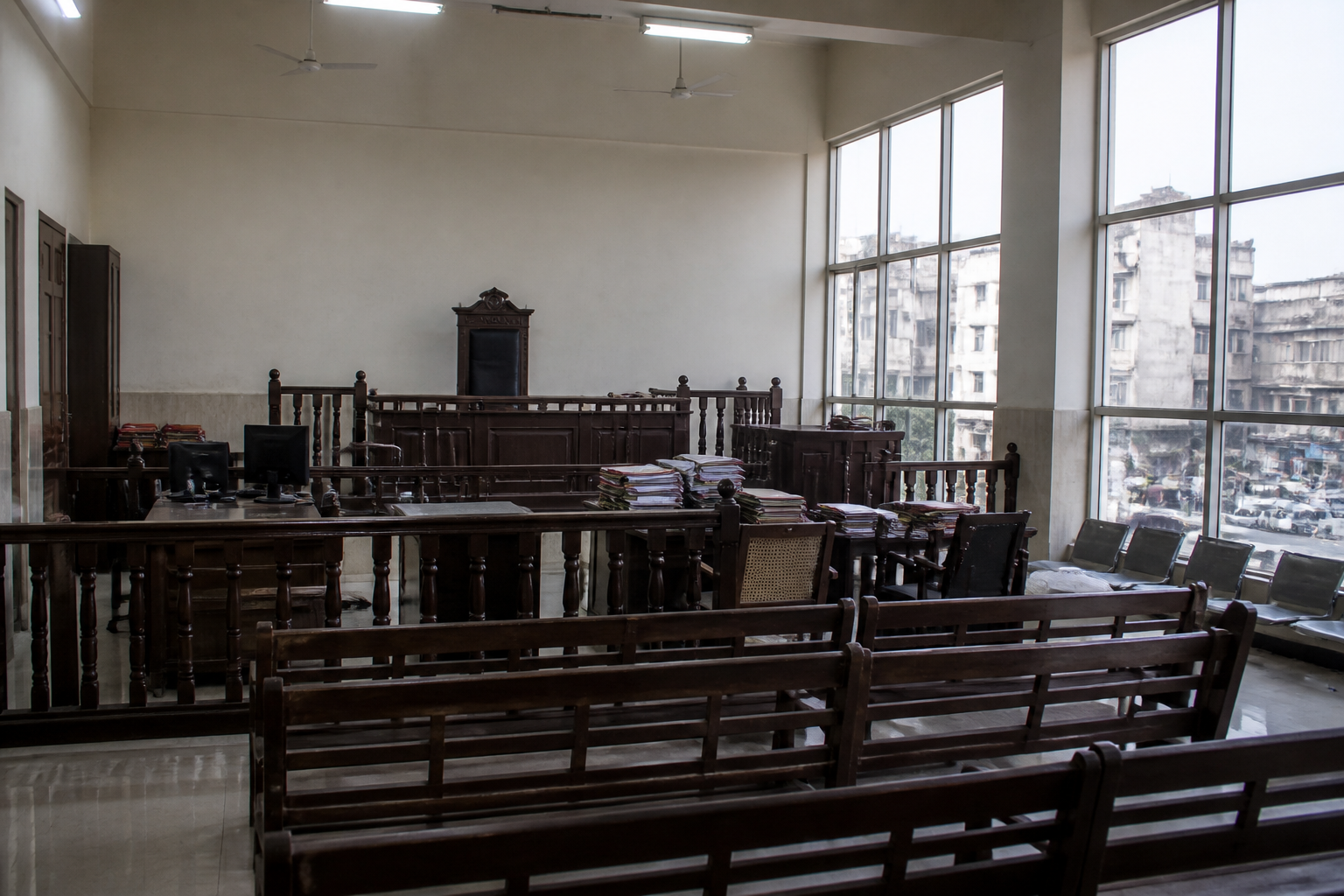
Maharashtra’s judicial system is expanding on paper while operating with barely two-fifths of its sanctioned strength, a gap that exposes the institutional limits behind the state’s growing court pendency. An affidavit filed by the state Law and Judiciary Department records that only 2,116 of 5,195 sanctioned judicial posts were filled in 2026, leaving nearly 60 per cent vacant.
The figures came before the Bombay High Court in proceedings related to appointments to civil judge junior division and Judicial Magistrate First Class posts. Chief Justice Mahesh Chandra Tripathi described the situation as “glaring” and said urgent steps were required to fill the vacancies. His observations placed the staffing shortage alongside a wider question: whether creating more posts can improve judicial capacity when thousands of existing positions remain unoccupied.
That question matters because courts are not only legal institutions. They are public services that depend on a chain of physical and administrative capacity: judges, courtrooms, registry staff, prosecutors, police coordination, case records and other infrastructure. When one part of that system expands faster than the others, the formal availability of justice may not translate into faster disposal of cases.
The affidavit shows how sharply Maharashtra’s sanctioned judicial strength has changed. In 2014, the state had 1,909 sanctioned judicial posts, of which 1,643 were filled. That represented a working strength of 86.07 per cent. The state’s filled strength was therefore substantially higher in proportion to its sanctioned capacity than it is today.
Following circulars issued in 2024, the sanctioned strength increased and reached 5,196 posts in 2025. Yet the working capacity recorded for that year was 2,054 officers, or 39.53 per cent. In 2026, the sanctioned strength stood at 5,195 posts, while only 2,116 were filled, taking the working strength to 40.73 per cent.
The comparison is significant not simply because the number of vacancies is large, but because the expansion of sanctioned posts has not been matched by recruitment and staffing. Between 2014 and 2026, the number of sanctioned posts more than doubled, while the proportion of posts filled fell by more than 45 percentage points, according to the figures cited in the report.
This creates a capacity problem that cannot be understood through sanctioned strength alone. A sanctioned post represents an authorised position. It does not, by itself, provide a functioning judge, a courtroom, administrative support or the operational resources required to hear and decide cases. The distinction between authorised capacity and working capacity is therefore central to understanding Maharashtra’s judicial infrastructure.
The pressure is visible in the state’s case backlog. Maharashtra’s district, sessions and magistrate courts face a pendency of more than 61 lakh cases, according to the National Judicial Data Grid. The supplied material does not establish that every pending case is caused by judicial vacancies. Pendency can reflect several factors, including the volume and complexity of litigation, procedural requirements, adjournments, investigation and prosecution processes, and the availability of court infrastructure. But the staffing figures show that the courts are dealing with this workload while a substantial share of their authorised judicial positions remains unfilled.
The issue is particularly relevant to proposals for fast-track courts. The affidavit was filed in response to an interim application in a public interest litigation by activist Vihar Shivajirao Durve. The petition seeks directions to establish fast-track courts for cases involving crimes against women and children. The state also faces a shortfall in functional fast-track courts, according to the report.
Fast-track courts are often presented as an institutional response to urgent categories of cases. However, their effectiveness still depends on the basic conditions of court administration: appointed judicial officers, supporting staff, suitable premises and the administrative systems needed to move cases through the process. If the wider judicial cadre is operating at about 40 per cent of sanctioned strength, the question of staffing becomes inseparable from any plan to create additional specialised capacity.
Chief Justice Tripathi questioned a proposal to create around 3,000 additional judicial posts while thousands of existing positions remain vacant. “Where is the justification to increase the number?” he asked, according to the report, while also pointing to the need for infrastructure and other associated facilities. He said that the proposed expansion would depend substantially on state facilitation.
The observation identifies two separate but connected administrative tasks. The first is recruitment and appointment to posts that already exist. The second is the creation and resourcing of new posts. Treating the second task as a substitute for the first could produce a larger sanctioned establishment without a proportionate increase in working capacity. Conversely, filling current vacancies without providing adequate courtrooms, staff and related infrastructure could leave the system constrained in a different way.
The institutional chain is also visible in the Chief Justice’s reference to a committee and the Public Service Commission. During the hearing, he said he had constituted a committee after encountering the shortage while reviewing judicial infrastructure and cadre strength earlier in the month. He indicated that the matter would be passed on to the Public Service Commission. The statement suggests that recruitment is not controlled by the High Court alone and requires coordination across judicial and state institutions.
This division of responsibility is important for understanding why vacancy figures can persist even after sanctioned strength has been increased. Authorisation, recruitment, selection, appointment and infrastructure provision involve different stages and institutions. A court may identify the need for more judges, while the process of filling posts depends on the state’s administrative machinery and the relevant recruitment mechanism. The report does not provide a timeline for completing the appointments, so the pace at which the gap can be reduced remains unclear.
The numbers also show why headline capacity can be misleading. In 2025, Maharashtra had 5,196 sanctioned posts but a working strength of 2,054. In 2026, the sanctioned total was marginally lower at 5,195, while filled posts increased to 2,116. That improvement in absolute numbers did not materially alter the overall picture: the working strength remained only 40.73 per cent of sanctioned capacity.
The contrast with 2014 is sharper. At that time, 1,643 filled posts represented 86.07 per cent of 1,909 sanctioned posts. By 2026, the state had 473 more filled posts than in 2014, but more than twice as many sanctioned positions and a far lower fill rate. The data therefore points to an expansion in the formal system that has outpaced the institutions responsible for making that expansion functional.
For citizens, the consequences of this gap are experienced through the time and uncertainty associated with court proceedings, although the supplied material does not quantify how long individual categories of cases take or how vacancies affect specific districts. The available evidence supports a narrower conclusion: Maharashtra’s courts are carrying a pendency of more than 61 lakh cases while operating with a large proportion of judicial posts vacant, and the High Court has identified the situation as requiring urgent attention.
The urban dimension lies in the way judicial capacity supports the wider functioning of cities and districts. Courts handle disputes involving residents, businesses, public agencies and criminal justice institutions. Their performance depends on buildings, staffing, recruitment systems and coordination between levels of government. Judicial infrastructure is therefore not only a question of courtroom construction. It includes the institutional capacity to operate those courts once posts are sanctioned and premises are available.
The immediate policy choice before Maharashtra is consequently not limited to whether more posts should be created. It is also whether the state can fill existing vacancies, provide the required infrastructure and make the recruitment process work at the scale implied by the sanctioned strength. The Chief Justice’s remarks bring these questions into the same frame as the proposal for around 3,000 additional posts.
What the evidence confirms is a widening gap between authorised and working judicial capacity. It also confirms that the gap is being considered alongside a pendency exceeding 61 lakh cases and a shortfall in functional fast-track courts. What remains to be established is the appointment timeline for vacant posts, the district-wise distribution of vacancies, the infrastructure available for additional officers and the state’s response to the High Court’s concerns. Those details will determine whether Maharashtra’s next expansion is merely numerical or produces a larger functioning court system.
