


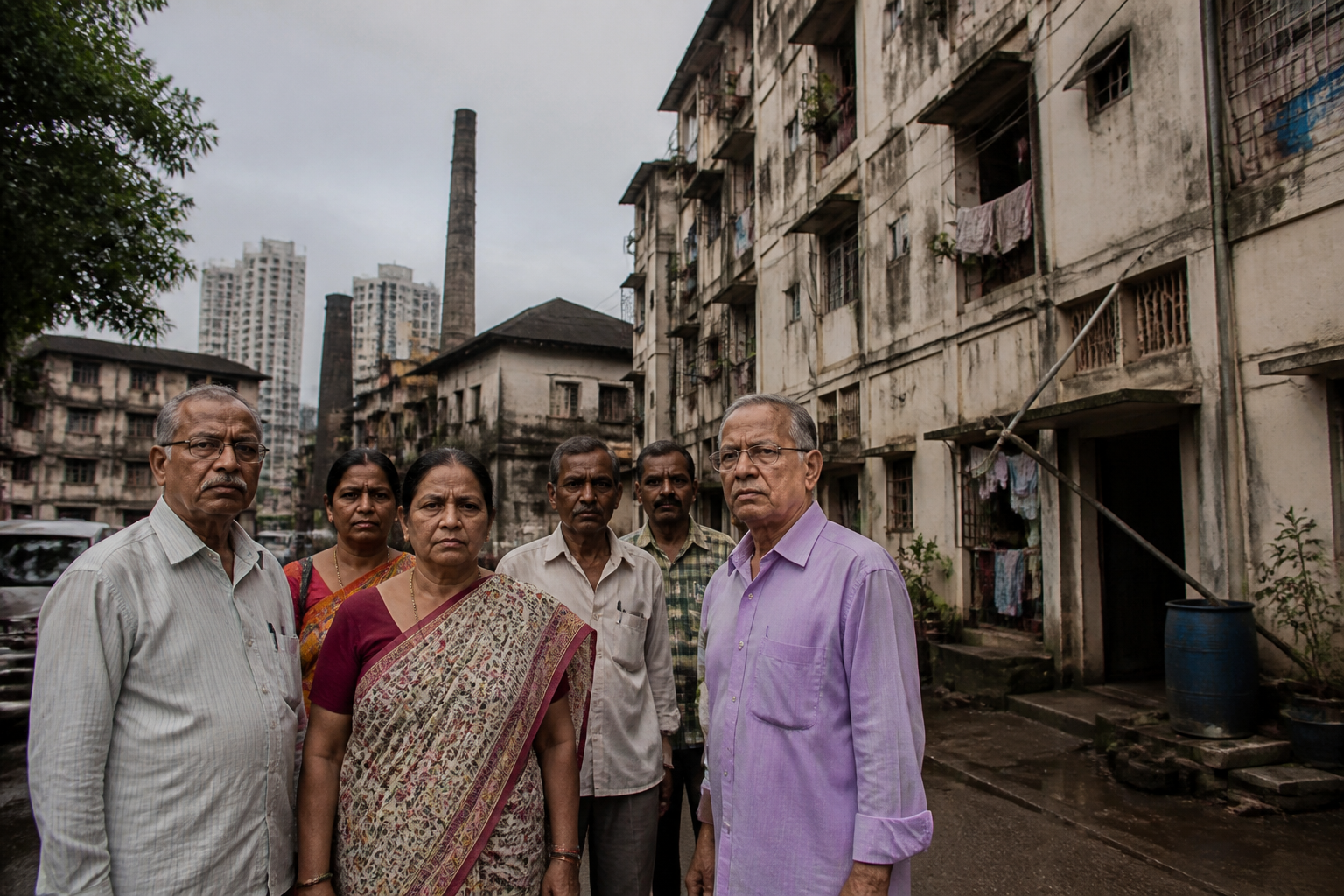
The continuing wait for homes promised to Mumbai’s mill workers has become a housing and governance problem extending across generations. More than 100,000 workers and heirs are still waiting, even after housing lotteries and schemes have transferred homes to only a fraction of the applicants who entered the process.
The scale of the delay is visible in the numbers reported by Loksatta. The Maharashtra Housing and Area Development Authority, or MHADA, has received nearly 1.75 lakh applications in two phases. Approximately 16,000 applicants have received homes through the process so far. Of the remaining roughly 1.5 lakh applicants, only 1.09 lakh have submitted documents for eligibility determination. The figures show that the housing pipeline is not simply waiting for construction or allotment; it is also still moving through an unresolved verification process.
For families, however, the administrative stages are experienced as years without a secure home. Harsha Ganesh More, whose father worked at Kohinoor Mill in Naigaon, told the publication that her family lost its livelihood after the 1982 textile strike and mill closures. Her father worked as a daily-wage labourer for the next decade while trying to support the family. His health deteriorated, and he died in 2015 without seeing the home he had hoped to receive. More said her own generation has now crossed the age of 50 while continuing to wait.
Her account illustrates the central difficulty in the mill-worker housing system: the original beneficiary is increasingly being replaced by heirs. Worker organisations told Loksatta that more than 50 per cent of mill workers are no longer alive. Since the original applicants are dying, descendants are submitting claims and attempting to establish their eligibility. MHADA’s Mumbai Board does not have an exact figure for the number of heirs, according to officials cited in the report, even as the number of successor claims grows.
That transition changes the administrative character of the programme. A scheme originally designed around workers who were employed by the mills must now establish relationships between deceased applicants and their heirs. It must also process documents that may have been generated over several decades, while dealing with families whose addresses, economic circumstances and household structures have changed. The supplied report does not establish how many applications are rejected, how many remain incomplete or how long each eligibility stage takes. But the available figures indicate that documentation is a major gateway to any future allotment.
The policy promise dates back to 2000, when a decision was taken to provide free homes on mill lands for the rehabilitation of textile workers. MHADA’s Mumbai Board was assigned responsibility for constructing and distributing the homes. The arrangement placed the programme within a broader redevelopment framework in which land once occupied by textile mills was expected to generate a rehabilitation benefit for workers affected by the collapse of the industry.
According to the report, MHADA has conducted three lotteries for homes built on mill lands and one for homes under a rental housing scheme of the Mumbai Metropolitan Region Development Authority, or MMRDA. Together, these four lotteries have provided homes to an estimated 16,000 workers and heirs. Against the nearly 1.75 lakh applications submitted in two phases, that number represents a limited reach. The report also states that more than 100,000 workers and heirs remain in the queue.
The gap between the original policy decision and the present beneficiary count raises a question about how rehabilitation commitments are measured. A government programme can be considered active because lotteries have been held and some homes have been distributed. For families still waiting, the relevant measure is different: how many eligible households have received homes, how many claims remain unresolved, and whether the promise survives the death of the original worker.
Laxman Walvekar, whose father worked at Jupiter Mill and died in 1998, is another example cited by the publication. Walvekar’s family is living in a rented home in Pratikshanagar and is facing financial difficulty. He has asked the government to treat the housing issue of mill workers and their heirs seriously and resolve it. His account, along with More’s, places the institutional backlog against the everyday reality of rental dependence and limited household finances.
The housing question is inseparable from the history of Mumbai’s textile economy. The 1982 strike devastated mill workers, according to the report, and the subsequent rehabilitation promise was intended to address the consequences of that economic rupture. But the city has changed substantially during the decades in which families have waited. The longer the process continues, the more the programme becomes a test of whether a public commitment can remain administratively workable after its original beneficiaries have aged or died.
The structure of responsibility is also significant. MHADA’s Mumbai Board is responsible for the construction and distribution of homes under the mill-land rehabilitation arrangement, while one of the reported lotteries involved an MMRDA rental housing scheme. This means that the beneficiary’s experience can depend on coordination between eligibility records, land-linked housing supply and lottery administration. The report does not provide a consolidated account of the total housing stock still to be built or distributed, nor does it specify a deadline for completing the process.
That absence of a clear completion timeline is important because the queue is not static. A long-running application process creates additional administrative work whenever a worker dies and an heir seeks recognition. It can also create uncertainty over which documents are accepted and how families prove succession. The report says that the exact number of heirs is not available with MHADA, making it difficult to assess the full size of the current obligation from the information supplied.
The available numbers nevertheless establish three distinct layers of the problem. First, only about 16,000 applicants have received homes through the four reported lotteries. Second, roughly 1.5 lakh applicants remain after those allotments, while 1.09 lakh have submitted documents for eligibility verification. Third, more than half of the original mill-worker population is reported to have died, shifting the claims increasingly towards heirs. These are not interchangeable categories, but together they show why the programme cannot be understood only as a housing-construction exercise.
It is also a question of records, succession and institutional capacity. The original policy was framed around workers. The current demand is increasingly being made by families. Until the authorities establish the eligible pool and clarify how successor claims are processed, the number of people waiting will remain difficult to determine precisely. The report’s figure of more than 100,000 people still awaiting homes therefore describes the scale of the reported backlog, while the absence of an exact heir count points to an unresolved administrative dimension.
For Mumbai, the mill-worker housing dispute reflects a wider urban challenge: rehabilitation promises often outlast the institutions, records and timelines through which they are delivered. A policy can be announced in one period, implemented through several agencies and inherited by families in another. When delivery extends across decades, the question is not only whether homes are being built, but whether the system can preserve rights, verify claims and communicate a credible route to resolution.
The evidence supplied in the report confirms that MHADA lotteries have delivered homes to a limited share of applicants, while a large number of workers and heirs remain outside completed allotments. It also confirms that the beneficiary base is changing as original workers die and heirs enter the process. The next developments that require close monitoring are the completion of eligibility verification for the 1.09 lakh applicants who have submitted documents, the identification of the remaining eligible heirs and any official timeline for future housing allotments. Until those milestones are established, the 2000 rehabilitation promise will remain unresolved for a large section of the families it was meant to serve.

