


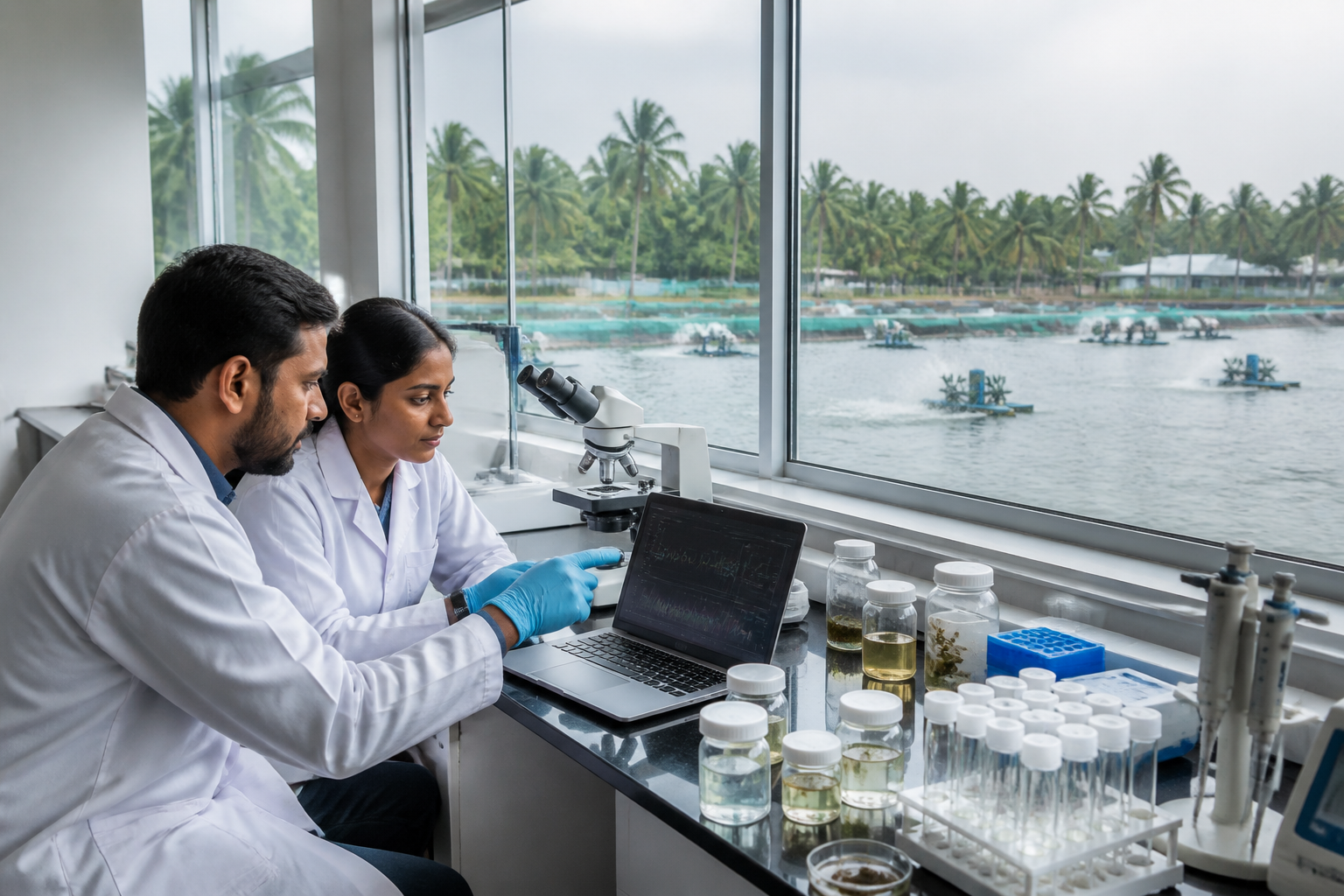
Researchers in Chennai have developed a database that brings together information on 690 chemicals used in aquaculture, creating an evidence base for a sector where chemical use, ecological risk and regulatory oversight are often difficult to assess together. ReCAnt, or Resource on Chemicals used in Aquaculture and their Ecotoxicity, was developed by the Institute of Mathematical Sciences in collaboration with the National Centre for Coastal Research and is available free of charge.
The database is important not simply because it is a new digital resource, but because it addresses an institutional problem: information about aquaculture chemicals has been scattered across scientific literature and different databases. For regulators, researchers and those monitoring coastal systems, the difficulty is not only knowing that a chemical is used. It is also understanding its toxic effects, environmental fate, movement through food webs, physicochemical characteristics and regulatory status in different countries.
That combination determines how a chemical should be assessed. A substance used to control disease or improve production may not remain confined to a pond or treatment system. The study associated with ReCAnt notes that chemicals can accumulate in organisms and potentially affect human health. The database therefore connects aquaculture management with ecological monitoring, food systems and public-health concerns rather than treating chemical use as a narrow production issue.
The resource covers chemicals used for several purposes, including antibiotics, disinfectants, pesticides, anaesthetics and water-treatment agents. These substances reflect the operational pressures of aquaculture, where disease prevention and production efficiency are central concerns. They also create a monitoring challenge because different chemicals may have different pathways through water, sediments, aquatic organisms and food webs.
ReCAnt attempts to make those pathways more visible. According to the information provided by the researchers, the database compiles data on therapeutic and toxic effects, environmental fate, movement through food webs and regulatory status across multiple countries. It also includes structural and physicochemical characteristics and integrates information from toxicological databases.
The value of such a system lies in bringing these categories together. A researcher examining a chemical’s potential ecological impact may need toxicology data, information about persistence and details of its reported use. A regulator may need to identify chemicals that warrant monitoring. A database that allows these questions to be examined together can support screening and prioritisation, even when it cannot by itself establish that a chemical is unsafe or illegal.
The study’s findings on regulatory information show why that distinction matters. Of 605 chemicals for which the researchers reviewed curated literature for regulatory information, 558 had no regulatory information reported in that literature. Forty-seven had at least one reported status. Cross-referencing with established regulatory lists increased the number of chemicals with some associated regulatory information to 57.
Those figures indicate a substantial information gap, but they do not establish that 558 chemicals are unregulated. The researchers specifically cautioned that the assessment was not exhaustive and that the absence of reported regulatory information did not mean a chemical had no regulatory status. This limitation is central to interpreting the database responsibly. Missing information is not proof of regulatory failure, but it is a reason for closer review.
The distinction also points to a common weakness in environmental governance: the difference between regulation that exists and regulation that is documented, accessible and usable. A chemical may be covered by a rule, restricted in a particular jurisdiction or assessed under a broader framework, while that information remains difficult to locate for researchers or monitoring agencies. Conversely, a lack of easily retrievable information can make it harder to decide what should be tested or tracked.
For Chennai and other coastal regions, the issue is connected to the way urban and peri-urban systems interact with aquaculture. The database was developed by Chennai-based research institutions, but the chemicals it covers may be relevant to aquaculture systems beyond the city. Aquaculture operates within wider watersheds and coastal environments, where water quality, farm management, food production and ecological health can intersect.
This does not mean that ReCAnt measures contamination in Chennai or identifies a specific local pollution event. The supplied study does not make that claim. Its role is different: it provides a structured information resource that can help researchers and authorities determine which chemicals require further assessment in particular aquaculture systems.
That potential for adaptation is one of the database’s most important features. The researchers said the resource could be adapted to specific aquaculture systems to screen chemicals of potential concern for monitoring and risk assessment. In practice, that means the same database could support different questions depending on the local production system, species, chemical-use pattern and environmental conditions being examined.
The institutional arrangement behind ReCAnt is also significant. The Institute of Mathematical Sciences brings expertise in data and scientific analysis, while the National Centre for Coastal Research is focused on coastal research. Their collaboration reflects the cross-disciplinary nature of chemical management in aquaculture. The problem cannot be addressed through production data alone, nor through toxicology without knowledge of coastal systems and aquaculture practices.
The database is not a substitute for enforcement, field sampling or regulatory decisions. It does not by itself show how frequently a chemical is used in a particular location, whether it has entered a water body or whether residues are present in food. Those questions would require system-specific investigation and monitoring. ReCAnt’s contribution is to make the existing evidence easier to find and compare before those decisions are made.
Its publication in Cell Reports Sustainability gives the work a documented research basis, while the free public availability of the database expands access beyond institutions with specialised information resources. Researchers can use it to identify chemicals for further study, and regulators can use it as a starting point for screening. The database may also help reveal where information is strong, where it is incomplete and which substances require a more detailed review.
The broader policy question is whether chemical management can keep pace with the complexity of aquaculture. A system based only on individual chemical approvals or isolated studies may miss interactions between production practices, environmental persistence and food-web movement. A searchable resource does not resolve that problem, but it can make the evidence architecture more coherent.
The numbers in the study also show why transparency and careful interpretation need to operate together. Reporting that 558 of 605 chemicals had no regulatory information in the reviewed literature could be misunderstood as proof that most chemicals are unregulated. The researchers’ qualification prevents that conclusion. It instead identifies a gap in documented information and points to the need for more systematic cross-referencing and assessment.
For urban and coastal governance, this is a familiar structural challenge. Environmental risks often cross administrative boundaries, while responsibilities are divided between research institutions, regulators, production systems and monitoring agencies. A database can improve the flow of information across those boundaries, but its impact will depend on whether authorities and researchers integrate it into local monitoring and risk-assessment processes.
ReCAnt therefore matters as both a scientific tool and a governance signal. It shows that the first step in managing chemical risk may be establishing what is known, what is uncertain and where information is missing. In aquaculture, that evidence must connect production needs with ecosystem protection, food security and human health.
What the database confirms is the scale and fragmentation of the available information: 690 chemicals are catalogued, while regulatory information remains limited in the reviewed literature. What it does not establish is the actual level of risk posed by each chemical in a specific aquaculture system. The next measure of its significance will be whether the resource is adapted for local monitoring, risk assessment and more consistent chemical-management decisions.
