


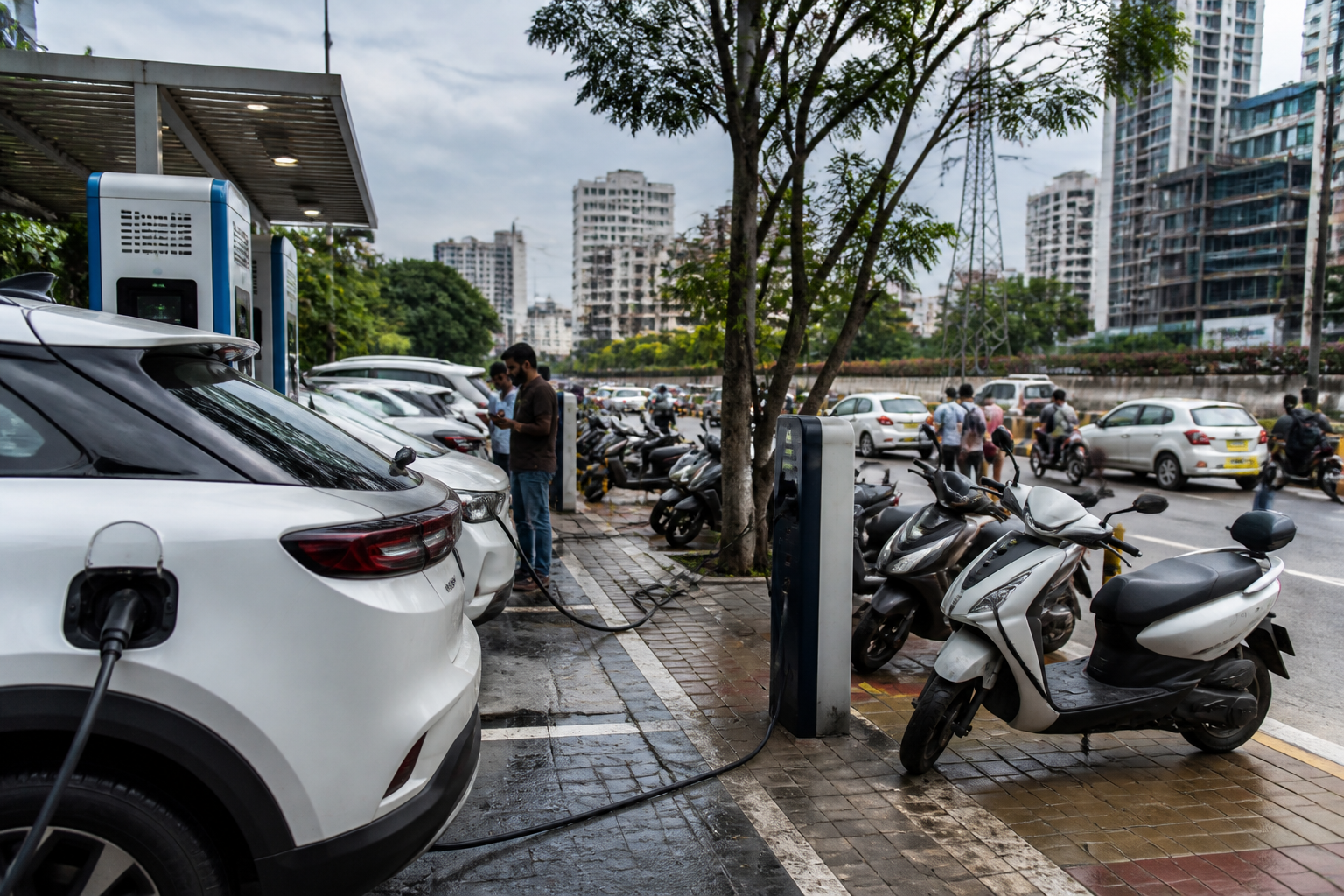
Karnataka’s third-place ranking in the India Electric Mobility Index 2025 highlights a state that has built an unusually strong policy and charging-infrastructure framework for electric transport. It also exposes a central urban challenge: much of that readiness is concentrated in Bengaluru, leaving the broader question of how evenly electric mobility can expand across the state.
The index, prepared by NITI Aayog in collaboration with WRI India, places Delhi first and Maharashtra second. Chandigarh and Goa follow Karnataka in the ranking. Karnataka scored 97 in the charging-infrastructure readiness category, the highest score in the country, according to a report released at a NITI Aayog workshop in New Delhi.
The ranking is based on the progress made by states and Union territories in electric mobility policy and implementation. It considers the institutional and infrastructure conditions required for electric transport rather than simply counting vehicles on the road. That distinction matters because electric mobility depends on a wider system: charging access, electricity connections, approvals, policy support, vehicle demand and manufacturing capacity must develop together.
For Karnataka, the score is linked to initiatives including Bescom’s EV Mitra platform, an integrated electric-vehicle charging application, a single-window approval system and an EV Accelerator Cell. These mechanisms indicate that the state’s electric-mobility effort is not limited to installing charging points. It also involves creating administrative systems through which charging operators, vehicle users and other stakeholders can access information and approvals.
That institutional layer is important in cities. A charging point is useful only when it is discoverable, operational, connected to the grid and located where vehicles can reasonably access it. Approvals can determine how quickly new facilities are installed, while a unified application can reduce the friction faced by drivers trying to locate available chargers. The index’s assessment therefore presents Karnataka’s performance as the outcome of policy and implementation choices rather than a single infrastructure project.
Karnataka’s EV infrastructure is strong, but unevenly distributed
The most striking number in the report is the state’s charging-network count. Karnataka has 6,979 electric-vehicle charging stations, while Bengaluru alone accounts for 4,896, according to Additional Chief Secretary of the Energy Department Gaurav Gupta, who represented Karnataka at the workshop. This means the capital accounts for roughly seven out of every ten charging stations reported in the state.
The concentration reflects Bengaluru’s position as Karnataka’s largest metropolitan economy and the most visible market for new mobility technologies. The city has a large base of technology companies, commercial activity and private vehicle use, all of which can support faster adoption of electric vehicles. A dense charging network is also more commercially viable where vehicle ownership and daily travel demand are high.
But the same concentration raises a governance question. A state can score highly on infrastructure readiness while residents outside its dominant metropolitan centre continue to face limited access. The available report does not provide a district-wise distribution of the 6,979 stations, their operating status, charger capacity or the proportion located along intercity routes. Without those details, the statewide figure cannot by itself show whether charging access is geographically balanced.
This distinction is particularly relevant for electric mobility because infrastructure requirements differ by vehicle type and travel pattern. A private car owner may depend on residential or workplace charging, while commercial fleets, buses, taxis and two-wheelers may need high-frequency public charging or battery-swapping arrangements. The index ranking establishes Karnataka’s strong readiness, but the supplied information does not explain how the network serves each of these user groups.
The Bengaluru-heavy distribution also affects the meaning of statewide adoption figures. If most vehicles and chargers are concentrated in one urban region, state-level growth can mask a more uneven transition. For policymakers, the next stage is not merely adding to the total number of charging points. It is understanding where demand is emerging, whether facilities are reliable and whether smaller cities and towns can support electric mobility without depending on Bengaluru’s network.
Policy continuity has shaped the ranking
Karnataka was the first state to implement a dedicated electric-vehicle policy covering vehicle sales, charging infrastructure and manufacturing, the report says. The Electric Vehicle Policy 2017 gave the state an early policy framework at a time when electric mobility was still being treated largely as an emerging sector.
That early move appears to have created continuity between policy, infrastructure and industrial development. The current set of programmes identified in the report includes both physical infrastructure and administrative tools. Bescom’s role as the nodal agency for developing electric-vehicle infrastructure provides an institutional centre for expanding and strengthening the state’s charging network.
The importance of a nodal utility becomes clearer in a city such as Bengaluru, where charging infrastructure intersects with electricity distribution, parking, land use and street management. A charging station is not only a transport facility. It also requires an appropriate site, a power connection, permissions and a service model that can keep the facility functioning. Coordination between the power utility and urban authorities therefore becomes part of the electric-mobility transition.
The single-window approval system and the EV Accelerator Cell suggest an attempt to reduce the administrative fragmentation that can slow infrastructure delivery. However, the report does not specify approval timelines, the number of applications processed, the investment attracted through these mechanisms or the performance of individual charging operators. Those are important measures for judging whether a policy framework is producing reliable public access rather than only strong institutional signalling.
Vehicle growth is testing the infrastructure system
Gupta said Karnataka recorded 15 per cent electric-vehicle sales in the first five months of the 2026–27 financial year and that the state had the country’s third-highest electric-vehicle sales after Uttar Pradesh and Maharashtra. The wording in the supplied report does not clarify whether the 15 per cent figure refers to the share of electric vehicles in total vehicle sales or to growth during the period. The figure should therefore be read cautiously until the underlying sales measure is specified.
The ranking nevertheless places Karnataka among the country’s leading electric-mobility markets. Higher vehicle sales can strengthen the case for more charging infrastructure, but they can also expose gaps in the network. If charger availability, reliability and geographic coverage do not keep pace with vehicle adoption, users may experience longer search times, queuing or dependence on private charging at homes and workplaces.
The report provides a count of charging stations but does not state how many chargers each station contains, what charging speeds are available or how frequently they are used. These details matter because station counts can conceal substantial differences in actual capacity. One facility with several high-speed chargers does not provide the same service as a location with a single slower charger. Similarly, the presence of a listed station does not confirm that it is operational at all times.
For urban transport planning, the quality of the network is therefore as important as its size. Public agencies and users need information on uptime, location, pricing, queueing and payment access. The integrated charging application mentioned in the report could help address the information problem, but the supplied material does not include usage or reliability data.
The bigger urban question is access, not only ranking
Karnataka’s position in the index is evidence of strong performance in policy and charging-infrastructure readiness. It confirms that the state has built a more developed electric-mobility framework than most states and has combined an early policy with utility-led implementation. The 97-point charging-readiness score is particularly significant because charging access is one of the main practical conditions governing whether electric vehicles can move beyond early adopters.
At the same time, the numbers point to a more complicated urban transition. With 4,896 of the state’s 6,979 charging stations located in Bengaluru, the capital is carrying most of the visible infrastructure burden. That may reflect demand and investment patterns, but it also means that the success of Karnataka’s electric-mobility strategy cannot be judged only through the experience of its leading city.
The next evidence required is more granular: the distribution of stations across districts, their operational availability, charging capacity, user demand and the relationship between public, workplace and residential charging. The state’s vehicle-sales performance also needs clearer measurement so that growth can be compared consistently with infrastructure expansion.
Karnataka has secured a leading position by building policy capacity and a substantial charging network. The harder test will be whether that network becomes dependable and accessible across different cities, user groups and travel corridors. The index establishes the state’s lead in readiness; the next phase will show whether readiness translates into an electric transport system that works beyond Bengaluru as well.
