


The government’s reported decision to consider production-linked incentive applications from automobile and auto-component companies with Chinese investment marks a potentially important shift in how India is managing the boundary between strategic scrutiny and manufacturing ambitions. The move does not reopen the auto PLI scheme for fresh applications. Instead, it could allow existing applicants whose foreign direct investment proposals have received approval to be considered for incentives tied to domestic production, investment and value addition.
According to Economic Times, officials said applications that now have FDI approvals will be examined. The reported decision could clear the way for PLI benefits for JSW MG Motor India and two Tata Auto Comp Systems ventures with Chinese companies. A senior official told the publication that a fresh application window would not be opened.
That distinction is central to understanding the policy development. The government is not publicly abandoning the approval framework introduced after relations with China deteriorated in 2020. It is instead dealing with a backlog created when Chinese-linked investments required additional scrutiny and pending FDI approvals delayed the processing of related PLI applications.
The result is a policy problem that sits at the intersection of industrial incentives, national-security screening and supply-chain development. The auto PLI scheme was designed to bring investment into advanced automotive manufacturing, including electric-vehicle technologies. But some of the companies and partnerships capable of supplying these technologies have links to Chinese firms, creating a practical tension between reducing exposure to China and accessing global manufacturing capabilities.
The background to that tension lies in the government’s response to the border clashes in the Galwan Valley in June 2020. India made prior government approval mandatory for FDI from countries sharing a land border with it and also banned more than 200 Chinese mobile applications. These measures affected the speed and certainty of Chinese-linked investment proposals across sectors.
Economic Times reported that India and China have since seen increased ministerial and official-level exchanges. President Xi Jinping’s visit to India earlier this month for the BRICS Summit, and his bilateral meeting with Prime Minister Narendra Modi, formed part of the backdrop to the reported change. The two countries have also agreed to resume direct flights, while New Delhi has introduced guidelines intended to expedite approvals for FDI proposals involving Chinese investment.
The reported auto decision therefore reflects an administrative sequencing issue as much as a diplomatic one. PLI eligibility depends on companies meeting specified production, investment and domestic value-addition conditions. Where an applicant’s investment structure required separate FDI approval, the incentive application could not move ahead in the same way as an application without that unresolved approval. Clearing the FDI stage can reopen the question of eligibility without changing the scheme’s basic conditions.
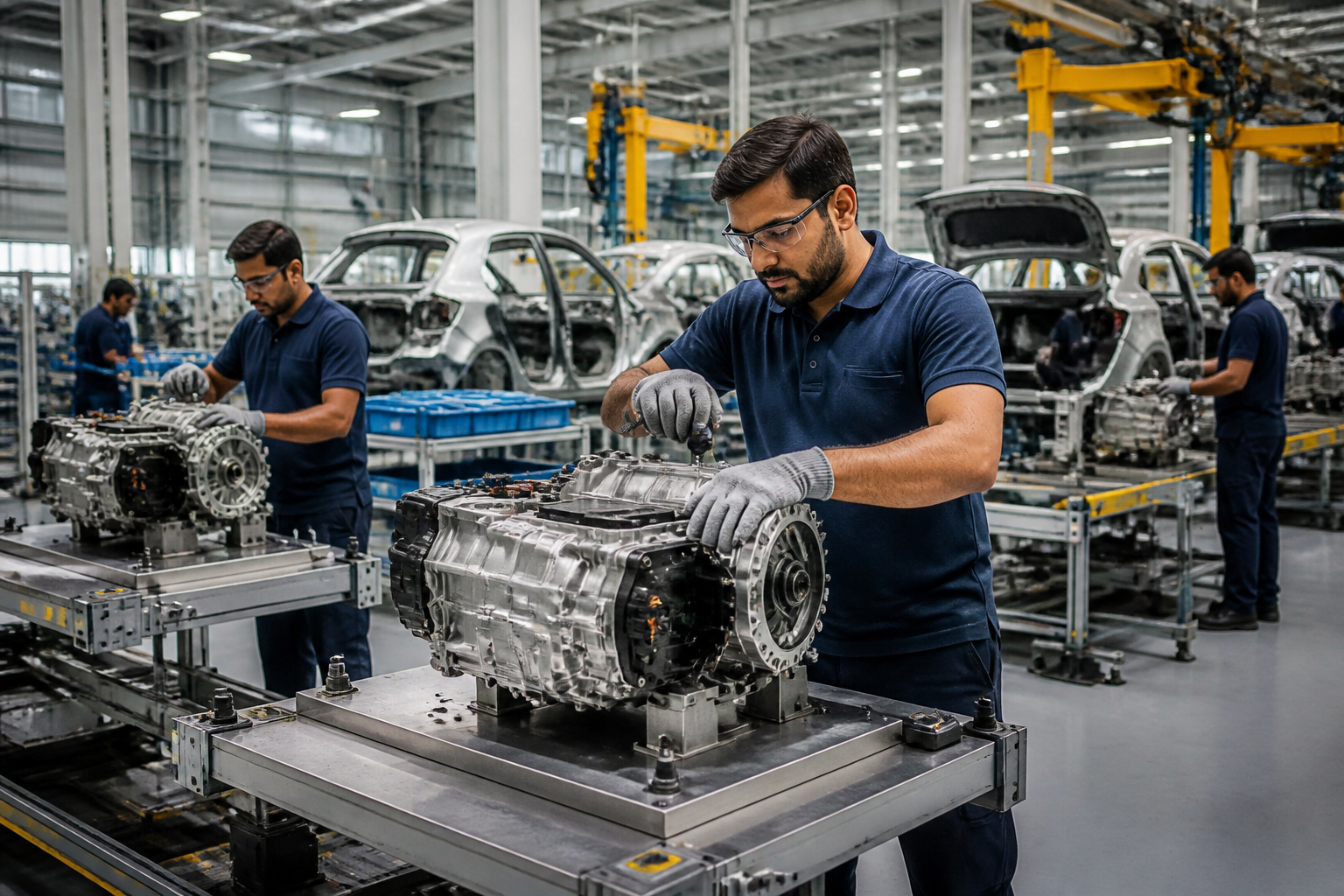
The companies mentioned in the report illustrate why the issue is relevant to the future of India’s vehicle and component ecosystem. JSW MG Motor India is a joint venture between JSW Group and SAIC Motor and sells MG-branded passenger vehicles in India. Tata Auto Comp Systems’ venture with Prestolite Electric Beijing, TACO Prestolite, designs and manufactures advanced electric drivetrains and traction motors for electric vehicles. Its other reported partnership, TACO Air International, works with Air International Shanghai Co on automotive air-conditioning systems.
These activities are located in parts of the automotive value chain that are important to electrification. Electric drivetrains, traction motors and thermal-management systems are not merely final-assembly components; they affect the ability of manufacturers to build vehicles and components domestically. The government’s challenge is to determine whether investment involving Chinese partners can contribute to domestic capability while remaining within the approval framework created for land-border investment.
The financial scale of the reported proposals also helps explain the policy interest. Economic Times reported that India may approve about $370 million in Chinese-linked auto investment, which would be the first such approval in nearly a decade. The report did not establish that all of this investment has already been approved or that every company mentioned will receive PLI benefits. The immediate development is that existing applications with FDI approvals are expected to be considered.
The policy is unfolding as the auto PLI scheme moves into a heavier spending phase. The scheme was approved in September 2021 with a budgetary outlay of Rs 25,938 crore. Incentives were to be paid from 2023-24 onwards for companies meeting targets relating to incremental production, investment and domestic value addition. Investments under the scheme have now exceeded Rs 45,000 crore, according to the report.
The government is expected to disburse about Rs 4,000 crore under the scheme in the current financial year. The report said these incentives would be given to eligible companies for achieving incremental sales in FY26. The FY27 Budget has earmarked Rs 5,939.87 crore for the scheme, nearly three times the Rs 2,091.26 crore allocated in the previous financial year.
Those figures show that the question is no longer whether the auto PLI scheme will remain a limited announcement-stage programme. Its implementation now involves a growing pipeline of investment claims, sales targets and public expenditure. Decisions on previously delayed applications will influence which companies can access the next phase of support and how the government balances speed of disbursement with the conditions attached to the scheme.
The reported approval of some applications also indicates that the process is not being handled as a single blanket decision. Economic Times cited an official as saying that a few applications, including one from Dixon Technologies’ venture with a Chinese partner for electronic components, had received approval for PLI benefits. This suggests that the government is assessing cases individually, with FDI approval functioning as an important gateway rather than an automatic guarantee of incentives.
That structure matters for industrial policy. PLI benefits are linked to performance, not simply to the presence of investment. Companies must meet the scheme’s eligibility and production-related requirements before incentives can be disbursed. The government’s reported approach allows it to preserve that performance-based framework while addressing applications that were held up by a separate investment-approval process.
It also leaves several operational questions unresolved. The supplied report does not specify the exact timetable for decisions on each pending application, the individual incentive amounts involved, or whether the companies mentioned have met all production and domestic value-addition conditions. It also does not establish whether the reported improvement in India-China relations will lead to similar treatment in other sectors.
For India’s automotive industry, the larger issue is how domestic manufacturing is defined in a period when supply chains remain international. A company can manufacture in India, employ local workers and add domestic value while still relying on a foreign partner for technology, capital or components. In advanced automotive segments, particularly electric vehicles, the distinction between local production and foreign-linked capability is especially significant.
For the government, the reported move offers a way to separate ownership or investment-origin concerns from measurable manufacturing outcomes, but only within the existing approval architecture. For companies, it may reduce uncertainty around applications that were neither rejected nor fully processed because their FDI approvals were pending. For policymakers, it creates a test of whether investment screening and industrial incentives can operate without leaving strategically important manufacturing proposals in administrative limbo.
The evidence currently confirms a limited but meaningful policy shift: existing auto PLI applications involving Chinese investment may be considered once the relevant FDI approvals are in place, while no fresh PLI application window is being opened. The next developments to monitor are the government’s decisions on the affected applications, the companies’ performance against production and domestic value-addition conditions, and the scale of incentives ultimately disbursed under the scheme.
